The Dwarfess and the Storm in the Stone
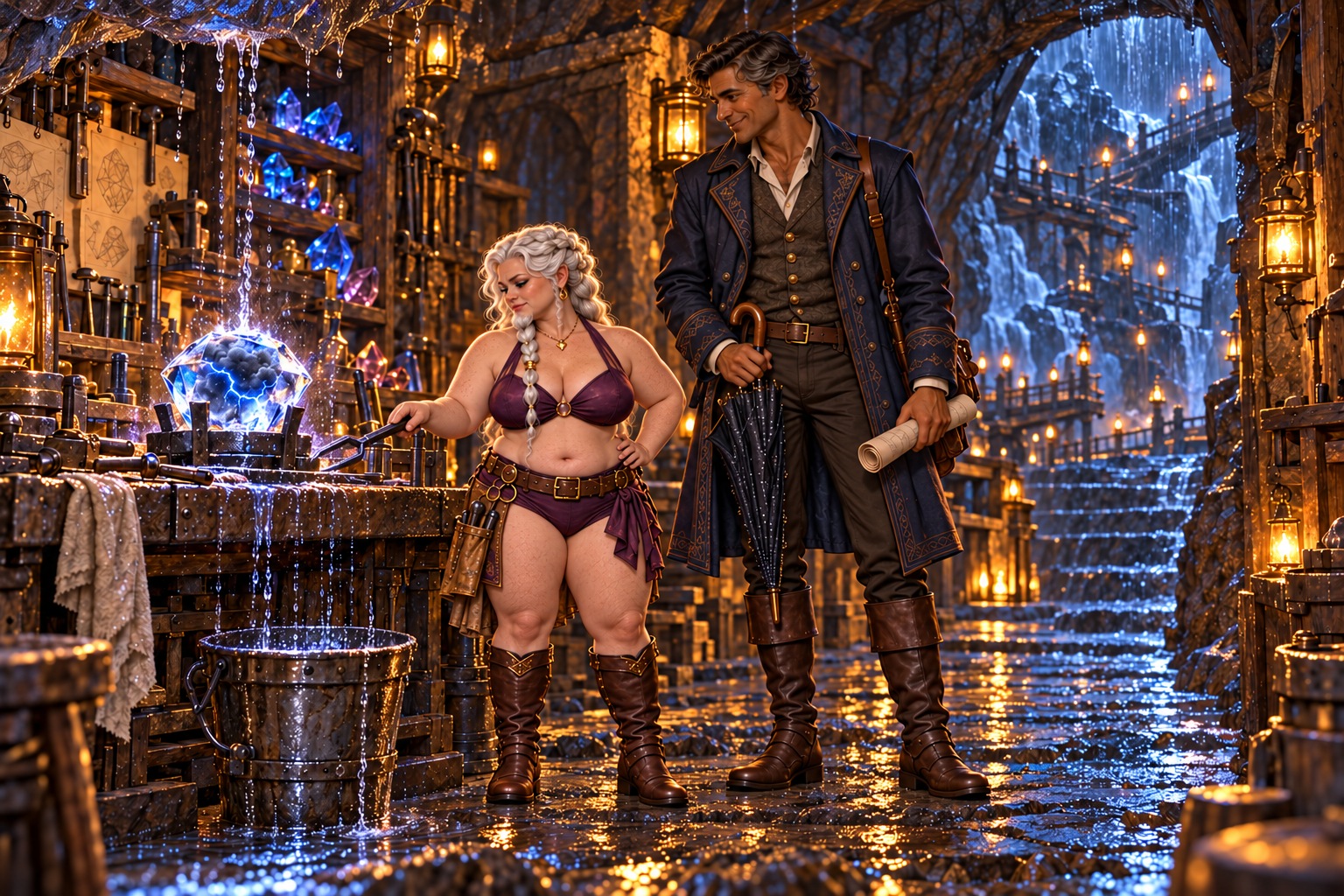
The finest diamond in the mountain was beginning to rain.
Dwarfs and dwarf women in medieval Norse literature
Old Norse writers use dvergr for a dwarf, plural dvergar. A dwarf in these sources might be a maker of divine treasures, a custodian of gold, a formidable speaker or one of the beings who support the sky. The evidence for dwarf women is a particularly good reason to keep the sources open. The texts give us kinship terms and some female figures, yet they offer far less of the everyday life of dwarf women than a reader raised on modern fantasy might expect. [1] [2]
Contents of this guide
In the Prose Edda's account of the gods' treasures, dwarf makers produce Sif's golden hair, Odin's spear and other remarkable objects. Brokkr and Sindri's contest ends with Thor's hammer judged the finest gift despite its imperfect handle. Craft in these stories can shape the fortunes of gods, and an object need not be flawless to matter.
Four dwarfs at the corners of the sky
In the medieval Icelandic Prose Edda, a dwarf can have a job considerably larger than making things for someone else to wear. In Gylfaginning the gods make the sky from the skull of the primordial being Ymir. A dwarf stands under each corner. Their names correspond to north, south, east and west. The passage gives a person who has never seen a dwarf a remarkably economical way to imagine four of them. Look as far as you can in any direction. Someone is holding up that end. Gylfaginning, the making of the sky
Elsewhere the gods need a bond that can hold Fenrir after conventional fetters have failed. Dwarfs produce Gleipnir, smooth and slight enough to look like a silken ribbon. Its ingredients include the sound of a cat’s footfall, the roots of a mountain and a fish’s breath. Any smith can show you a lump of iron. These makers can work with things their customer could not even pick up. Fenrir is understandably suspicious of the pretty ribbon. He demands a pledge, and the price is paid by the god Týr. An object apparently too delicate to do its work changes the future of everyone present. Gylfaginning, the binding of Fenrir
What went wrong at the bellows
The famous short handle of Thor’s hammer has a workshop history. In the Brodeur translation, Sindri tells Brokkr to keep the bellows moving. During the last forging a fly bites Brokkr’s eyelid. Blood runs into his eyes, he swats it away, and for a moment the blast falters. When the gods judge the gifts, their decision takes account of what the hammer can do in defence of their home. A reader can admire the finished marvel and still remember the worker who had to keep pumping while half-blind. That is the side of the mountain worth visiting before meeting Hedra. Skáldskaparmál, the contest of gifts
Where do dwarfs come from?
In Gylfaginning, Snorri describes life stirring in the flesh of the primeval being Ymir. The dwarfs first have a maggot-like existence there. By the gods’ decision they acquire understanding and human shape and live in earth and stone. The sequence matters. The material from which the cosmos is made also gives rise to some of the beings that inhabit it. Their association with rock begins as a story about the world’s body, before it becomes a story about what anyone might extract from a mine. [1]
A catalogue of names follows. A reader expecting a series of biographies can easily hurry past the list. Yet names can survive where deeds have been lost or went unrecorded. Four of them, Norðri, Suðri, Austri and Vestri, make immediate sense in relation to directions and the support of the sky. The fact that one name has a clear narrative duty does not license invention of a lost career for every other bearer. A reference work should be able to say where a surviving list ends. [1]
The dwarf who knows what the moon is called
In Alvíssmál, a dwarf comes to claim Thor’s daughter as his bride. Thor keeps the claimant talking by asking what different peoples call the same things. Earth, heaven, moon and sun all acquire multiple names according to the community speaking. The dwarf knows an astonishing amount. His peril lies in answering one more question, then one more, as the night passes. At the end Thor points out that the dawn has overtaken him. The closing lines leave the consequences to the audience. Many retellings make the expected result more explicit than the surviving ending does. [3]
Compare this scene with a forging contest. In both, the dwarf’s specialist ability makes him indispensable to the plot. Here that ability is linguistic and cosmological. Calling him only a miner would miss why Thor needs a trick, and why the poem preserves such an extraordinary vocabulary. It would also conceal something else the poem tells us: a dwarf can be imagined pursuing a marriage alliance with a god’s household. The dispute concerns kinship and authority as much as it does the danger of sunrise. [3] [2]
Andvari, the ransom and the last ring
The prose surrounding the verses of Reginsmál tells how the gods incur a debt for killing an otter who was a member of a humanlike family. The required compensation is gold enough to fill and cover the skin. Loki catches Andvari, a dwarf who spends time in the form of a fish, and demands his treasure. Andvari tries to keep a final ring. When it too is taken he pronounces a curse on the wealth. A tiny piece of an enormous ransom becomes the part that matters most. [4]
The dwarf’s position is quite different from that of a smith commissioned to make a remarkable gift. His wealth is being taken to pay someone else’s debt. The gold passes into a family in which ownership will prompt further bloodshed, and the later story of Sigurd and Fafnir grows out of that chain of transfers. Reading these poems together makes the dwarf at the pool more than an incidental supplier of cursed jewellery. His grievance gives the treasure its history. [4] [5]
What evidence is there for dwarf women?
A challenging passage in Fáfnismál concerns the origins of the norns, beings associated with fate and with the circumstances of birth. The speaker includes daughters of Dvalinn among them. That is real evidence for a female lineage connected to a named dwarf. It leaves open questions about whether daughters is being used literally, how the norns’ identity relates to a dwarf kindred and how widely a poet’s audience would generalise from the line. A single genealogical expression cannot supply a standard portrait of a female dwarf. [5] [2]
Ugnius Mikučionis surveys dwarf family relationships and female dwarfs across medieval Nordic sources, including material outside the best-known Eddic passages. The choice of corpus affects the answer: finding very few women in a short selection of smith stories tells us something about which stories were selected. It cannot by itself demonstrate their absence from the broader literature. For Hedra, the useful historical inheritance is the breadth of occupations, familial claims and relations with stone. The beard, the wardrobe and the diamond with a storm inside it are choices made for this particular character. [2]
Hedra and the storm inside her diamond are new fiction. Her bearded female design, the imagined mountain community and both comic customs are modern fantasy choices, not claims about historical Norse women or universal dwarf beliefs.
Sources: The Prose Edda, Skaldskaparmal, chapter XXXV, translated by Arthur Gilchrist Brodeur (1916) · Ugnius Vizgirda Mikucionis, They Were Such Skilled Craftsmen: How to Manipulate a Dwarf (2023)
Sources and further reading
- Snorri Sturluson, Gylfaginning, the formation and naming of the dwarfs
- Ugnius Mikučionis, Dwarfs' Family Relations and Female Dwarfs in Some Medieval Nordic Sources, Scandia
- Poetic Edda, Alvíssmál, translated by Henry Adams Bellows
- Poetic Edda, Reginsmál, the ransom for the otter
- Poetic Edda, Fáfnismál, especially stanza 13 on the norns
The Dwarfess and the Storm in the Stone
The finest diamond in the mountain was beginning to rain.
Hedra put a bowl beneath it.
By midnight, she had changed the bowl for a bucket. By one, the bucket had overflowed, and thunder was rolling inside a stone no larger than her fist.
She had spent thirty years learning where to strike a diamond. This one was teaching her where not to stand.
Someone knocked at the forge door.
Ruan came in carrying a rolled map and a closed umbrella. His coat was perfectly dry.
"The rain is coming through the lower galleries," he said. "You appear to have stolen the weather."
"The miners found it. I improved the cut."
He looked at the water running between her boots.
"A considerable improvement."
A blue light opened inside the diamond. For an instant she saw a whole bank of clouds moving beyond its smallest face. Then lightning struck the iron tongs, and she dropped them with a curse.
Ruan backed away from the workbench.
"How much storm is in there?"
Hedra watched another drop gather on the polished point.
"More than there was an hour ago."
She sent the night workers up to the surface. Then she wrapped the stone in its raw outer casing, closed the padded carrying frame around it and buckled the straps.
Ruan unrolled his map on the only dry patch of table.
"It needs open sky. Not the valley. If that much cold air spills beneath the cliffs, the wind could bring the snow down."
He pointed to the old quarry above the cloud line.
"Here."
Hedra looked at the long, broken stair drawn along the mountain's northern face.
"You make that look pleasantly flat."
"People complain when I put the terrifying bits in scale."
She fastened the carrying frame to her back. Ruan reached to adjust a twisted strap, then stopped when she turned her head.
"If you're going to help, help."
His fingers worked the leather loose beside her shoulder. They were warm against the wet edge of her collar. She had known him through three surveying seasons, a dozen suppers and one kiss interrupted by a delivery of coal. Neither had mentioned the kiss since.
"There," he said.
She took a short hammer and a cutting wedge from the bench.
"Try not to look so relieved."
They climbed through the mountain while water followed them down the steps.
At the outer gate, the night was clear. Stars shone above a field of old snow. Rain drummed steadily inside the frame on Hedra's back.
Ruan tied a rope between their belts.
"I know the way," she said.
"I know you do."
He tested the knot and went ahead.
Halfway up, the stair ended.
A winter fall had carried six steps into the dark. Ruan brought out his telescope, studied the opposite wall and found the old iron sockets of a work platform. Hedra found the sockets without the telescope and gave him an affectionate look he pretended not to notice.
They set the rope across the gap. She went first, carrying the storm against her spine.
When Ruan followed, a stone broke beneath his boot.
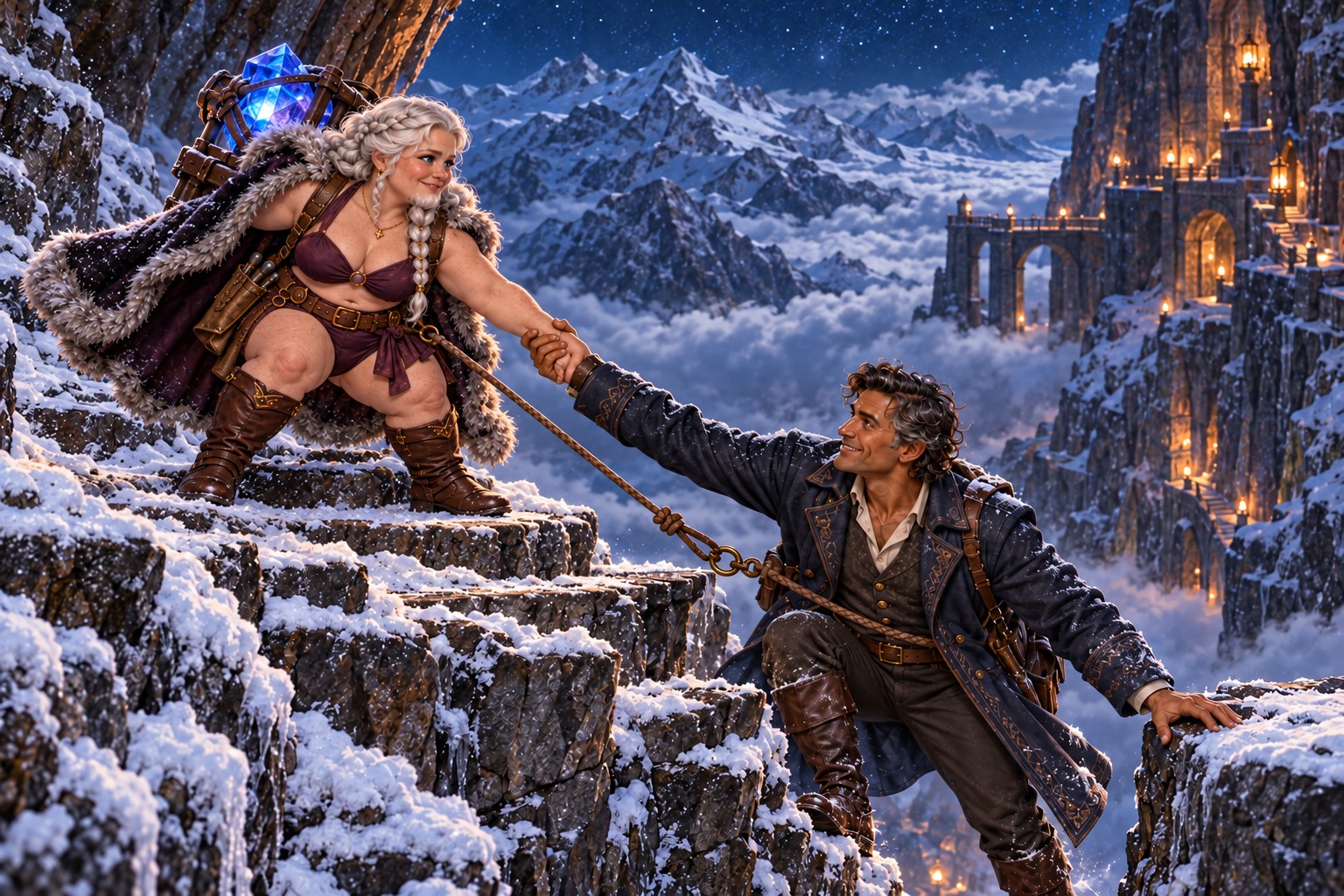
Hedra caught his wrist. The rope snapped tight; for a moment his whole weight hung between them.
"The terrifying bit?" she asked through her teeth.
He found a foothold.
"I'll mark it."
She hauled him onto the ledge. Neither let go immediately.
At the quarry, the wind ribbon on his staff streamed towards the valley.
Ruan went still.
"Not yet."
Hedra lowered the frame onto a stone block. A hairline of blue light was growing through the casing. Water ran from it in a continuous thread.
"It may not wait for your permission."
"If you open it now, the storm goes down the mountain."
He watched the ribbon. She watched the crack.
The diamond was beautiful. Even now, with lightning caught in its depths, she could see the cut she had meant to make: a broad face above a crown of smaller ones, every angle gathering the light.
She turned it over and set the wedge against the rough underside instead.
Ruan glanced down.
"Won't that ruin it?"
"Yes."
The ribbon fell slack.
For one breath, nothing moved.
Then the wind lifted from the valley and streamed out across the open sky.
"Now."
Hedra struck.

The stone opened with a sound like a door torn from its hinges.
Cloud poured over them. Ruan went to one knee, arms locked around the quarry rail. Hedra caught the front of his coat and held him against her as rain rose past their faces and lightning spread through the dark above the cliffs.
The storm climbed.
They stayed together until they could see the stars again.
At dawn, Hedra carried the broken diamond back into the forge. The mountain smelled of wet stone. The lower galleries were draining.
She put the two halves on her bench.
Ruan set a cup of tea beside her.
"I am sorry about your masterpiece."
She turned one half in the pale window light. Its hollow held a clear spoonful of rain.
"I wanted to know what it could become."
Outside, a distant roll of thunder moved away towards the plains.
Ruan smiled.
"You found out."
Hedra reached for his coat. He stepped close before she had to pull.
This time there was no coal delivery. His hand settled at her waist; her beard brushed his cheek as she kissed him, slow enough to make the long climb feel like a sensible way to spend a night.

When they parted, she took the hammer from the bench and hung it on its hook.
"Breakfast," she said.
"Then I should finish the map."
"Later."
She turned the sign on the forge door and took his hand again.
The Husband's Council
Vestra’s visitor expects an intimate evening. The household has plans of its own.
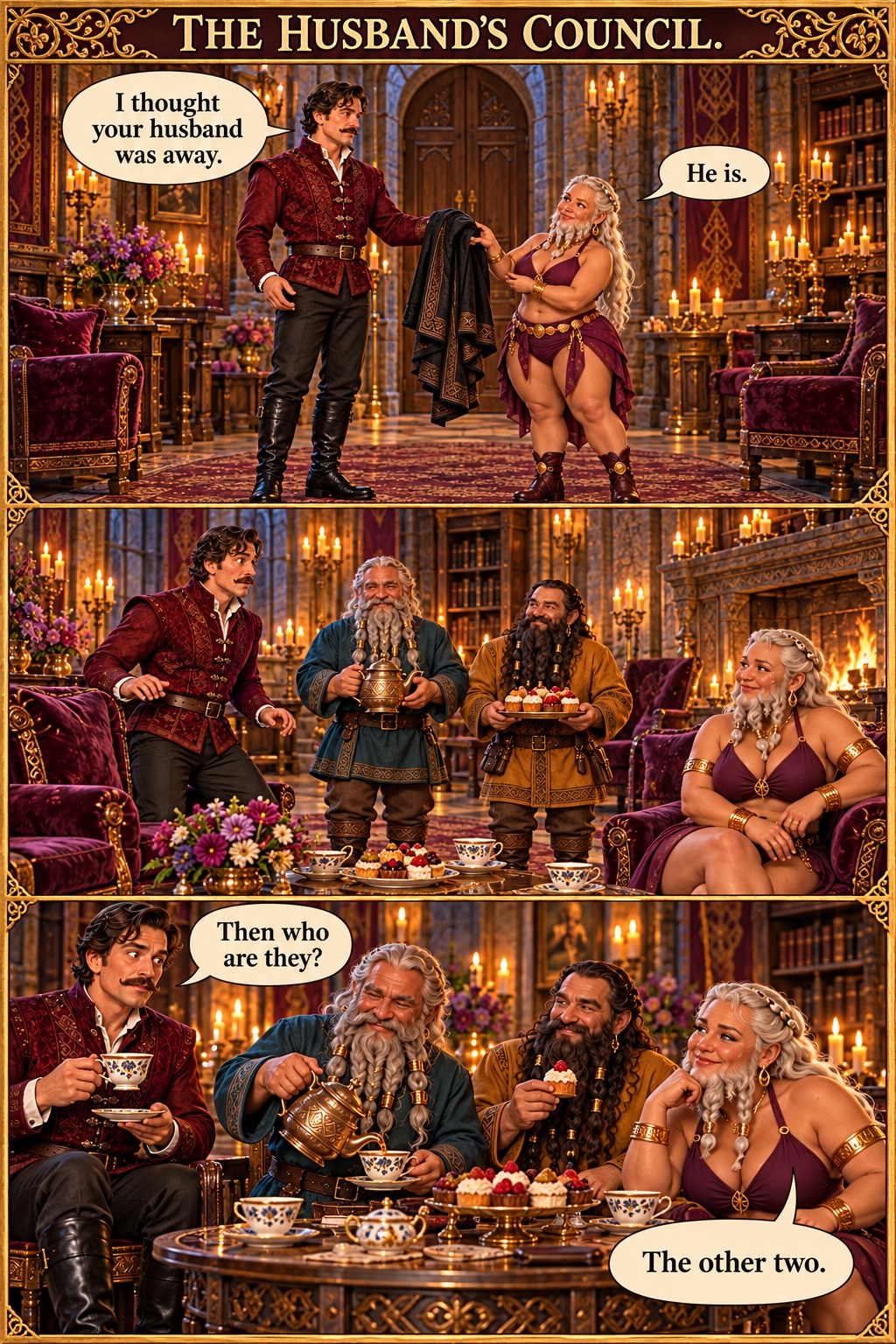
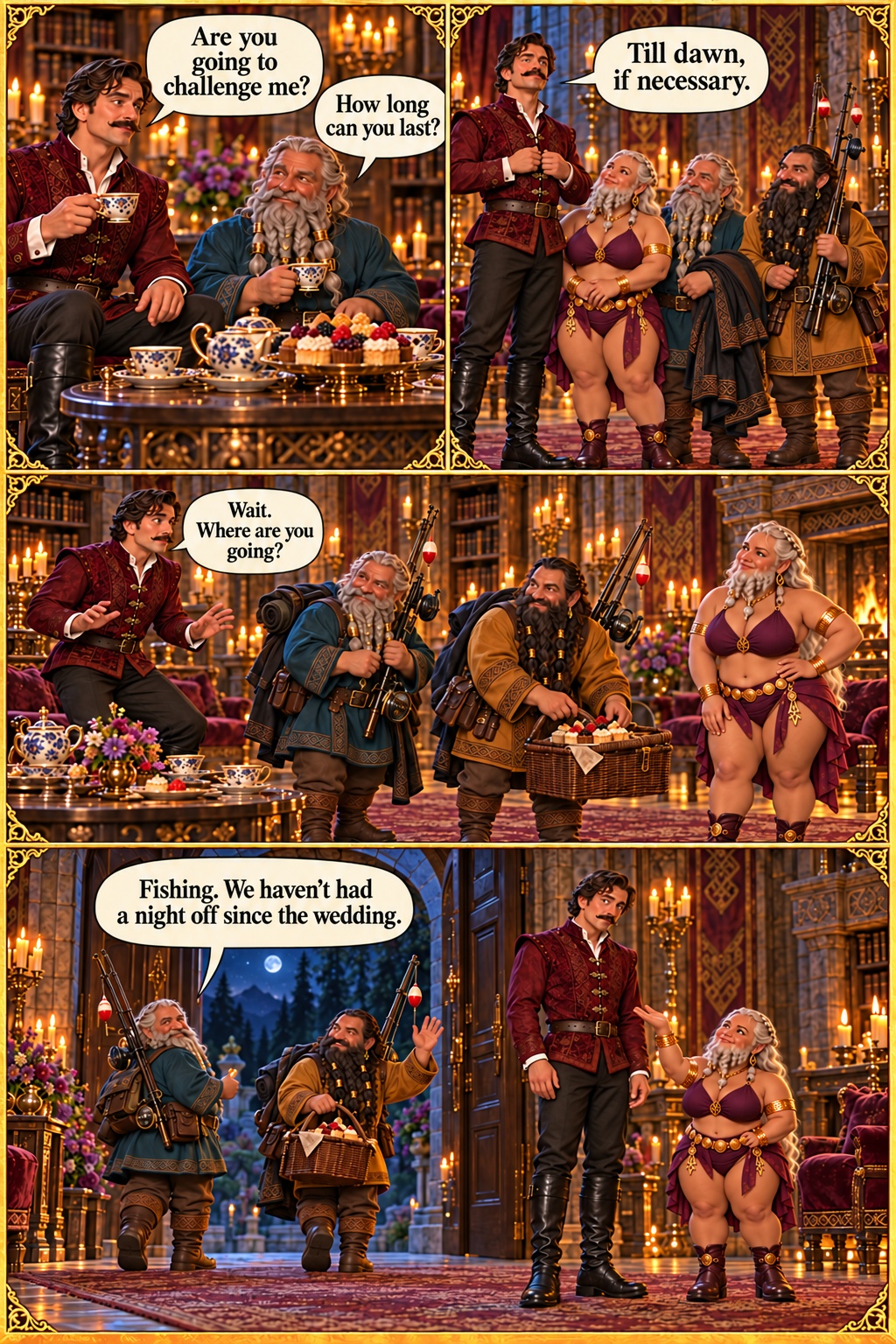
Read the comic transcript
Panel 1. Vestra welcomes Dorian into her candlelit parlour.
Dorian: I thought your husband was away. / Vestra: He is.
Panel 2. Two husbands arrive with tea and cakes.
Panel 3. Vestra explains who the two men are.
Dorian: Then who are they? / Vestra: The other two.
Panel 4. Dorian expects a challenge from the grey-bearded husband.
Dorian: Are you going to challenge me? / Grey-bearded husband: How long can you last?
Panel 5. Dorian boasts that he can last till dawn.
Dorian: Till dawn, if necessary.
Panel 6. The husbands abruptly collect their fishing equipment.
Dorian: Wait. Where are you going?
Panel 7. A husband explains their sudden enthusiasm for a night out.
Grey-bearded husband: Fishing. We haven't had a night off since the wedding.
Decent Company
Ruan dresses for a formal evening. Dwarven etiquette has one small objection.
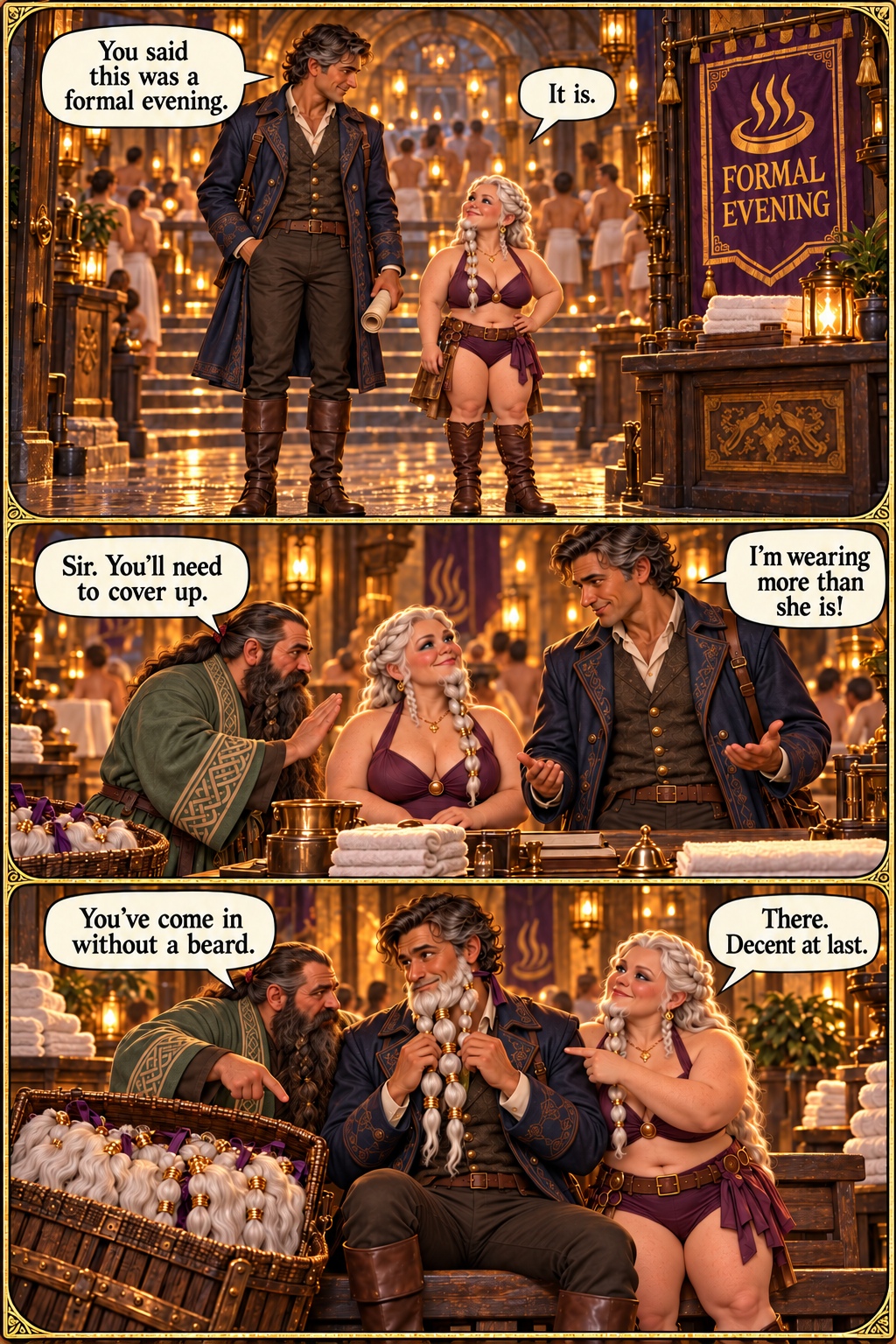
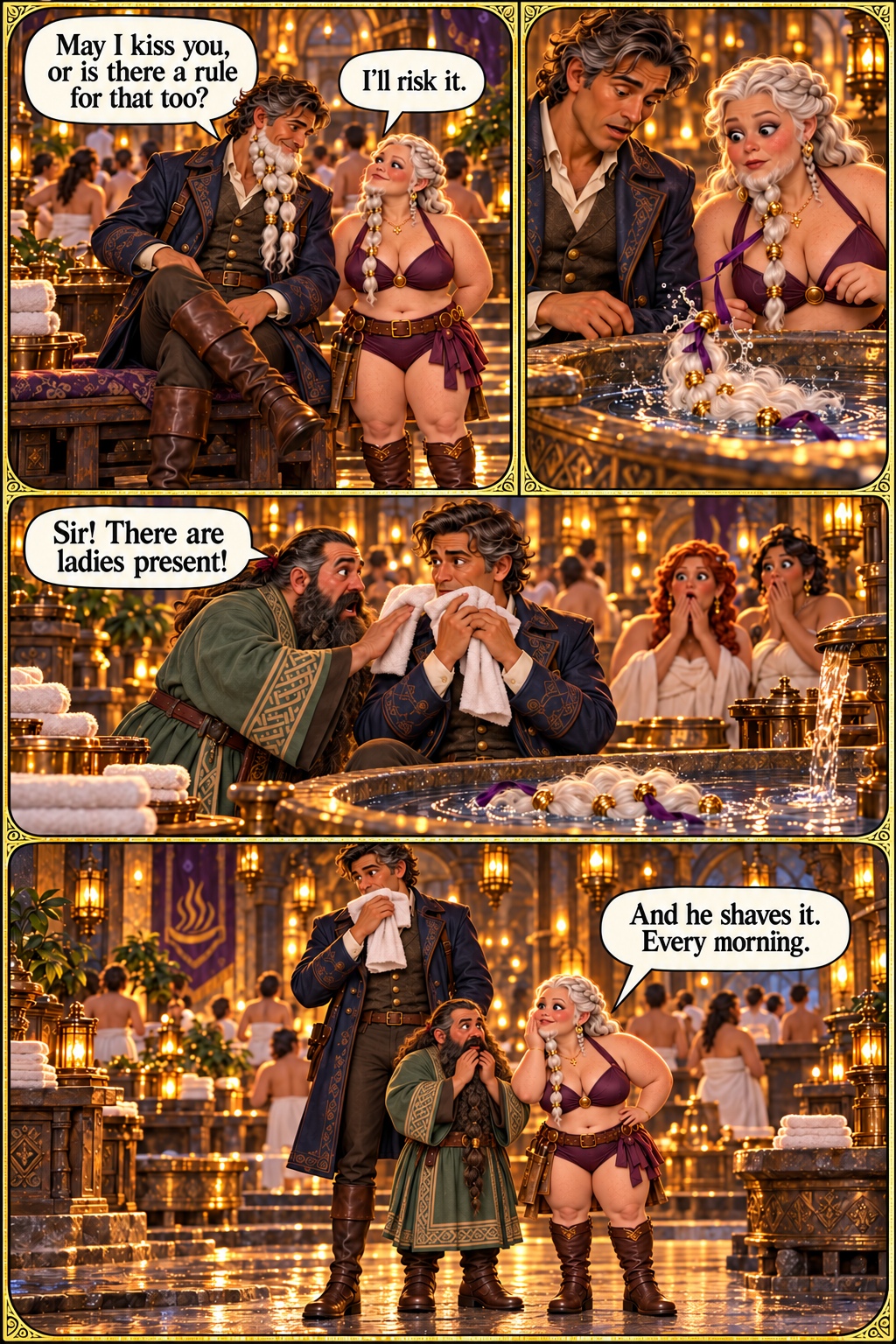
Read the comic transcript
Panel 1. Hedra and Ruan arrive at the bathhouse’s formal evening.
Ruan: You said this was a formal evening. / Hedra: It is.
Panel 2. The attendant admits Hedra but stops Ruan.
Attendant: Sir. You'll need to cover up. / Ruan: I'm wearing more than she is!
Panel 3. Hedra fits Ruan with an ornate loan beard.
Attendant: You've come in without a beard. / Hedra: There. Decent at last.
Panel 4. The couple sit beside the bathhouse reception basin and discuss a kiss.
Ruan: May I kiss you, or is there a rule for that too? / Hedra: I'll risk it.
Panel 5. After an off-panel kiss, Ruan’s false beard catches on a clasp and drops into the water.
Panel 6. The attendant rushes to shield Ruan’s exposed chin.
Attendant: Sir! There are ladies present!
Panel 7. Hedra reveals Ruan’s daily shaving habit.
Hedra: And he shaves it. Every morning.
Comedy in Motion
Scheduled on YouTube for Nov 24, 2026. The player becomes available after release.
Watch on YouTube
Scheduled on YouTube for Nov 26, 2026. The player becomes available after release.
Watch on YouTube
Curator’s Cabinet
For readers drawn to dwarven fantasy, Dwarfess by Love Smiths brings the theme into a handcrafted adult silicone design.
For keeping small treasures together: a personalised name-and-birth-flower jewellery case from L’Atelier Époustouflant.
Affiliate disclosure: This page contains affiliate links. If you purchase through them, we may earn a commission at no extra cost to you. Read our disclosure.
Roots of the Tale
The folklore introduction draws on Old Norse accounts of dwarf makers. Hedra, Ruan, the storm stone, Vestra’s household and the bathhouse customs are original Velvet Bestiary fantasy. Their appearance and social customs are creative choices, not historical claims. Illustrations are AI-assisted.
Another encounter awaits: Kanaloa and the Ship That Crossed the Town · Browse the stories.