Creature feature · Cerberus
Cerberus and the Woman Who Returned Twice
A locksmith reaches the gates of the underworld and finds herself already waiting there.
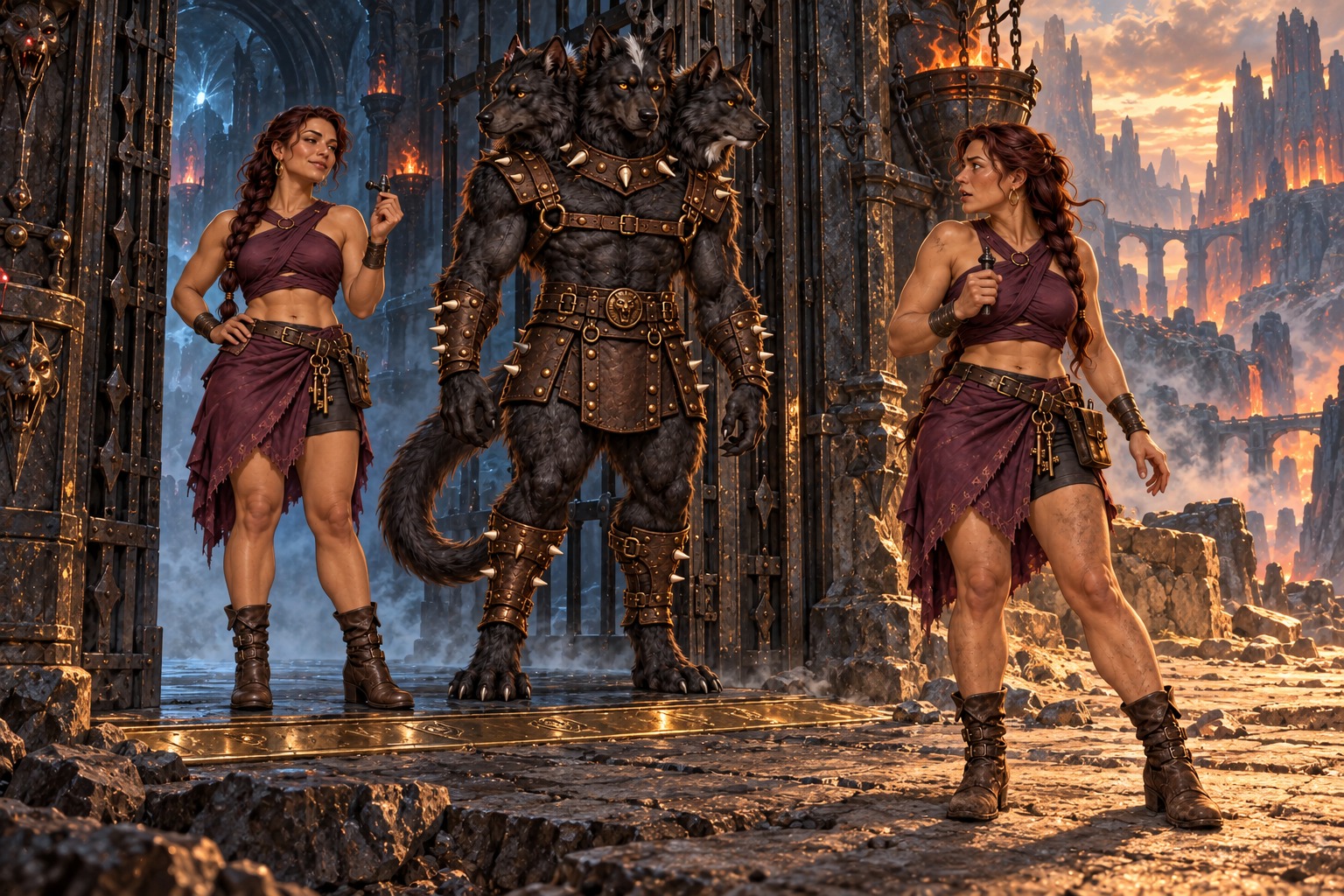
Cerberus, the hound of Hades
Cerberus (Greek Kerberos, Κέρβερος) is the dog who guards the realm of the dead in Greek mythology. If you met him on the way in, he might wag his tail. The danger came when you tried to leave. The most familiar Cerberus has three heads, yet an early poet gave him fifty and an Athenian painter managed with two. His best-known adventure is a round trip: Heracles brings him into daylight alive, shows him to the king who demanded him, and takes him home. Greek storytellers, Roman poets and a medieval Italian poet each found a different use for the same formidable dog. [1] [2] [3]
Contents of this guide
- Where the written record begins
- Parents, siblings and the sound of fifty mouths
- Did Hades really name his dog Spot?
- Which way is the dog facing?
- How Heracles brings him up alive
- A painter gives each mouth a job
- Which cave led to Hades?
- Orpheus, Aeneas and Psyche meet the guard
- What happens to the dog in daylight?
- From the throne of Serapis to Dante's third circle
- Why the same dog turns up beside Pluto today
- Where the ancient accounts end and Tamar's tale begins
- Sources and further reading
Where the written record begins
How old is the hound? A useful starting point is around 700 BCE, the conventional approximate date for Hesiod, who already names him. Dating poetry composed in an oral tradition is difficult. Even the relative order of Hesiod and Homer is disputed. When Homer alludes to an underworld dog as a figure the audience will recognise, we glimpse a story already in circulation. That gives us evidence of its age without supplying a year of invention or an identifiable first storyteller. [19] [1] [4]
In the Iliad, Athena remembers how often she helped Heracles when Eurystheus set him impossible tasks. Fetching the dog of Hades is her example. She is angry with Zeus, and her point is a personal one: his son once depended on the very goddess he now thwarts. Homer can evoke the whole adventure in a few lines. The audience needs to know how dreadful the errand was. The passage supplies neither the dog’s name nor a count of his heads. [4]
The Odyssey tells it from the other side. In Book 11, Odysseus meets the shade of Heracles among the dead. Heracles recognises another man whose life has been hard and offers his own worst ordeal by way of comparison. A weaker man had authority over him and sent him after the hound because he could think of nothing harder. Hermes and Athena helped him bring it up. Here the labour has a particular sting for its teller. The man strong enough to lead a hound out of death’s country was obliged to take orders from the king who stayed at home. [5]
Hesiod’s Theogony, another work of archaic Greek epic, gives the dog a name and relatives. Hesiod is setting out how gods and other beings are related and how the world came to have its present order. A monster belongs in that project as surely as a god or a river does. The poem provides two places to look: the account of Cerberus’s birth around lines 306–312, and the description of the approaches to the underworld around lines 767–774. They answer different questions about the same hound. [1]
Parents, siblings and the sound of fifty mouths
Hesiod makes Cerberus the offspring of Echidna, a woman above and a serpent below, and Typhaon, also called Typhon. Before Cerberus comes Orthos or Orthrus, the hound of Geryon. After him comes the Hydra reared by Hera. Readers tracing the labours of Heracles will encounter this family more than once. The cattle of Geryon have a guard, the waters of Lerna have their serpent, and the halls of the dead have their dog. A detail belonging to one sibling need not belong to the others. The Hydra’s regenerating heads, for example, play no part in the capture of Cerberus in the Library. [1] [2]
Hesiod gives the hound fifty heads, an appetite for raw flesh and a voice likened to bronze. That last detail is easily lost in pictures. A listener can imagine the noise before trying to count the necks. The Library, a much later Greek compilation conventionally attributed to Apollodorus, describes three canine heads, a dragon’s tail and serpents’ heads on the back. Keep track of which heads a description is counting. An artist who adds snakes to a three-headed dog has given it many more mouths without changing its three principal heads. [1] [2]
Horace takes the count to a hundred in Odes 2.13. A falling tree has nearly killed the speaker, who imagines what he might have heard among the dead. The shades crowd around the Greek poets Sappho and Alcaeus, and even the hundred-headed beast lowers its dark ears to listen. There is an ancient report that the Greek poet Pindar also gave the hound a hundred heads. The form of the evidence differs. For Pindar we depend on later testimony, whereas Horace’s poem survives and we can read what the creature does in the surrounding lines. [20] [21]
Did Hades really name his dog Spot?
The Greek name is Kerberos, written Κέρβερος. Cerberus is the Latin form familiar to English readers. Museum catalogues use both, so it is worth searching under both when looking for ancient pictures. The often-repeated translation Spot began as a question about the relationship between languages. Scholars compared the Greek name with a Sanskrit description of one of the dogs associated with Yama, lord of the dead in Vedic tradition. The Sanskrit word can describe a spotted or brindled coat. [22] [23]
That comparison has two attractions, the sound of the words and the occurrence of dogs beside the dead in both traditions. It also has a difficulty. The sounds do not correspond as neatly as the nursery version of the story suggests. Maurice Bloomfield’s 1905 discussion lays out the objection alongside the proposed relationship. There are two dogs in the Vedic comparison, and Hesiod gives his many-headed guardian no naming scene. Hades affectionately calling a dog after the markings on its coat is a modern way to tell the joke. Whether the two ancient words share a history remains a separate linguistic question. [23] [1]
Which way is the dog facing?
The halls belong to Hades and Persephone. Hesiod pictures the dog on watch in front of them. He moves his ears and tail in welcome as the dead approach, then keeps watch for anyone crossing the threshold the other way. The welcome is a trap that can be understood without giving the animal a single line of speech. What looks like the beginning of a relationship with a friendly household dog is the last moment at which the newcomer could mistake whose household this is. [1]
Later descriptions furnish more of the neighbourhood. In the Aeneid, Charon has a boat and controls a water crossing. Cerberus occupies a cave beyond it. After the travellers get past the hound, they hear the voices of the dead, and further on they encounter Minos in a judicial role. The ferryman, watchdog and judge are three distinct figures. A map drawn from Virgil is a map of one poet’s journey. In the Library, the landmark where Heracles finds the dog is called the gates of Acheron. [6] [2]
How Heracles brings him up alive
In the Library the assignment comes last in the familiar sequence of twelve labours. Heracles first goes to Eleusis seeking initiation. He needs purification for bloodshed before he can participate. Only then does he descend at Taenarum in Laconia, at the southern end of the Peloponnese. On the way he draws his sword against the shade of Medusa. Hermes has to tell him that she is a phantom. A weapon that would have been sensible above ground has already proved useless once before Heracles comes within reach of the dog. [2]
He encounters Theseus and Pirithous held fast below. Theseus can be raised. When Heracles tries to raise Pirithous the ground shakes and he releases him. The episode sets a limit on what even this visitor can take home. When he finally requests Cerberus, the ruler of the dead grants permission on a condition: he must master the animal without using his weapons. The lion skin and armour still protect him. He embraces the hound and keeps his hold although the creature’s serpent tail bites him. It is one of the rare heroic captures in which killing the monster would make the whole undertaking a failure. [2]
Eurystheus gets to see what he ordered, then Cerberus returns below. For a different dramatic sequence, turn to Euripides’ tragedy Heracles. His family has been waiting for him while a usurper threatens their lives. When he comes back, his father asks how he got the dog and where it is. His reply locates it temporarily in a grove sacred to Demeter at Hermione. The question of what happened to the dog while the hero got on with the rest of his day was already one an ancient dramatist could have a family member ask. [7]
A painter gives each mouth a job
An Attic neck-amphora in the Metropolitan Museum, attributed to the Diosphos Painter and dated about 500 BCE, offers an especially good close look. On one side Heracles is trying to lead a two-headed Cerberus. One mouth has hold of the loop of the leash. The other has caught the end of the hero’s lion skin. Cover either head with a finger on the museum photograph and half the joke disappears. Turn the jar around and the other side shows Hermes and Athena, the divine figures associated with the journey. [3]
An earlier water jar in the Louvre, made at Caere in what is now Italy about 525 BCE, gives the spectator another point of view. Heracles advances with the hound while Eurystheus gestures from inside a great storage jar, a pithos. The painter picked out heads with different colours. The eye goes from the open mouths to the human figure seeking shelter. The king who could safely demand a monster from a distance has to decide what to do when it is delivered. These objects give direct evidence of what ancient viewers could see. Both antedate the surviving mythographic handbook, and neither needs its permission to tell the story differently. [8] [3]
At Olympia, visitors to the Temple of Zeus could once look up at a different moment in the journey. A marble relief from about 470–457 BCE shows Heracles pulling a collared hound into view. Only the front of the animal emerges. Enough survives to see its head, and the feet of Hermes survive nearby. The catalogue photographs show both the surviving fragments and a reconstruction. The fragment asks a viewer to imagine the rest of the animal still below ground. A modern outline drawing, in filling out the scene, records the archaeologist’s interpretation as well as the sculptor’s surviving work. [24]
Which cave led to Hades?
Pausanias, a Greek travel writer of the second century CE, describes a cave at Cape Taenarum associated with Heracles’ journey. He also records a practical objection: inspecting the cave reveals no road continuing underground. He sets beside the poets’ account an explanation credited to the earlier writer Hecataeus of Miletus. In this telling a lethal local serpent had earned the name hound of Hades because its bite delivered people to the dead. Heracles could therefore have carried a real and terrible creature to Eurystheus. Pausanias preserves the disagreement. It is evidence for ancient inquiry into the legend, not an identification of a species behind it. [9]
Other communities attached the journey to their own landscape. At Troezen, Pausanias mentions a place by the sanctuary of Artemis the Saviour where people said Heracles brought the hound up. At Hermione there was a chasm associated with the same event. For a modern atlas, two different exits for a single journey look like a problem. For a traveller hearing what each community said about its own ground, both reports belong in the book. A place-name in a local account tells us where people located the story, even when it cannot tell us where the story began. [10]
Orpheus, Aeneas and Psyche meet the guard
Orpheus goes below for Eurydice. In Book 4 of Virgil’s Georgics, his music draws the shades together. The Furies stand transfixed, Ixion’s wheel stops and Cerberus holds his three mouths open. Listen to the pause in that last image: three mouths perfectly capable of raising the alarm remain agape. The moment ends more tragically elsewhere on the journey. Orpheus loses Eurydice when he turns to look back as they approach the light. He has already passed the hound. In this poem even music that arrests the whole underworld cannot spare a lover that final test. [11]
In Book 6 of Virgil’s Aeneid, Aeneas seeks his father Anchises. His guide, the Sibyl of Cumae, has brought a prepared morsel made with honey and treated grain. Cerberus raises the snakes on his neck and opens his throats to seize it. Once it takes effect his huge body stretches across the cave, and Aeneas passes while the watchman sleeps. It is the Sibyl who knows what to bring and when to throw it. Charon has already ferried them over. The morsel for the dog and the golden bough shown to the ferryman belong to different encounters. [6] [12]
Psyche has a practical problem that Aeneas’ passage barely touches: how much food does a traveller need for the return journey? In Book 6 of Apuleius’s Latin novel Metamorphoses, also called The Golden Ass, a speaking tower gives her instructions for visiting Proserpina. Two coins are for the ferryman and two cakes for the three-headed dog. Psyche has to preserve the return fare and the second cake while others along the way ask her for help. The test is partly one of keeping hold of the right things. The dog is dangerous on both halves of this journey. That is a revealing difference from the warm welcome Hesiod gives the arriving dead. Psyche, after all, arrives alive and means to go home. [13]
What happens to the dog in daylight?
Ovid gives the emergence its own afterlife in Book 7 of Metamorphoses. Cerberus resists the light, howling and flecking the ground with foam. In the poet’s account, a poisonous plant springs from the rocky soil where the foam falls. This explains the origin of aconite within the poem. Ovid nests the episode inside a different family’s story: Medea has obtained the poison and is plotting against Theseus. By the time Theseus is in danger, the hound has long since gone home, yet the land still carries the consequences of bringing him out. [14]
Comedy remembers a different inconvenience. In Aristophanes’ Frogs, staged in Athens in 405 BCE, Dionysus visits the underworld disguised as Heracles. The lion skin is very recognisable. Unfortunately, the person who answers the door remembers what its last wearer did to his dog. Aeacus directs his fury at the apparent culprit. The audience gets the aftermath from the household’s point of view: what was the crowning labour of a great hero to people above ground was the theft of a watchdog to somebody downstairs. [15]
From the throne of Serapis to Dante’s third circle
At the Bibliotheca Alexandrina’s Antiquities Museum, a headless marble statue still has an identifying companion. A three-headed Cerberus sits by the feet of the enthroned Serapis, a god worshipped in Greco-Egyptian religion. The hound here is at rest. No hero is present and no one is crossing a gate. His presence helps the viewer recognise the seated god and his connection with the world below. This is a third way to read an ancient image of the animal, alongside the portraits of capture and delivery. [16]
In canto 6 of Dante’s Inferno, written in medieval Italy, Cerberus presides over the gluttonous in the third circle. Cold, filthy rain falls continually. The creature barks through three throats and claws the shades beneath him. Dante gives him a greasy beard, red eyes and a large belly. The pilgrim’s guide is Virgil himself. Where the ancient Sibyl offered something carefully prepared, Dante’s Virgil scoops up handfuls of earth and throws them into the hungry mouths. A reader who knows the Aeneid can recognise the action and feel how cruelly the meal has changed. Dante has given the guardian an appetite appropriate to the particular circle he inhabits. [17] [6]
Why the same dog turns up beside Pluto today
On a modern star chart, Kerberos is one of Pluto’s moons. The name, announced in 2013 alongside Styx, continues the association between Pluto and the underworld. These are two different borrowings with distinct referents: one satellite bears the name of the hound, the other the name associated with the underworld river. A reader moving from a Greek vase catalogue to a NASA image will find the same Greek spelling serving a new purpose more than two millennia later. [18]
Where the ancient accounts end and Tamar’s tale begins
Readers looking for a single ancient origin for the three personalities in our illustration will find several different uses of several heads instead. One painter needed two pairs of jaws to worry a lead and a lion skin. Virgil needed three throats capable of raising a single tremendous alarm. Dante made all three share an indiscriminate hunger. Tamar’s Cerberus has his own bronze collar, an upright body and three voices that disagree about supper. The locksmith, the broken hinge and the visitor wearing Tamar’s face belong to this story. Its oldest debt is smaller and more exact: it matters very much which way a person is trying to cross the threshold.
Sources and further reading
- Hesiod, Theogony 295–315 and 767–774, Center for Hellenic Studies
- Pseudo-Apollodorus, Library 2.5.12, University of Victoria
- The Met, Attic neck-amphora attributed to the Diosphos Painter, about 500 BCE
- Homer, Iliad 8.362–369, Samuel Butler translation
- Homer, Odyssey 11.601–626, the encounter with Heracles
- Virgil, Aeneid 6.417–425, Latin text and Dickinson College commentary
- Euripides, Heracles, the hero's return and Amphitryon's questions
- Musée du Louvre, Caeretan hydria E 701, Heracles and Cerberus
- Pausanias, Description of Greece 3.25.4–6, A Pausanias Reader
- Pausanias, Description of Greece 2.31.2 and 2.35.10
- Virgil, Georgics 4.467–493, Dickinson College Commentaries
- Virgil, Aeneid Book 6, the crossing of the Styx and the road beyond
- Apuleius, The Golden Ass, Book 6, the tower's instructions and Psyche's return
- Ovid, Metamorphoses 7.404–424, University of Virginia Ovid Collection
- Aristophanes, Frogs, the arrival at the underworld door
- Bibliotheca Alexandrina, Antiquities Museum, enthroned Serapis with Cerberus
- Dante, Inferno, canto 6, Princeton Dante Project
- NASA, Pluto's newly named moons Kerberos and Styx, July 2013
- Mait Kõiv, A Note on the Dating of Hesiod, The Classical Quarterly 61 (2011), pp. 355–377
- Horace, Odes 2.13, the near miss with the tree and the singers in the underworld
- Aaron Floky, doctoral study of dogs in Greek religion, University of Western Australia, discussion of Pindar fragment 249a/b
- Getty Research Institute, Kerberos, Iconography Authority record 901002558, Greek and Roman names
- Maurice Bloomfield, Cerberus, the Dog of Hades (1905), primary text of his comparison and its linguistic difficulties
- Perseus Art and Archaeology, Olympia Cerberus Metope, photographs of fragments and reconstruction
An original tale
The woman at the gate
Tamar reached the gates of the underworld twice. The second time, she was already waiting there.
The other woman stood beneath the arch in Tamar's plum travelling clothes, with Tamar's auburn braid over one shoulder. She held up a small iron pin between two fingers.
“There you are,” the other Tamar said. “I was beginning to worry.”
The real Tamar stopped on the black road. Her own iron pin lay inside her closed fist.
Behind the woman, Cerberus straightened to his full height. The three heads above his bronze collar turned towards the two visitors. His body blocked the gate as completely as a fallen tower.
“That,” Tamar said, “is a remarkably rude thing to do with my face.”
She had arrived before dusk to mend a hinge. Cerberus had sent for the best living locksmith within a day's walk of the old burial road. Tamar had been rather pleased by the recommendation until she learned that all the other locksmiths had declined.
The lower gate was sagging. Its hinge pin had worked loose and fallen into the passage behind the arch. Each night the iron scraped farther across the stone; each night more fingers could fit through the widening seam.
“You cannot fetch it?” she had asked.
Cerberus had opened one enormous hand. In it lay a bent pair of tongs, scarcely recognisable.
“I tried to be delicate.”
“I can see you made a thorough attempt.”
The head on the left had laughed. The middle one had not.
Tamar had offered him her tool roll while she knelt to examine the hinge. He held it so carefully that her smallest screwdriver did not stir. When she looked up, all six ember-coloured eyes were watching her hands.
“There is a brass mark in the passage,” the middle head told her. “Go no farther. Take the pin. Return.”
The head on the right lowered his voice. “If anyone calls you, let them call.”
“Even if it sounds urgent?”
“Especially then.”
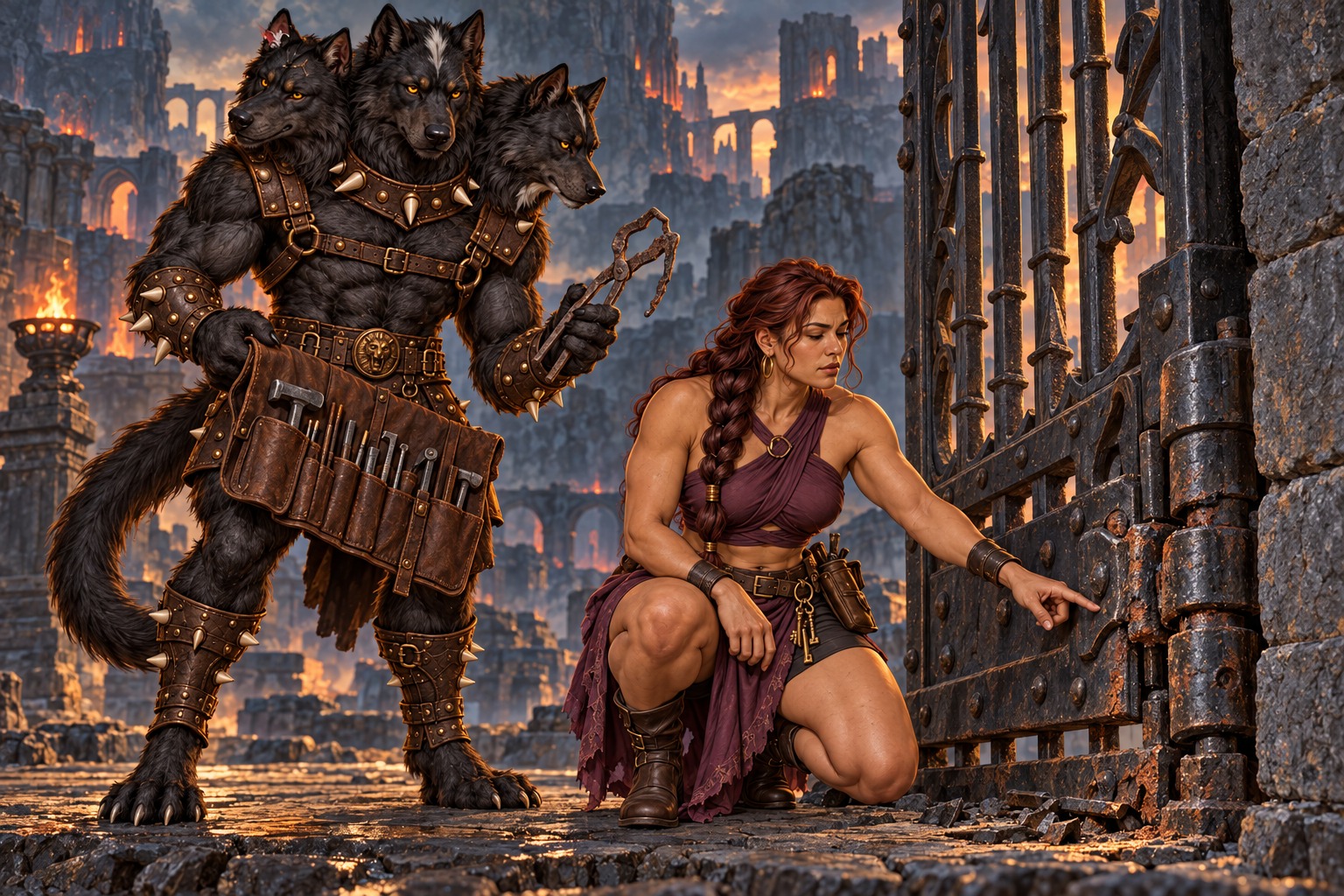
Inside, the passage smelled of cold rain. Tamar found the pin beyond the fallen lintel. She also found a staircase descending into a lightless hall. From somewhere below, her own voice asked whether she had forgotten something.
She kept walking towards the gate.
By the time she reached it, the voice had got there first.
Now the other Tamar smiled at the guardian. “You can see which of us belongs here.”
The head on the left glanced at the real Tamar's muddy boots. The middle head watched the pin in each woman's hand. The right head said nothing.
“I belong at my workshop,” the real Tamar said. “Preferably before the kettle burns dry.”
Her double gave a soft, disappointed sigh. “Don't be frightened. He can protect you.”
“I am frightened. That doesn't make me an idiot.”
Cerberus lowered his tool-laden hand between them. “Finish the hinge.”
Neither woman moved.
“Both of you.”
Tamar knelt. The other woman knelt opposite her, matching the movement almost perfectly. They reached for the same hammer.
For a moment Tamar saw herself as a stranger might: handsome, composed, plum wrap neatly tied, braid lying in a clean curve against her shoulder. Her double had even remembered the tiny crescent-shaped burn on her thumb.
It was the clean braid that bothered her. The real one was full of stone dust.
Tamar took the hammer before the other hand could close around it. “You can hold the pin.”
The double smiled and placed her pin into the hinge. It passed through the iron as though through smoke.
The smile disappeared.
Tamar drove her own pin into place with three hard blows. The gate rose cleanly from the stone. Behind it, something drew a long, frustrated breath.
Her double caught her wrist.
The fingers were cold enough to hurt. Tamar dropped the hammer. Across the passage, the dark staircase seemed abruptly much nearer.
“You brought me this far,” the other woman said.
Tamar pulled back. The grip tightened.
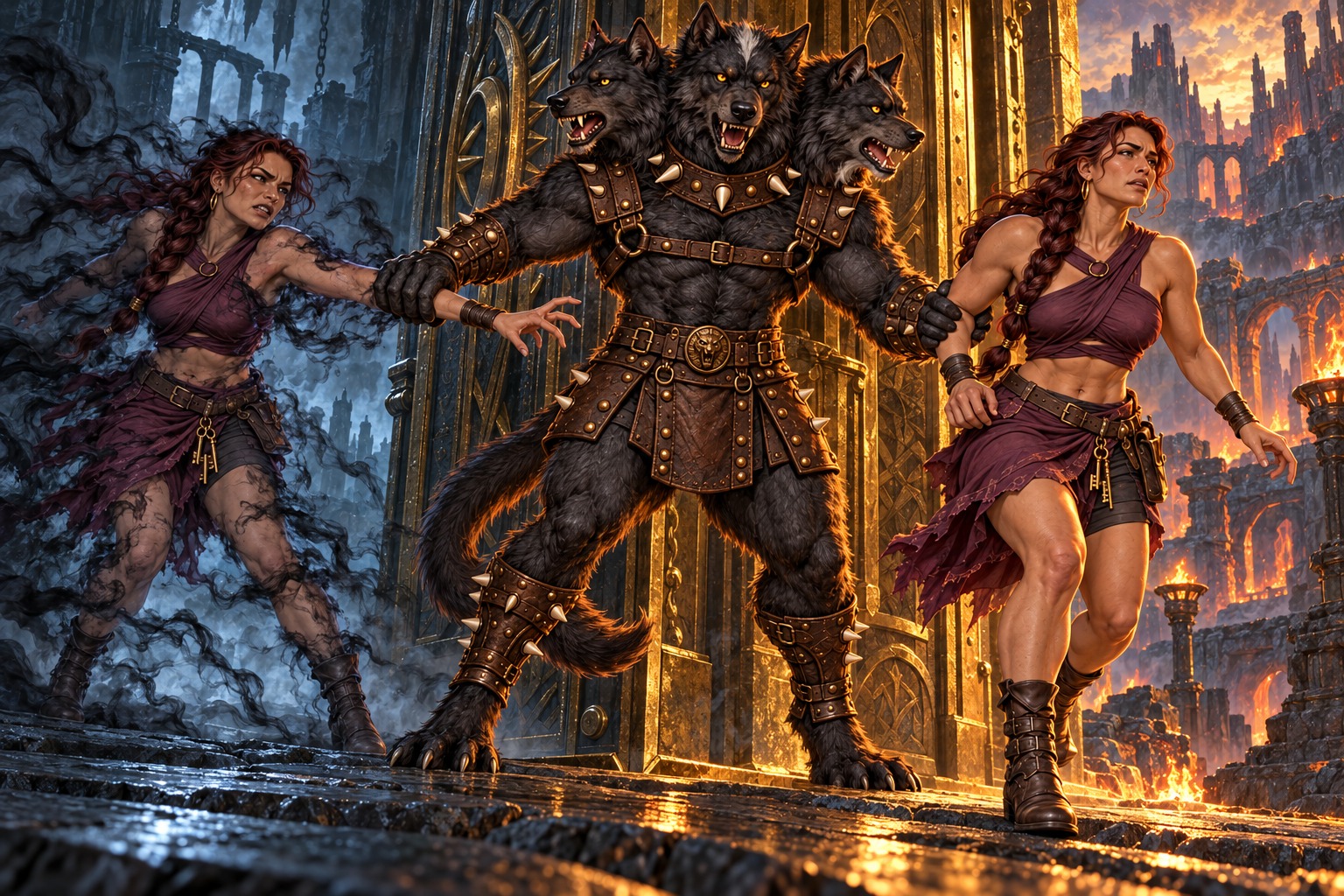
Then Cerberus caught the double's forearm. His other hand closed gently around Tamar's elbow. He moved the two women apart with terrible, unhurried strength.
For the first time, his three voices spoke together.
“You were not invited.”
The borrowed face split into a dozen expressions: anger, pleading, mockery, then a look of such naked hunger that Tamar stopped struggling. Whatever wore her shape had no wish to be her. It only wanted to stand where she stood.
Cerberus pushed it across the brass line. The face vanished. For a moment the passage held nothing but a thin outline of a woman, flat as a stain against the dark.
Tamar snatched up her hammer. With her free hand she swung the repaired gate shut.
The lock caught.
On the other side, her own voice struck the iron once.
Then it was quiet.
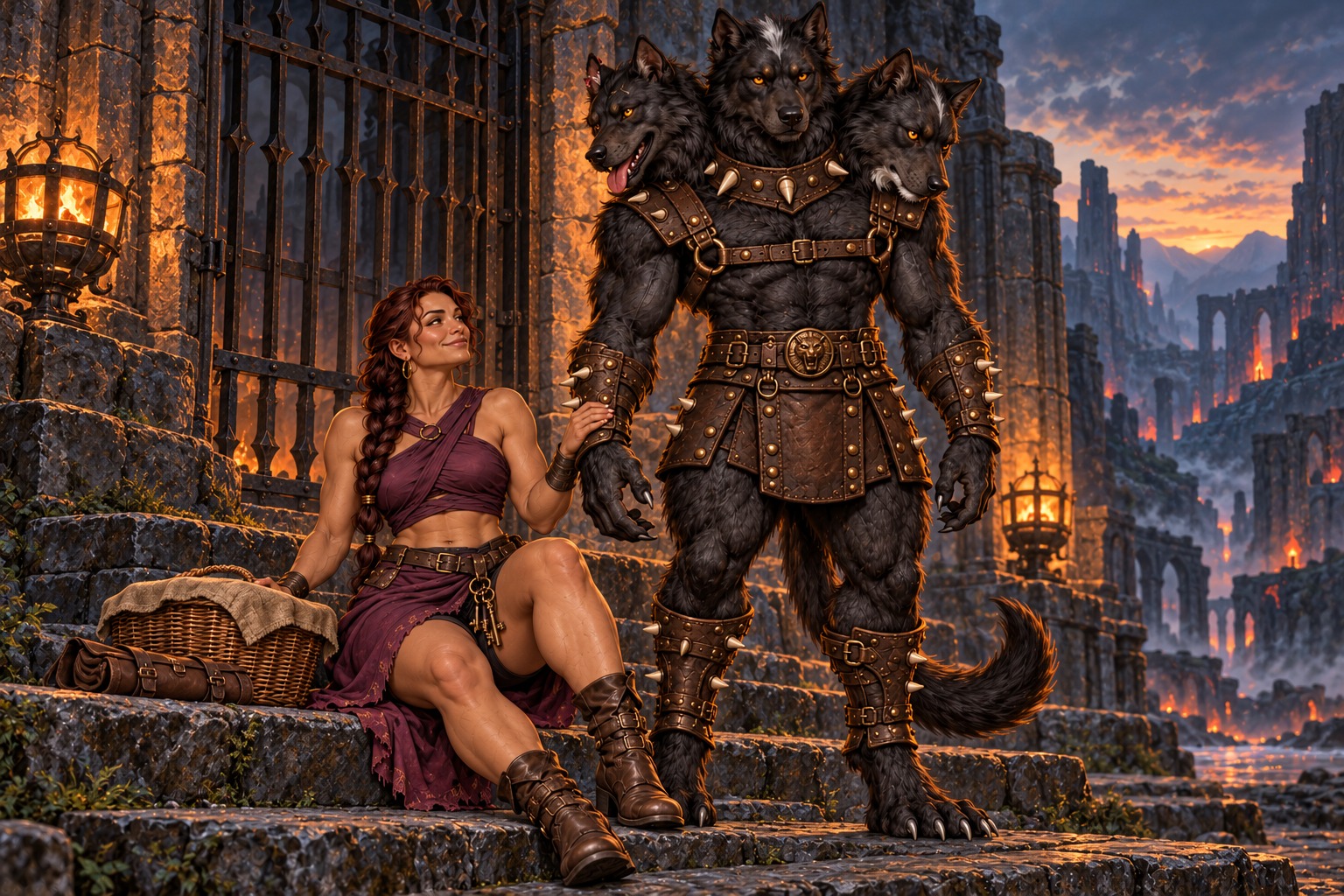
Tamar sat down on the lowest step. Cerberus remained beside her, watching the gate until her breathing steadied.
“How did you know?” she asked.
The left head looked at the hammer in her lap. “She didn't know how to hold that.”
“She might have learned.”
The middle head considered her. “You told us you were afraid. She kept telling us what we wanted to hear.”
The head on the right leaned closer. “And I could hear your heart.”
Tamar looked down at the huge hand still supporting her elbow.
“That wasn't entirely fear.”
For the first time that evening, the middle head had no answer ready.
The one on the left looked delighted.
Tamar rose, brushed stone dust from her skirt and took back the tool roll. Cerberus had kept every screwdriver in its proper loop.
“Tomorrow,” she said, “you can bring those tongs to my workshop. They ought to be repaired before you attempt anything delicate again.”
“I cannot leave the gate.”
She pointed to the patch of road immediately beyond his feet. “Then I'll bring a bench. And supper. You may continue looming.”
The middle head drew himself up. “I do not loom.”
The other two looked at him.
Tamar smiled. “One question before I cook. Do I bring one plate or three?”
“One,” said the middle head.
“Three,” said the left.
The head on the right studied her for a moment. “How much were you planning to make?”
Two original animated comics
A little less dignity
Keeping the underworld in order is one thing. Arranging a date is quite another.
No Privacy
A private date is complicated when your wingmen are attached.
Also on YouTube from 6 December 2026, 20:00 Paris time.
Read the dialogue
Cerberus: I know somewhere we can be alone.
Tamar: Do you?
Cerberus: You two. Look away.
Cerberus: I’ve wanted to—
Left head: Less growling.
Right head: More growling.
Tamar: Do they give notes on everything?
Cerberus: I can’t even have a wank without a running commentary.
Music: Origami by Scott Buckley, CC BY 4.0. Excerpted, faded and mixed under dialogue.
Staying Power
He asked his date to impress him. She took it literally.
Read the dialogue
Veiled visitor: I can keep a man hard all night.
Cerberus: All three of us?
Veiled visitor: Easily.
Cerberus: Go on, then. Impress me.
The reveal: She removes her veil; Cerberus turns to stone.
Visitor: Hard enough for you?
Music: The Illusionist by Scott Buckley, CC BY 4.0. Excerpted, faded and mixed under dialogue.
Roots of the Tale
The folklore introduction draws on Apollodorus, Hesiod and Virgil. Tamar, her double, the upright speaking guardian and both comic encounters are original Velvet Bestiary fantasy. These stories do not retell an ancient romance. All characters are adults; illustrations, animation and voices are AI-assisted.
Another guardian awaits: The Nightwarden and What the Forest Kept · Browse the stories.