Lilith and the Thirteenth Bell
Every night, the bell promises peaceful sleep. Then the city stops dreaming—and the bronze begins to speak.

Lilith in scripture, Jewish storytelling and later art
Lilith, Hebrew Lilit, has a name in a biblical wilderness, traits in rabbinic discussions, a feared presence in household protections and a biography in a medieval story about Adam. These witnesses are separated by centuries and by what their authors were trying to do. The woman who leaves Eden comes into focus much later than the being named in Isaiah. Reading the sources in sequence explains why the modern Lilith can be recognisable to people who would disagree on nearly every detail of her story. [1] [2] [3]
Contents of this guide
- A name in a landscape emptied of people
- What someone wanted a bowl to do
- What a translation of Isaiah has to decide
- Where do the hair and wings come from?
- The famous plaque with an uncertain name
- Why tell the story of Adam beside a sickbed?
- Who is looking at Lilith in modern retellings?
- Sources and further reading
Lilith belongs to several layers of Jewish literature and folklore. They should not be flattened into one unchanging biography. Later traditions describe a dangerous night demon; protective amulets also belong to her history. Her familiar role as Adam's first wife appears in the medieval Alphabet of Ben Sira, rather than in the Genesis account of Eve's creation.
In that tale, Lilith and Adam are both formed from earth. She argues that their shared origin makes them equals, refuses his demand for submission, and leaves. The same text also gives her a frightening role in beliefs about infant illness. That darker material matters to her history, even where modern interpretations emphasise independence and refusal.
A name in a landscape emptied of people
Isaiah 34 offers an early place to look for the Hebrew word lilit. Edom has been laid waste. Its buildings and open places have passed to creatures that make their homes where people no longer do. In verse 14, lilit finds a resting place among them. Notice how little biography the verse needs. There is no marriage, no quarrel in Eden and no child’s cradle in this passage. Translators have even had to decide how much of a name to give this inhabitant of the ruins. The medieval commentator Rashi identifies a female demon. The difference between a word in a poem and a commentator’s identification is worth keeping in view. Isaiah 34:14 with Rashi, Sefaria
What someone wanted a bowl to do
A ceramic incantation bowl exhibited by the British Museum brings the danger much closer to home. The museum dates the tradition represented by the bowl to roughly 500–800 CE in what is now Iraq. At the centre of this example is a bound female figure with loose hair. The inscription asks for protection against Lilith. The maker has done something quite different from painting a portrait to admire. The image shows the threatening visitor already restrained, in the condition the people seeking protection wanted her to be in. British Museum, Feminine Power exhibition guide, Lilith and the incantation bowl
An amulet also supplies the occasion for telling the later Alphabet of Ben Sira story. A king’s son is ill. Ben Sira writes protective names and images on an amulet, and the king wants to know who the figures are. Only then comes the familiar account of Adam and Lilith. Three angels pursue her after she leaves. She refuses to return, but agrees to spare a child when she recognises the angels or their names on an amulet. Read the frame as well as the argument in Eden and the teller’s immediate concern becomes audible. Someone beside a sick child wants to know what a frightened family can do tonight. Alphabet of Ben Sira, the amulet passage in Hebrew and English
What a translation of Isaiah has to decide
In Isaiah 34 the devastated land of Edom fills with inhabitants that flourish where a human settlement has fallen silent. The Hebrew word lilit occurs among them. A translator can retain a strange name, choose a nocturnal being familiar to the target audience or describe the creature more generally. Readers encountering a name in one translation and a night creature in another may be looking at the same Hebrew word. Sefaria makes it possible to inspect the verse with translations and commentary side by side. [1]
The passage offers habitat and company, and little personal history. It gives the creature somewhere to rest. There is no scene of her creation, argument over equality or departure from a husband. Turning the page to Genesis will not supply a missing episode about a woman named Lilith there. The story that joins her to Adam is an interpretation told in another work. Keeping the locations in the library distinct makes the later author’s imaginative achievement easier to see. [1] [3]
Where do the hair and wings come from?
The Babylonian Talmud mentions Lilith in more than one context. In Shabbat 151b a warning about sleeping alone assumes a being who can seize a solitary sleeper. In Niddah 24b the likeness of Lilith comes up in a discussion of childbirth and ritual law: the resemblance is human, with wings. A passage in Eruvin 100b invokes her hair as a point of comparison. A reader can assemble an image from these passages, but the rabbis are engaged in different discussions. None sets out to write an illustrated life of Lilith. [4] [5] [2]
An incidental comparison can tell us that a feature was recognisable enough to refer to in passing. It seldom tells us everything the audience thought about the being. In particular, wings in a rabbinic discussion do not identify every earlier Near Eastern image of a winged woman. Text and object each need their own evidence before being given the same name. [5] [6]
The famous plaque with an uncertain name
The fired clay relief now called the Queen of the Night depicts a winged, taloned female figure above lions with owls to either side. Its modern title is deliberately descriptive. The British Museum discusses different identifications for the Old Babylonian figure, among them Ishtar and the underworld goddess Ereshkigal. The visual details can be studied very closely. The identity of the figure is an interpretation, and a reproduction with a confident caption can lose that distinction entirely. [6]
Compare the relief with the inscribed incantation bowls. The plaque provides the viewer with an arresting body whose name is disputed. An inscription can give a named threat a place in a particular person’s fears without supplying a stable portrait. Images shared under Lilith can therefore have quite different evidentiary value. An inscribed household protection, a modern painting inspired by the story and a much earlier relief are three separate entries in the history of her image. [7] [6]
Why tell the story of Adam beside a sickbed?
The Alphabet of Ben Sira places its Lilith episode inside a story about a child in danger. Ben Sira prepares an amulet. Asked why it bears certain names or images, he tells how the first pair quarrelled, how Lilith departed after pronouncing the divine name and how three angels were sent after her. The account explains why signs of those angels can have protective force. Details of equality and refusal explain the rupture between the pair. Details of an oath explain what a later household should expect the amulet to accomplish. [3]
When the story is excerpted as “Adam’s first wife,” the opening question about a child’s safety can vanish. The same passage can then sound like a manifesto about marriage. Read in its frame, Lilith is allowed an argument about her own origin and is also a figure whom the family has cause to fear. The text is a medieval narrative with a distinctive voice. Its place in Jewish cultural history does not make every part of it a shared doctrine of Jewish religious life. [3]
Who is looking at Lilith in modern retellings?
Dante Gabriel Rossetti’s sonnet Body’s Beauty introduces Adam’s first wife and concentrates on her hair. In the poem the hair can hold a viewer captive. The nineteenth-century poet turns material associated with an older demon into a meditation on beauty, desire and the perspective of the person watching. In Jewish feminist theology, Judith Plaskow’s The Coming of Lilith gives Eve and Lilith a relationship of their own. The question of what the two women might say if they could meet opens an entirely different story from that told by Adam about either of them. [8] [9]
Both works matter to the later life of the figure. They have named authors, identifiable audiences and concerns of their own. A reader seeking the earliest attestation should begin with the Hebrew verse. A reader seeking Lilith’s case against Adam should look for Ben Sira. A reader interested in how she came to embody autonomy will learn more by following these later acts of retelling than by trying to extract a single timeless definition from all of them. [1] [3] [9]
The story below is an original gothic fantasy. Its affectionate Lilith, relationship with a bell restorer, stolen dreams and dream-binding bell are new inventions. It borrows the atmosphere of a formidable visitor by night; it does not claim to recover a forgotten episode of religious tradition.
Sources: The Alphabet of Ben Sira — translated primary text · Jewish Encyclopedia — Lilith
Sources and further reading
- Isaiah 34:14, Hebrew text, translations and commentary, Sefaria
- Babylonian Talmud, Eruvin 100b, Sefaria
- The Alphabet of Ben Sira, the amulet episode, translated primary text
- Babylonian Talmud, Shabbat 151b, Sefaria
- Babylonian Talmud, Niddah 24b, Sefaria
- British Museum, Queen of the Night relief, collection record 2003,0718.1
- British Museum, Feminine Power exhibition guide, incantation bowl
- Dante Gabriel Rossetti, Body's Beauty, 1881 proof, Rossetti Archive
- Judith Plaskow, The Coming of Lilith, collected writings, Beacon Press
Lilith and the Thirteenth Bell
At midnight, every bell in the city rang twelve.
The one above Severin Vale's workshop rang thirteen.
He was standing on a chair, trying to remove its clapper, when a woman's voice rose from below him.
“You used to have better excuses for keeping me awake.”
Lilith stood inside the locked door. Rain gleamed on the ridges of her horned crown. Her wings were folded behind black dragon-scale armour, and the green stone at her throat lit the underside of her chin.
Severin nearly dropped his spanner.
“The door was locked.”
“I remember how you like it.”
He climbed down. For a moment they stood close enough to embrace, each waiting for the other to make an error worth forgiving.
She looked past him at the bell.
“What have you made?”
“A quieter city.”
It had begun with a commission from the hospital: a bell whose evening note would ease troubled sleep. Severin had made its bronze shell. A travelling magician had supplied the silver wire wound around its clapper.
For six nights, the patients had slept peacefully.
On the seventh, they stopped dreaming.
Then the bakers stopped. Then the watchmen, the washerwomen, the magistrate. People woke exhausted, unable to remember whether they had ever wanted anything beyond the next day's work.
“They've begun blaming you,” he said.
“They generally do.”
She passed him and laid one claw against the bronze.
Something knocked back.
Severin stepped nearer.
Beneath the metal he heard waves, a barking dog, somebody laughing in a room he could almost remember. Then his mother's voice called his name.
His hand closed around the spanner.
Lilith watched his face.
“You heard her before.”
He nodded.
His mother had died in the spring. For months he had dreamed of reaching her door just after it closed. He had paid the magician himself when the hospital could not afford the final fee.
“I wanted one night without that door.”
Lilith's expression changed. She had been with him the morning after the funeral. He remembered her sitting on the kitchen floor while he refused food, company and finally her.
“I would have stayed,” she said.
“I know.”
It was a poor answer, but an honest one.
She lifted the inspection plate beneath the bell. Silver wire had grown through the clapper's mounting like roots. In its loops, tiny moving shapes pressed against the metal: ships, staircases, faces.
“It takes the whole dream,” she said. “Not just the part that hurts.”

Severin reached for his cutters.
The workshop vanished.
He stood outside his mother's door.
Warm light lay under it. He smelled bread. A chair scraped inside.
He knew exactly what he had to do. Knock. This time, arrive in time.
Behind him, Lilith caught his wrist.
“Severin. Look down.”
He looked.
His boots stood on the workshop floor. The door began halfway up the wall, where the bell hung. One more step would have put his hand inside the moving clapper.
He staggered back. The kitchen smell soured into hot metal.
“Can you hold it?” he asked.
Lilith slipped both hands beneath the bronze lip. Her wings opened across the room, blotting out the lamps.
“Work quickly.”
He climbed the chair and cut the first wire.
A wave broke across the ceiling.
At the second, a hundred sleepers began speaking at once. Dust shook from the rafters. Lilith's jewellery burned green against her skin.
The last wire ran through the mounting bolt. He could not reach it with the cutters.
“The hammer,” he said.
Her tail hooked the tool from his bench and passed it up.
Even now, he almost smiled.
“You could have told me you could do that.”
“You could have asked me to dinner.”
The clapper jerked against her grip. Her smile went.
“Hit it.”
He drove the mounting pin sideways. Once. Twice.
His mother's voice came again, so near that he felt her breath.
This time he kept his eyes on the pin.
The third blow freed it.
Lilith lowered the clapper onto the bench. Severin seized the loose silver coil in the tongs and pulled it clear.
Dreams burst through the roof.
There was no hole afterwards. Only a long shiver of light passing through the tiles: ships with impossible sails, forgotten lovers, flying dogs, a woman dancing barefoot on a table. Over the hospital, a flock of blue horses turned towards the river and disappeared.

Lilith sat down very abruptly.
He was beside her before her wings had finished folding.
“Are you hurt?”
“Your chair is dreadful.”
He knelt and took her hands. A shallow burn crossed one palm. He cleaned it with water, wrapped it in linen and held it longer than the task required.
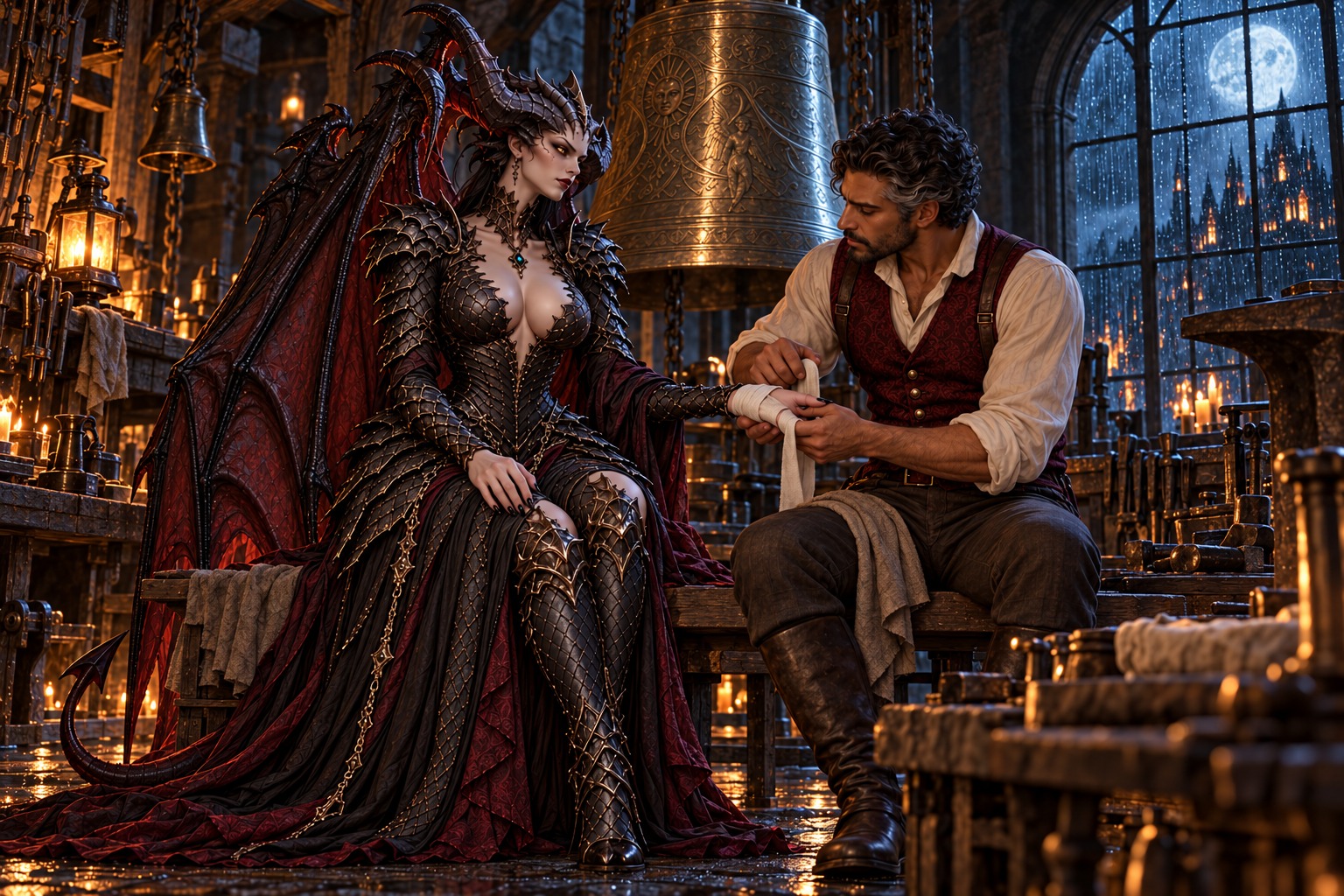
“Dinner,” he said.
“You have bread, half an onion and something becoming a second onion.”
“Breakfast, then. Somewhere expensive.”
She touched his cheek with her uninjured hand.
“You may have another bad dream tonight.”
He leaned into her palm.
“Will you be here when I wake?”
“If you ask me.”
So he did.
Later, she kissed him beside the cold forge. He drew her close carefully, mindful of her hand, and felt her wings settle around them. When she laughed against his mouth, the sound belonged entirely to the room they were in.
Across the city, people turned in their beds and began to dream.
The bell above the workshop remained silent.
Unsheathed
The captain has a magnificent weapon. Unfortunately, it has opinions.
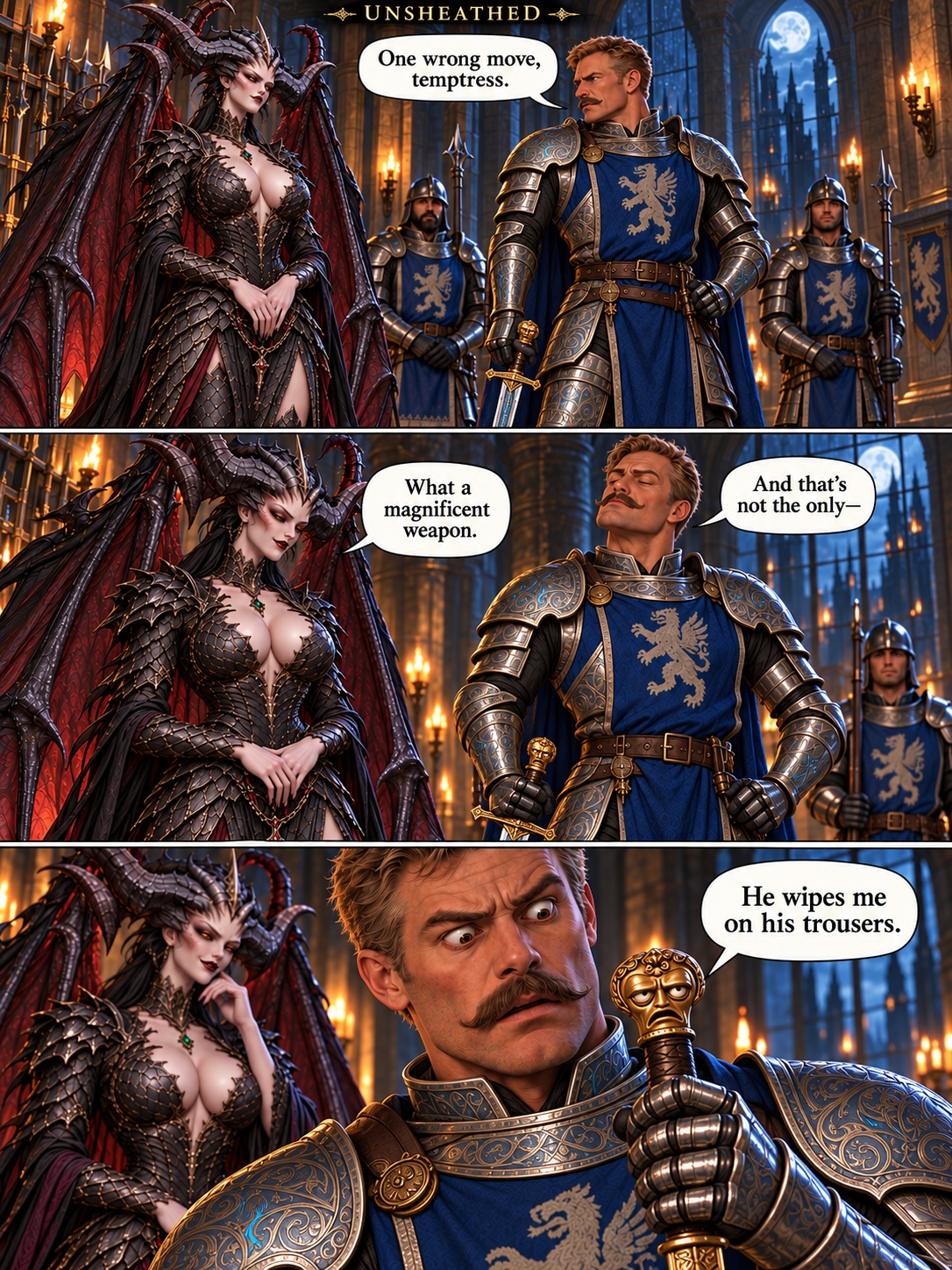
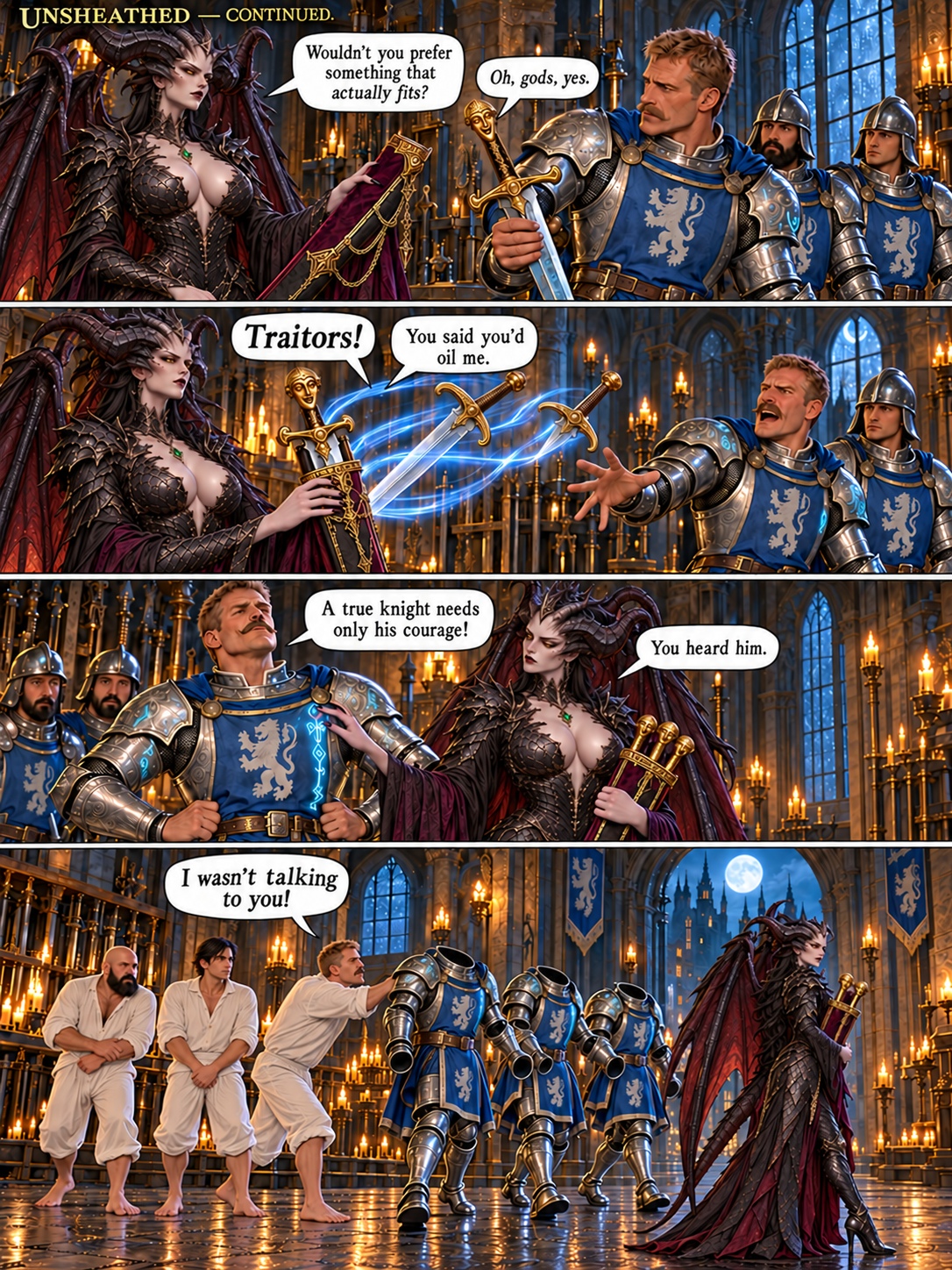
Read the comic transcript
Panel 1. A palace captain stands guard before Lilith with his enchanted sword held low at his side. Two armoured guards block the doorway behind him.
Captain: One wrong move, temptress.
Panel 2. Lilith looks down to admire the sword while its captain keeps hold of the grip and puffs out his chest.
Lilith: What a magnificent weapon. / Captain: And that’s not the only—
Panel 3. The sword interrupts. Its pommel has a small expressive face. The captain stares at it.
Sword: He wipes me on his trousers.
Panel 4. Lilith lifts an empty velvet-lined scabbard from a weapons display and addresses the sword.
Lilith: Wouldn’t you prefer something that actually fits? / Sword: Oh, gods, yes.
Panel 5. The sword tears out of the captain’s hand and slides into the scabbard. The other swords leap after it.
Captain: Traitors! / Sword: You said you’d oil me.
Panel 6. The empty-handed captain takes a heroic stance. Lilith looks at the runes on his breastplate.
Captain: A true knight needs only his courage! / Lilith: You heard him.
Panel 7. Three empty suits of enchanted armour march away with Lilith, leaving three guards in baggy linen underclothes. The captain grips the attached collar of his departing suit.
Captain: I wasn’t talking to you!
The Exorcist
An impressive priest. Excellent references. One awkward family connection.

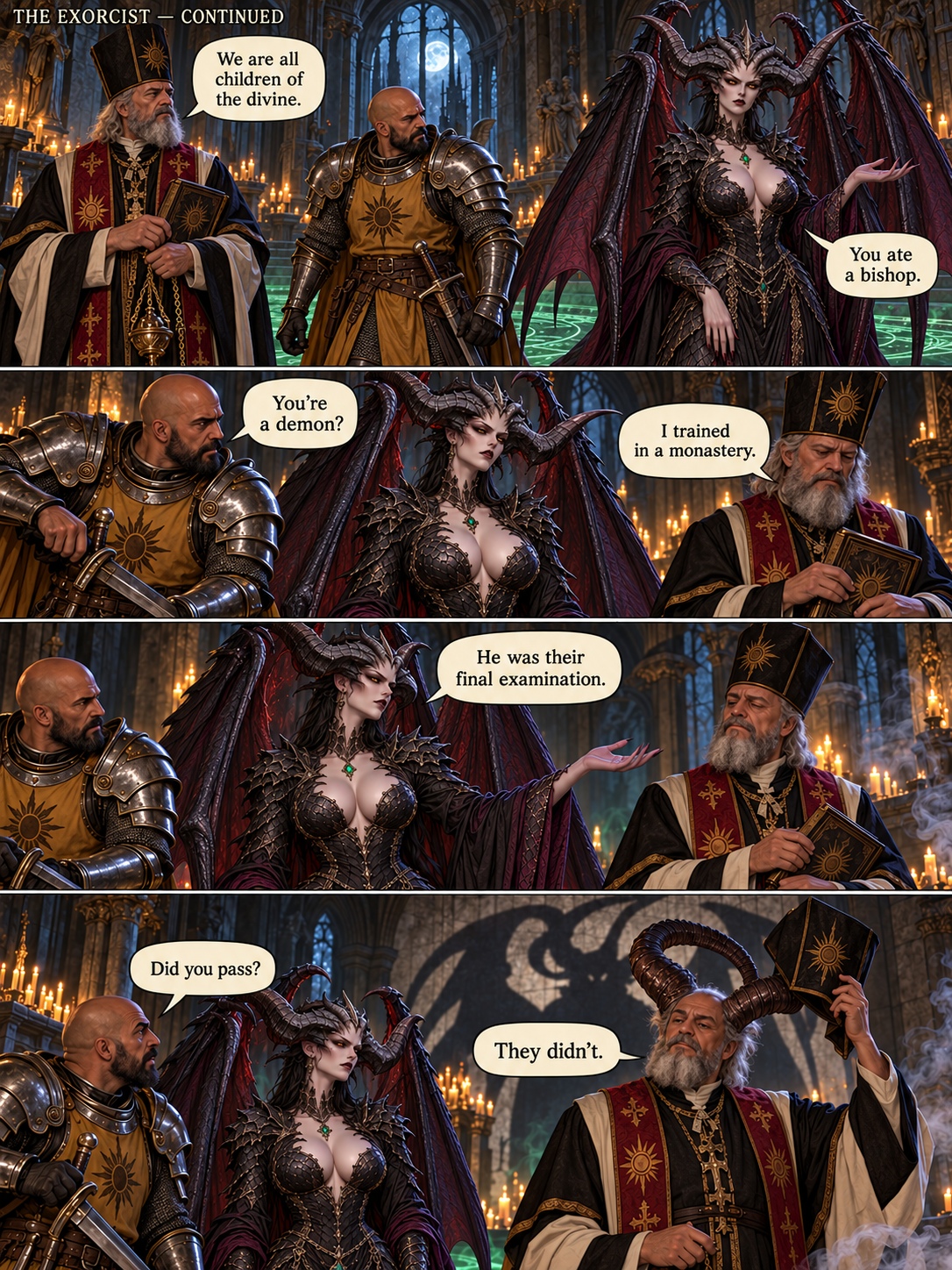
Read the comic transcript
Panel 1. Lilith stands inside a glowing containment ward in a ruined chapel. A captain ushers in an imposing priest with a holy book and censer.
Captain: One demon. Send her back to hell. / Priest: Stand well back.
Panel 2. The priest opens his book and raises the censer theatrically.
Priest: Foul creature! In the name of—
Panel 3. Lilith recognises the priest. He freezes open-mouthed. Incense drifts through the silence.
Lilith: Uncle?
Panel 4. The captain slowly turns towards the priest.
Priest: We are all children of the divine. / Lilith: You ate a bishop.
Panel 5. The captain reaches for his sword. The priest closes his book.
Captain: You’re a demon? / Priest: I trained in a monastery.
Panel 6. Lilith gestures towards the priest as though providing an excellent reference.
Lilith: He was their final examination.
Panel 7. The captain looks at the priest, who removes his tall hat. Two huge horns spring upright. His shadow becomes monstrous.
Captain: Did you pass? / Priest: They didn’t.
Comedy in Motion
Scheduled on YouTube for Nov 28, 2026. The player becomes available after release.
Watch on YouTube
Scheduled on YouTube for Nov 30, 2026. The player becomes available after release.
Watch on YouTube
Curator’s Cabinet
For readers drawn to Lilith’s dark regality, the Lilith adult silicone design by Love Smiths carries the fantasy into a handcrafted piece with an enveloping silhouette and ornamental details.
For a gothic touch beside your evening glass: a personalised slate coaster from L’Atelier Époustouflant, with designs including a horned skull and spectral bat.
Affiliate disclosure: This page contains affiliate links. If you purchase through them, we may earn a commission at no extra cost to you. Read our disclosure.
Roots of the Tale
The folklore introduction distinguishes documented Jewish literary traditions from this original fantasy. Severin, the dream-binding bell, Lilith’s relationship with him and both comic encounters are original Velvet Bestiary fiction. Illustrations are AI-assisted.
Another encounter awaits: The Horn and the Hollow Well · Browse the stories.