The Horn and the Hollow Well
Every night he cleared the village water. Every dawn, something beneath it put the poison back.
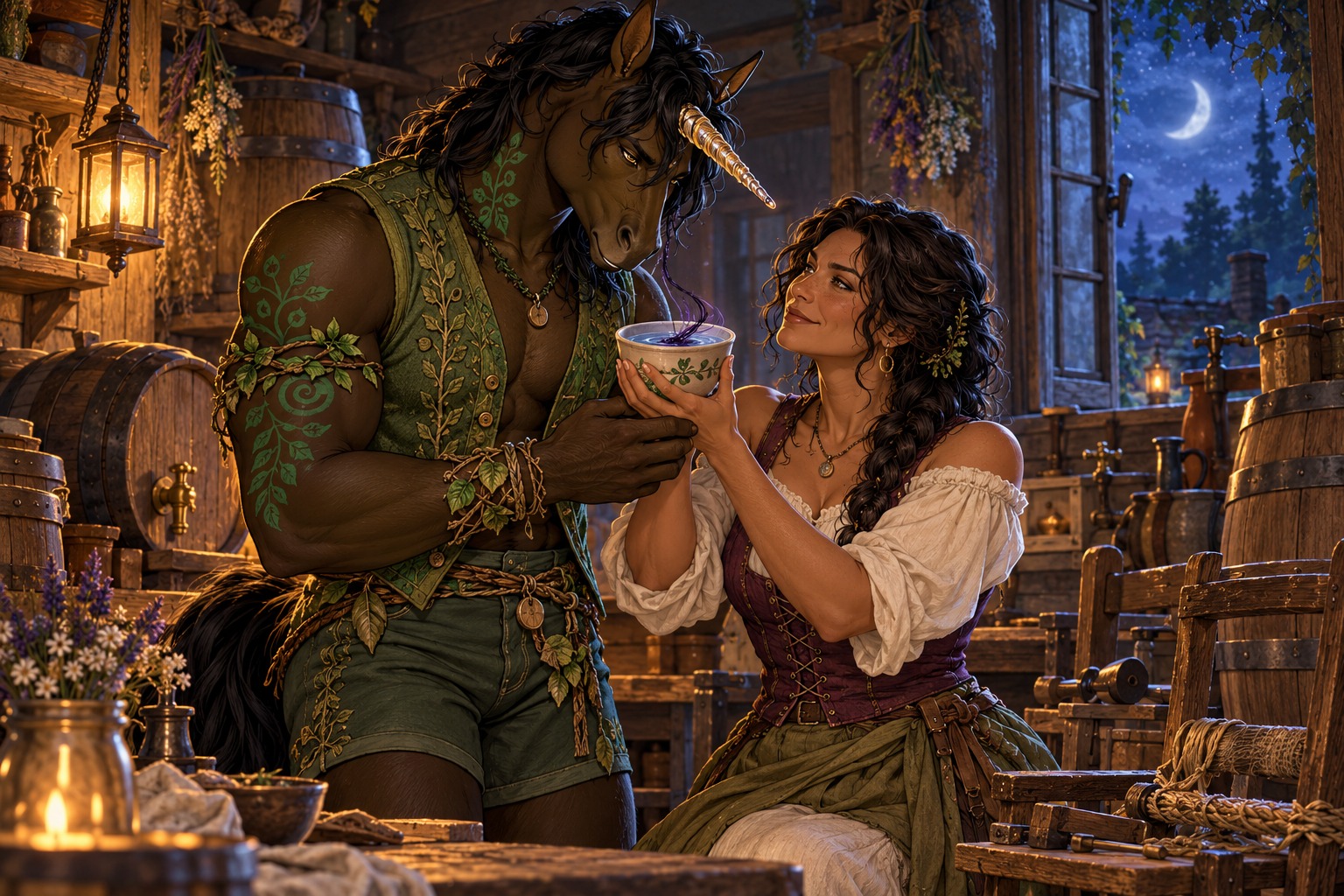
Unicorns, their horns and the separate history of druids
A unicorn is a one-horned creature, but that definition leaves almost everything else open. Pliny’s animal from India is difficult even to picture as a horse. A manuscript hunter needs a maiden to capture his quarry. A wealthy European could own what was sold as its horn. Druid has its own history as a name for a human religious specialist. The Unicorn Druid in this feature brings together traditions that can be traced independently. [1] [2] [3] [4]
Contents of this guide
The unicorn has not always belonged to a gentle world of rainbows. In European medieval art it is also a dangerous quarry, a healer and a creature whose beauty makes other people want to possess it.
One enduring belief gives its horn the power to cleanse poisoned water. A late-fifteenth- or early-sixteenth-century tapestry fragment in the Menil Collection shows animals waiting as a unicorn lowers its horn into a stream. The museum identifies the gesture as purification and explains its Christian symbolism. This is evidence for a historical belief, not a claim that an animal horn can make water safe to drink.
Menil Collection: Unicorn Purifying the Waters
Another strand connects the unicorn with a maiden who allows hunters to approach it. The Met's publication A Blessing of Unicorns discusses this bestiary tradition. The encounter can be beautiful and treacherous at once: the apparent refuge is also a means of capture. That tension is more interesting than treating the unicorn as a reliable judge of somebody's private life.
The Met: A Blessing of Unicorns
The famous tapestry now titled The Unicorn Rests in a Garden offers a different puzzle. Its creature wears a collar and sits inside a low fence. The Met presents the beloved willingly bound by love as one possible interpretation, alongside religious readings. The loose chain, the easily crossed fence and the pomegranate's associations with fertility make the image less simple than a picture of an animal successfully locked away.
The Met: The Unicorn Rests in a Garden
Stand at the edge of the fountain
In the Met’s tapestry of the water being purified, the unicorn is already on its knees. Twelve men have found the animal they came to hunt. Yet the artist gives the eye so many other places to go that the hunt can wait. Pheasants and goldfinches perch on the fountain. Beside the stream are plants that a reader of medieval herbals might have known as antidotes, including sage and pot marigold. The cleansing of the stream is the museum’s interpretation of the lowered horn. The plants help make the case. A tapestry can tell you what a gesture means by what grows beside it. The Met, The Unicorn Purifies Water
Another animal with one horn
Open the Aberdeen Bestiary to the entry for the monoceros. Try drawing from the description before looking at the picture. Start with a horse’s body. Give it an elephant’s feet, a deer-like tail, a bellow that would stop a traveller in his tracks and a forehead horn four feet long. The author declares that people can kill this creature but have never taken one alive. This is a particularly fierce medieval one-horned beast. Someone expecting the dainty, approachable animal of the maiden-and-unicorn scene has picked a very different page. Medieval books and images allow both pictures to survive. University of Aberdeen, Monoceros, folio 15r
The apparently peaceful unicorn behind its low fence offers one last test of the eye. There are red marks on its flank. The Met points out that there are no corresponding wounds and reads the marks as juice from the pomegranates overhead. It also allows that this hanging may have been conceived as an independent image. Imagine seeing it in a room of its own, before seeing a single tapestry of the hunt. What looks like an injury after a chase can look like ripe fruit dripping onto the back of a resting animal. The Met, The Unicorn Rests in a Garden
A one-horned animal in Roman natural history
Pliny describes the monoceros using features an unfamiliar creature might share with known animals. Its body resembles a horse’s, its head a stag’s, its feet an elephant’s and its tail a boar’s. Its single long horn projects from the middle of the forehead. Its low call and its reputation for resisting capture alive complete the picture. A reader assembling this animal strictly from the description will get something very different from a white riding horse with a fine spiral horn. [1]
The description belongs to a compilation about the natural world, where a writer could assemble reports about lands few readers would see for themselves. That helps explain the inventory of body parts. It is a device for communicating unfamiliar anatomy. Later, a painter depicting the maiden’s encounter must solve another problem: how large can this animal be if the crucial action takes place in a person’s lap? A change in the purpose of the account can produce a substantial change in the creature a reader imagines. [1] [2]
Why a maiden appears in the medieval hunt
In the European bestiary tradition a hunter faced with a creature too fierce to capture has another resource. A maiden can attract the unicorn and receive it in her lap, giving the hunter an opportunity to seize or kill it. A Christian reader could recognise the Incarnation in the encounter: Christ takes bodily form through the Virgin Mary. Some images also make the later suffering of Christ painfully present as a hunter attacks the trusting animal. The maiden is the figure through whom an apparently impossible capture becomes possible. [2]
A manuscript illustration can tell several parts of the story simultaneously. The animal rests its head, the woman receives it and a hunter is already in position. A reader approaching through the later tapestries may instead be able to follow the hunt from panel to panel, with hounds, armed men and onlookers acting in succession. The religious and courtly possibilities of the unicorn image overlap. The surviving works reward close attention to who touches the animal, who carries a weapon and which episode the artist chose to show. [2] [5]
What was bought and sold as unicorn horn?
A long, spiralling tusk on display at the Met Cloisters belongs to a narwhal, a marine mammal. Objects of this kind occupied a valuable place in European collections as unicorn horn. The museum cites the valuation of such a horn in Lorenzo de’ Medici’s collection at his death in 1492: 6,000 florins. That is evidence for the value attributed to a particular possession. It is also evidence that someone who encountered the word unicorn in an inventory might actually be able to touch the object under discussion. [3]
A larger example of the material’s prestige survives in Denmark. Frederik III commissioned a throne made between 1662 and 1671. The Royal Danish Collection connects its design to the biblical account of Solomon’s throne and identifies its pale material as narwhal tusk. On a cabinet shelf a long tusk could be admired for the shape it seemed to give the legendary horn. Worked into a throne, it also expressed a ruler’s wealth and aspirations. Neither a tapestry nor an inventory alone would tell that part of the unicorn’s history. [6]
What a druid did in Caesar’s account
Julius Caesar describes druids in the sixth book of his Gallic War, written in the first century BCE. He attributes to them religious duties, teaching, arbitration of disputes and the authority to exclude people from sacrifices. He reports long training in memorised verse and discussion of the stars, the world and the gods. This is a Roman commander’s account of people in Gaul during a war of conquest. It gives historically situated evidence about the title, filtered through an observer with interests of his own. [4]
There is no unicorn kit among those duties. The Welsh narrative of Ceridwen and Gwion supplies a different comparison for the shape-changing in our tale, and its transformations have their own pursuit and sequence. The combination in Merrin makes sense as fantasy because the constituent histories are distinct: a beast that once defied the hunter, a figure of ritual and learning, and the narrative possibility of acquiring another body. A reader coming primarily for unicorn folklore can follow any of those threads back to its own evidence. [4] [7] [2]
Shape-changing has its own, separate literary history. In the Welsh story of Ceridwen and Gwion Bach, the pursued boy and his pursuer move through animal forms during their chase. Eryri National Park recounts that tradition. It does not describe a unicorn druid, and it should not be used as evidence that such a being belonged to ancient Welsh religion.
Merrin, his humanoid form, his relationship with Nessa and the curse beneath the well are original fantasy. This tale brings the older images of healing, pursuit and captivity into a new woodland mystery. The historical sources provide roots; the people and events that follow belong to this story.
Sources and further reading
- Pliny the Elder, Natural History 8.31, Philemon Holland translation
- J. Paul Getty Museum, bestiary manuscripts, the unicorn hunt and the Incarnation
- The Met Cloisters, Narwhal Tusk, collection record
- Julius Caesar, Gallic War 6.13–14, University of Chicago
- Metropolitan Museum of Art, A Blessing of Unicorns
- Royal Danish Collection, Frederik III's narwhal throne
- Eryri National Park, Ceridwen and Gwion Bach
The Horn and the Hollow Well
Nessa knew something was wrong with the well when the water smelled of violets.
Water should not smell of anything. Certainly not the perfume her grandmother had worn to funerals.
She carried a cup to the kitchen, where Merrin was attempting to repair a chair without admitting he had broken it. His dark mane was tied back. One hoof braced a loose rung; the other tapped against the floor with the impatience of a much larger animal.
“Before you taste that,” he said, “don't.”
“That bad?”
He took the cup. The gold spiral above his brow caught the hearthlight as he lowered its point into the water. A black thread unwound beneath the surface, tightened like a dying worm, and vanished.
He passed it back.
Nessa smelled rain on stone.
“You could have said thank you for saving your breakfast,” he suggested.
“I was waiting until you saved the chair.”
The first night, he cleared six buckets. The second, the whole well. By the third morning the violets had returned, and Nessa had poured away two batches of ale.
She left a clean bowl on the wellhead at sunset. Merrin purified the water in it, then did the same to the water below. At dawn the bowl was still clear. The well was black.
“So it isn't your magic wearing off,” she said.
“An unflattering theory, but no.”
“Something underneath is doing it again.”
The villagers wanted him to stand beside the well every night. There was even talk of building him a little shelter.
“Generous,” Nessa said when she heard. “Will they put a bowl out as well?”
Merrin's ears tilted back. She knew that movement. It meant he was choosing his answer carefully.
“They have fields to water.”
“And you have somewhere to be when the sun goes down.”
His gaze moved to her mouth.
“I am trying to be public-spirited.”
“You can try it after supper.”
Instead they waited until the village slept, lifted the old inspection slab behind the well and followed the sound of running water into the bank.
Nessa went first with a lantern. Merrin followed in his upright form, shoulders brushing the stone. Below his green waistcoat, the muscles of his arms shifted as he held the slab clear. He had offered to go alone. She had reminded him which of them understood old barrel hoops, water channels and the consequences of saying, ‘It's probably sound.’
The passage opened into a chamber beneath the orchard. Water entered through a crack in the far wall and fell into a shallow basin. Beside it stood a stone post no higher than Nessa's waist.
A chain was fastened to the post.
At its other end, under a drift of pale roots, lay a collar.
Merrin stopped so abruptly that she felt the change in the air before she turned.
“Don't touch it.”
She lowered the lantern.
The collar was too fine for a working animal: silver flowers over blackened iron, a little gilt leaf beneath the buckle. A broken length of spiral horn lay inside it. The bone was dark at the cut end.
A drop of water struck the horn. Violet colour spread from it into the basin.
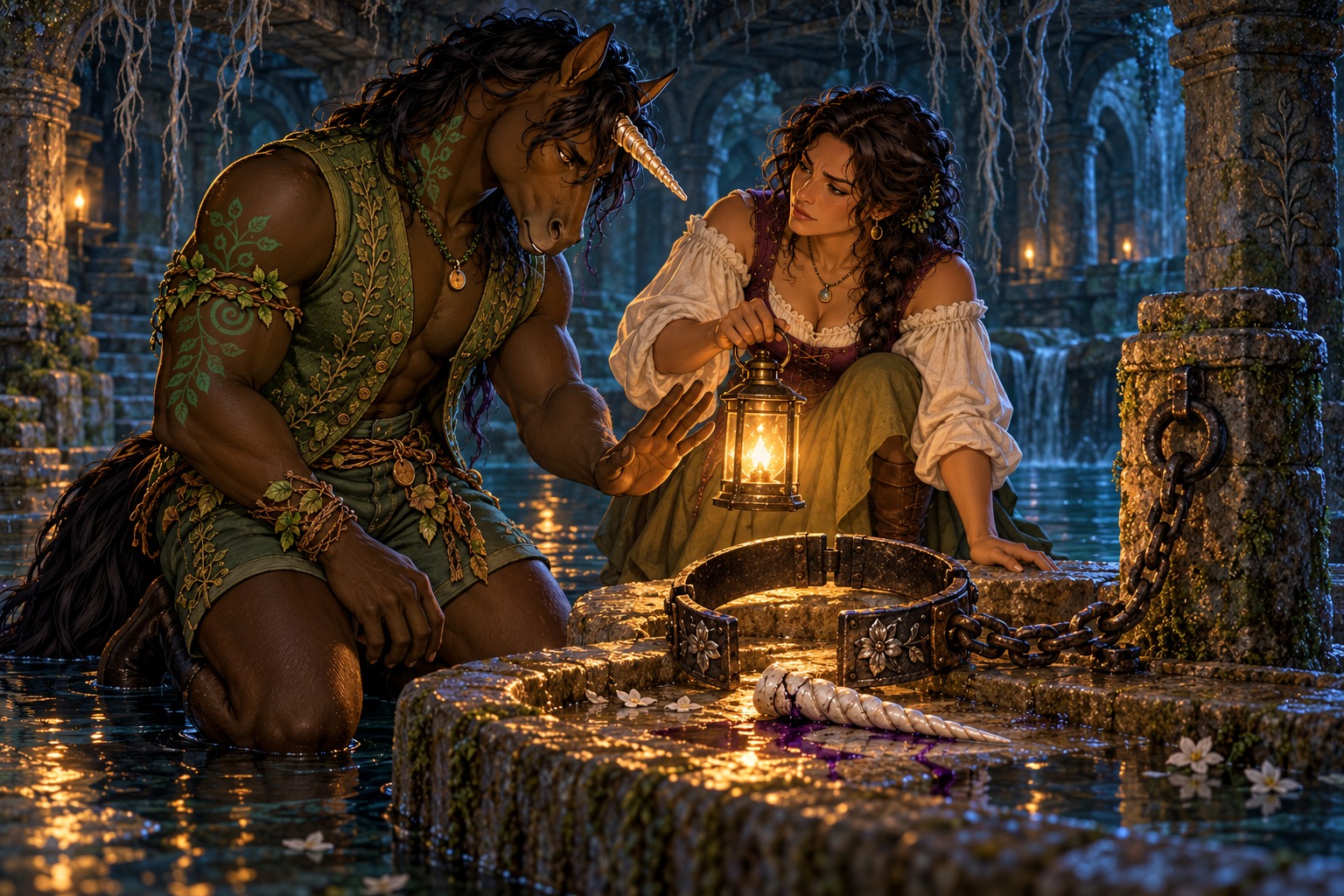
“They built the well over this,” Nessa whispered.
Merrin knelt. He did not reach for the horn. For a long moment he looked at the buckle, as though trying to understand how something so small had been sufficient.
There were letters around the collar. Nessa rubbed the mud away with a corner of her apron.
FOR THE GOOD OF ALL.
She had seen the same words on the old stone above the village well.
“A blessing that couldn't walk away,” she said.
Merrin's jaw tightened.
“A horn they could keep using after the creature was dead.”
The chain gave a small, hard sound against the post. Neither of them had moved it.
Nessa watched another violet stain enter the water.
“Can you clear it?”
“The water. Yes.”
“I mean this.”
His hand closed against his knee.
“I don't know.”
It was the first uncertain answer he had given her all week. She set the lantern down and sat beside him on the cold stone.
He had told her once about a hunter who had offered him salt from an open palm. He had told the story as a joke. She had laughed because he had laughed, and only later wondered how close the hunter had come.
“You don't have to stay here,” she said.
“Neither do you.”
“I have a cellar full of ruined ale. I'm practically invested.”
That brought the smallest movement to his mouth. She laid her hand beside his and waited. When he turned his palm upward, she took it.
The collar's fastening had swollen shut. Nessa could see where an earlier hand had hammered the pin into place.
“I can open that,” she said.
Merrin looked at her.
“You said not to touch it. You didn't say I couldn't be rude to it with a chisel.”
He laughed then, once, without much air.
She fetched her cooper's tools. He held the chain against a flat stone while she worked at the pin. Each blow sent a shiver through the silver flowers. The water rose around their boots and hooves. A cold smell filled the chamber: old metal, disturbed earth, the sweetness of too many violets.
On the fourth strike, the lantern guttered.
On the fifth, the chain pulled tight.
Merrin caught her wrist before the chisel could slip. His thumb rested over her pulse.
“Again,” he said.
She struck.
The pin broke.
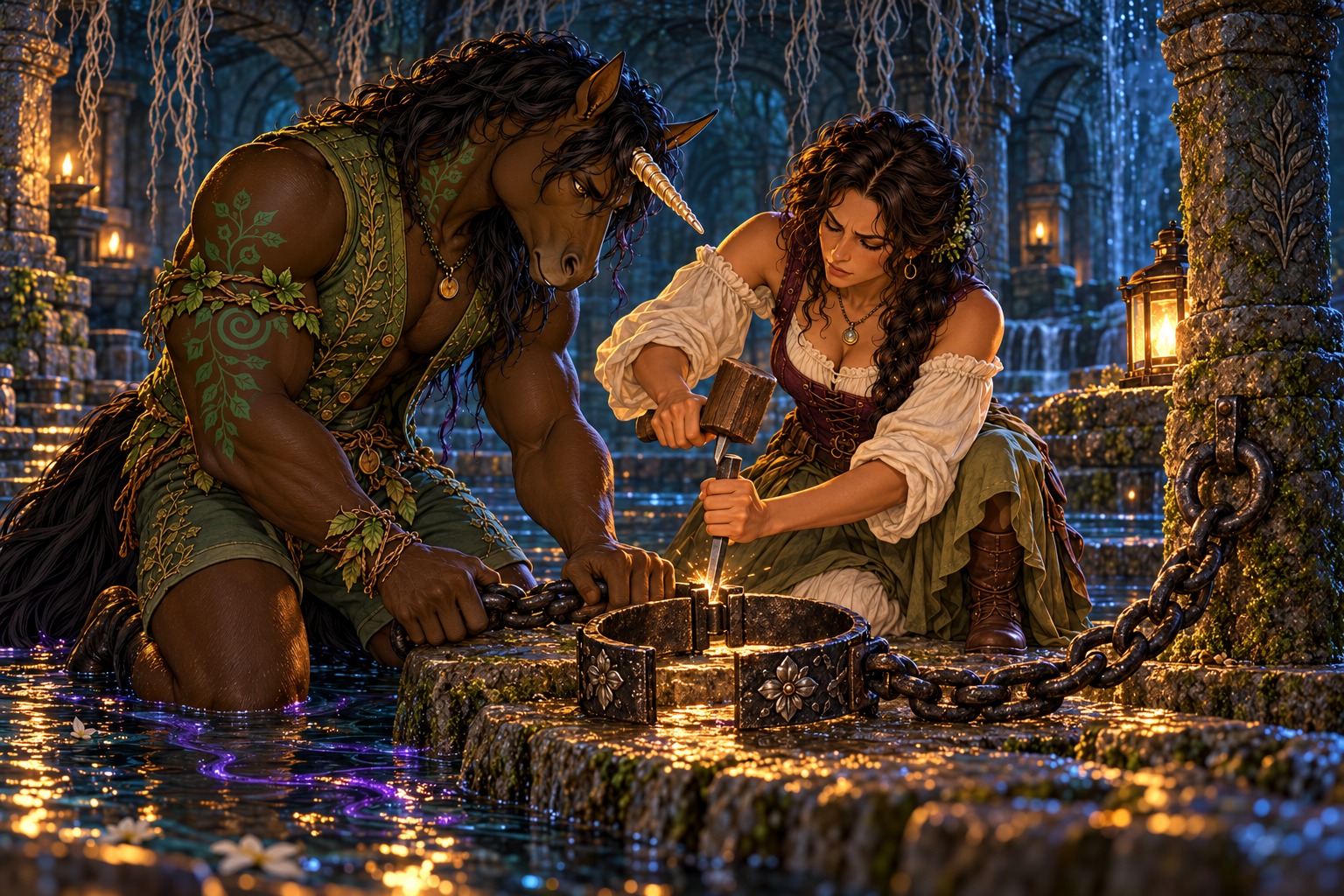
For an instant the water stood still against the walls. Then it rushed through the loosened stones with a force that took the lantern and swept Nessa sideways.
Merrin's arm closed around her waist. His hooves skidded on the flooded floor. She caught the edge of the inspection shaft, scraped her palm and held on while he pushed her upward.
They came out into the orchard together, soaked, breathless and carrying the broken horn wrapped in Nessa's apron.
Behind them the water found a new course through the bank.
Neither spoke until the first bird began.
At the edge of the wood they buried the horn beneath a young pomegranate tree. The broken collar stayed above ground, open, where anyone coming along the path could see the words on it.
“Will that end it?” Nessa asked.
“We'll find out.”
They did not announce a miracle.
They drew water at breakfast, at noon and after sunset. They left it overnight. They drew it again the following morning.
On the third day Nessa began another batch of ale.
Merrin repaired the chair properly.
That evening she found him in the courtyard, in his upright form, leaning against the low gate. Fresh leaves had caught in his dark mane. He was turning the broken fastening pin between his fingers.
“You can throw that away,” she said.
“I was considering it.”
She took it from him and put it on the kitchen shelf, beside a bent nail and the key to a door that no longer existed.
“Things that failed to keep something in,” she explained.
He looked at the collection, then back at her.
“An interesting place to invite a guest.”
“You're very welcome to leave.”
She meant it. He heard that she meant it, and something in his face eased.
He stepped close enough for her to feel the warmth of him through her damp evening shawl. The narrow tip of his horn caught a little lantern light above her.
“I know,” he said.
She took his waistcoat between her fingers and drew him down to a kiss. He smiled against her mouth, then kissed her again, more slowly. When she stepped back, his hand stayed lightly at her waist.
“Supper?” she asked.
“Is there wine?”
“At a safe distance from your forehead.”
He followed her inside. The low gate remained open behind them.
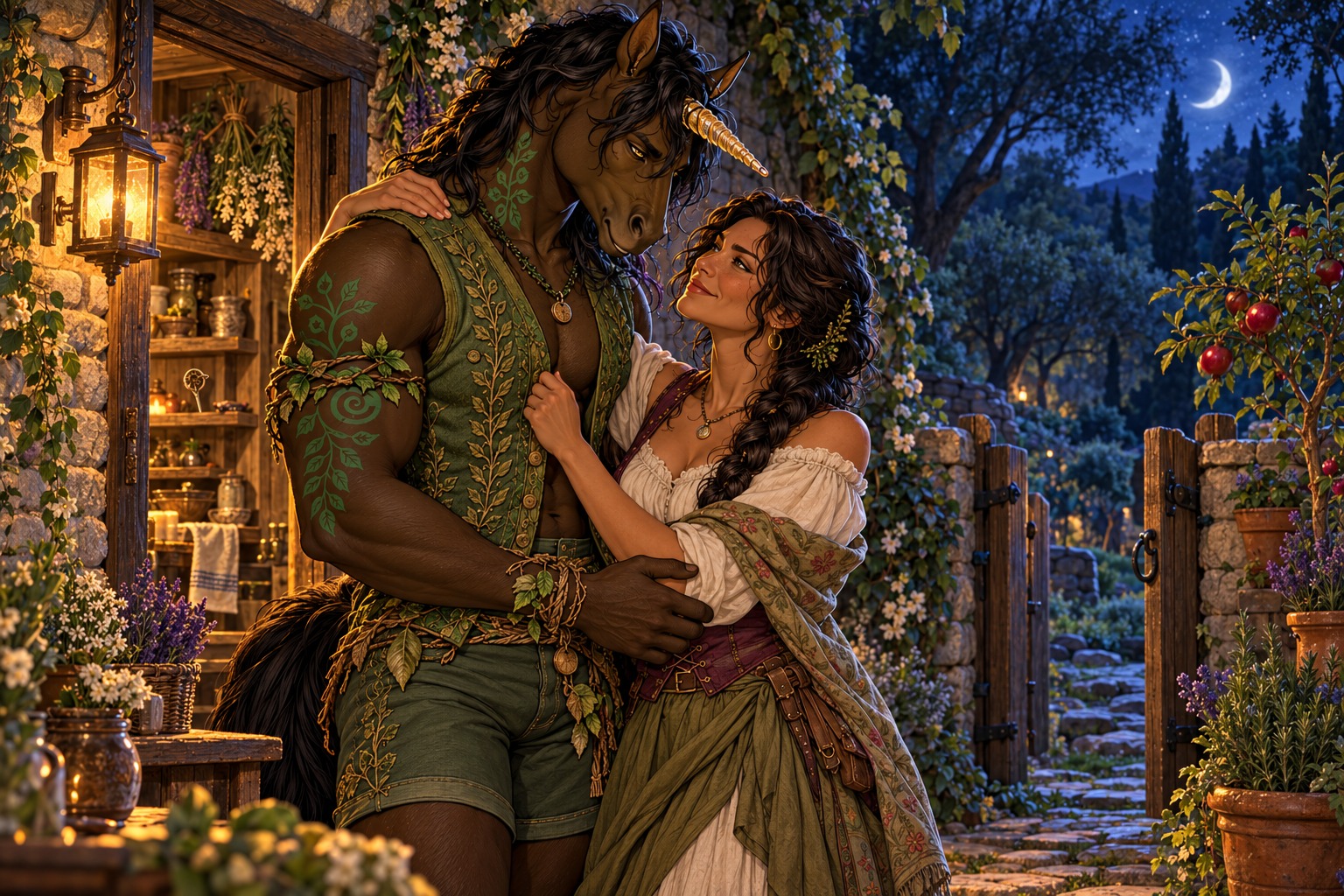
For the first time in a week, the well carried nothing darker than the reflection of the moon.
A Very Pure Vintage
A romantic toast meets an extremely inconvenient blessing.
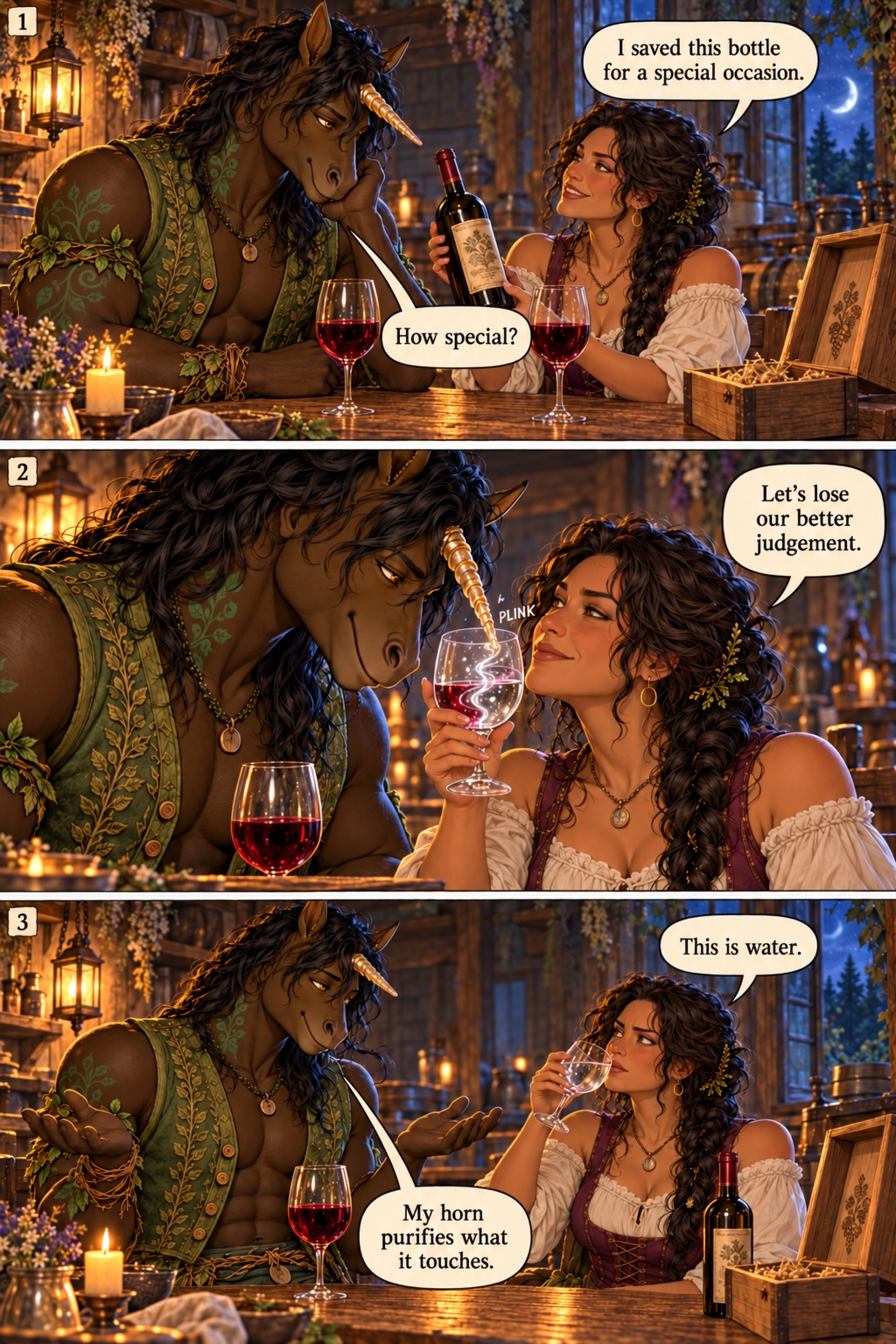
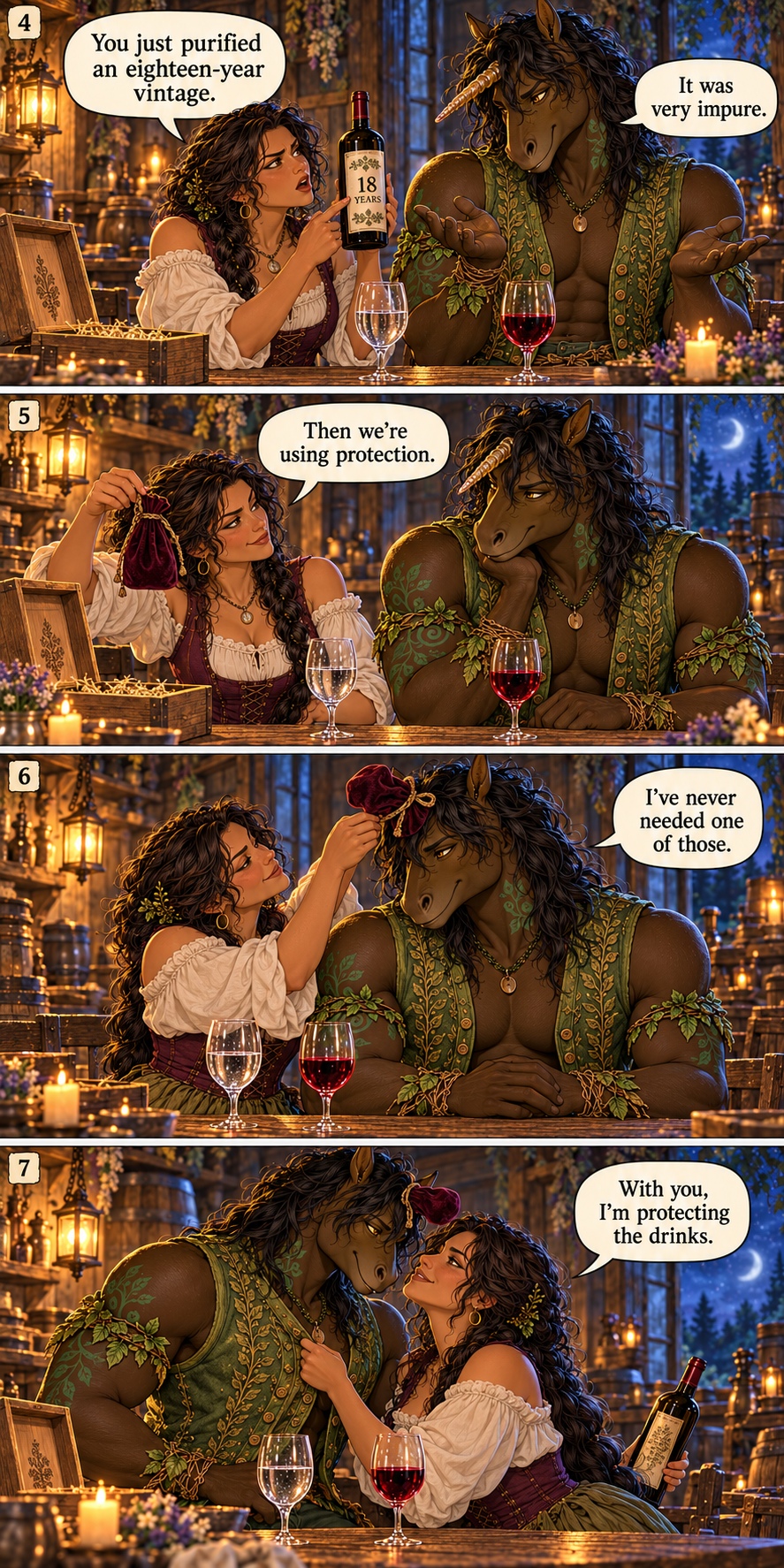
Read the comic transcript
Panel 1. Nessa: I saved this bottle for a special occasion. / Merrin: How special?
Panel 2. Nessa: Let's lose our better judgement. / PLINK
Panel 3. Nessa: This is water. / Merrin: My horn purifies what it touches.
Panel 4. On the wine label: 18 YEARS. / Nessa: You just purified an eighteen-year vintage. / Merrin: It was very impure.
Panel 5. Nessa: Then we're using protection.
Panel 6. Merrin: I've never needed one of those.
Panel 7. Nessa: With you, I'm protecting the drinks.
Built to Last
A lifetime guarantee meets an enthusiastic couple.
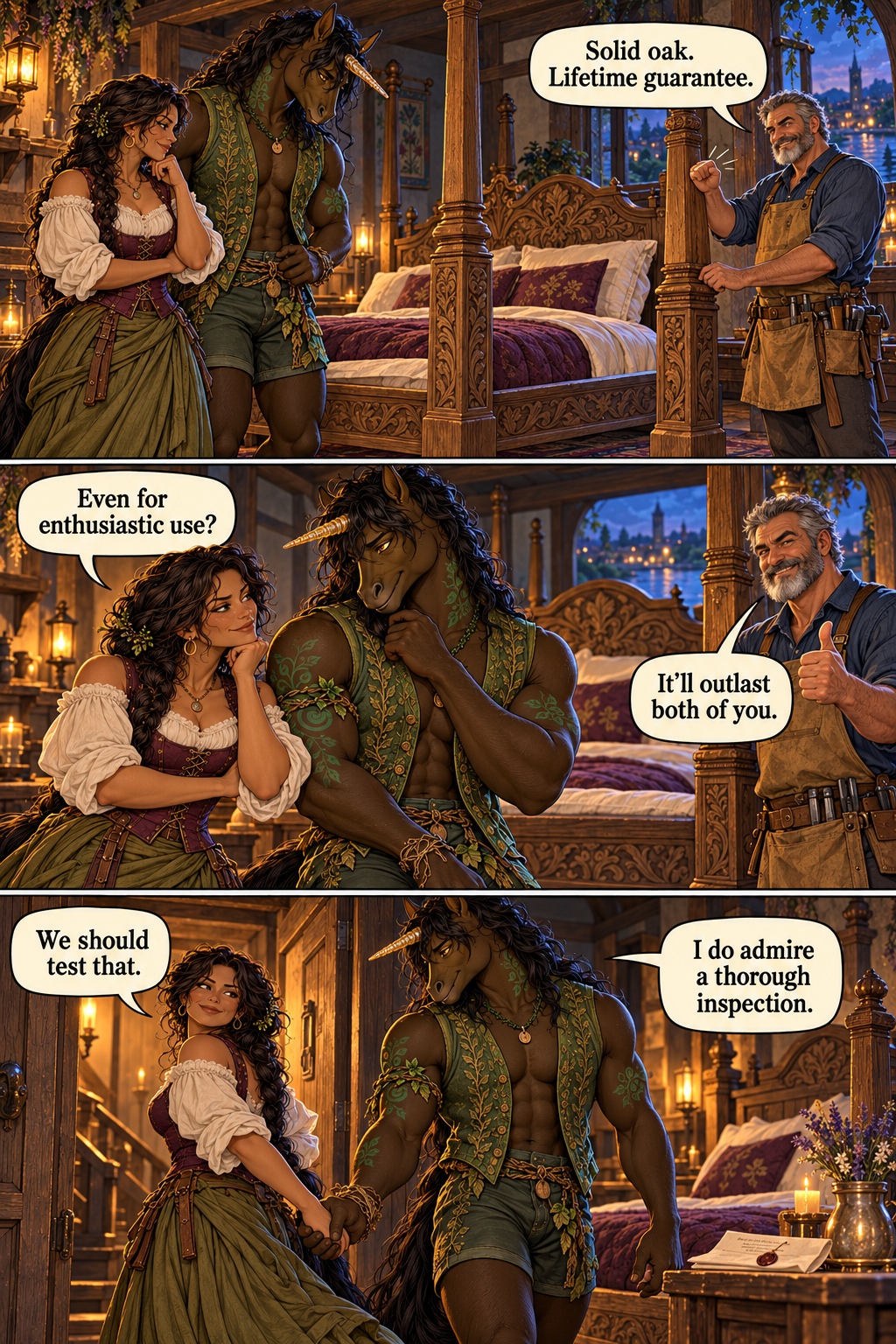
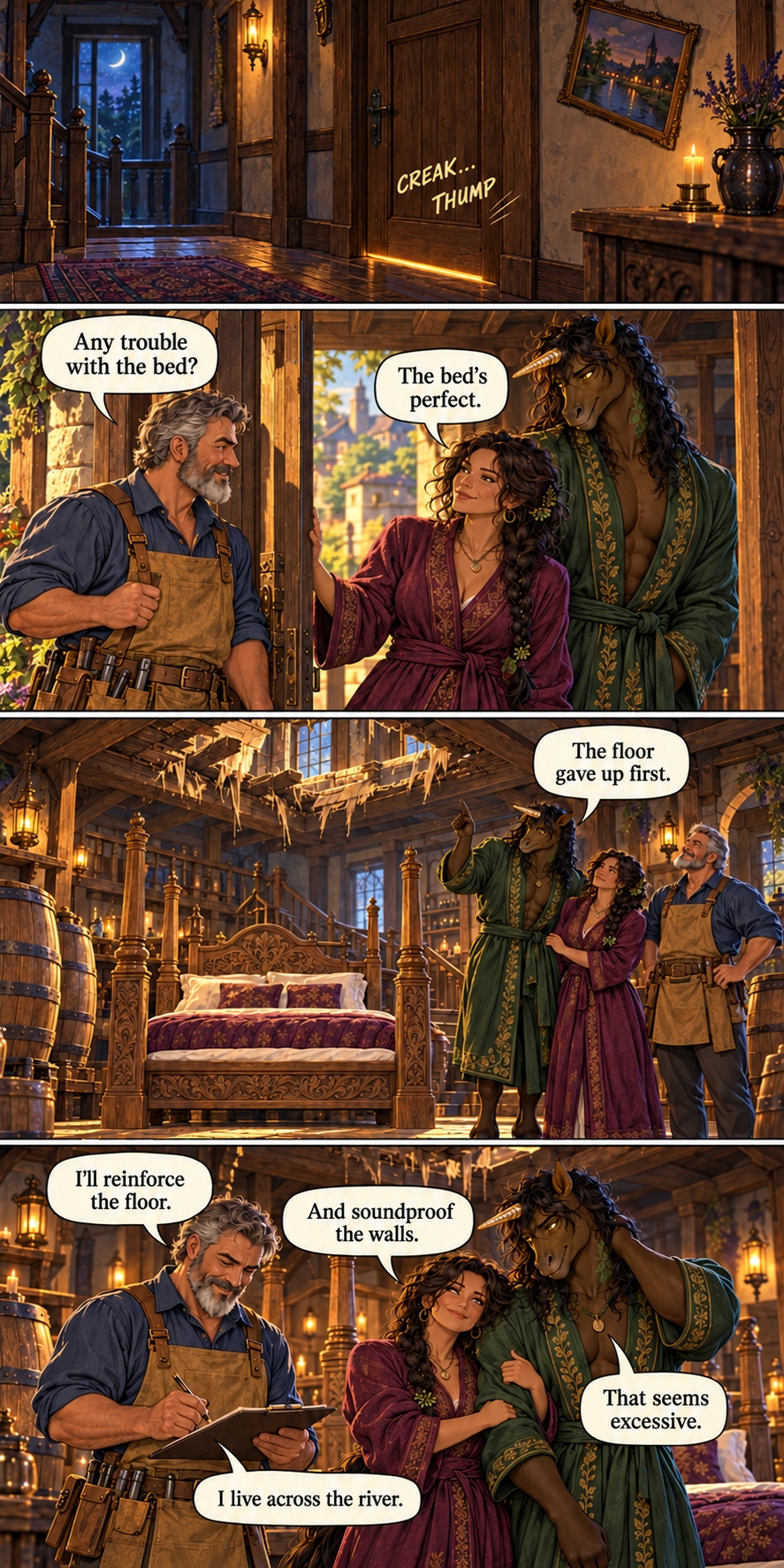
Read the comic transcript
Panel 1. Carpenter: Solid oak. Lifetime guarantee.
Panel 2. Nessa: Even for enthusiastic use? / Carpenter: It'll outlast both of you.
Panel 3. Nessa: We should test that. / Merrin: I do admire a thorough inspection.
Panel 4. Night falls outside their closed bedroom door. / CREAK… THUMP
Panel 5. Carpenter: Any trouble with the bed? / Nessa: The bed's perfect.
Panel 6. Merrin: The floor gave up first.
Panel 7. Carpenter: I'll reinforce the floor. / Nessa: And soundproof the walls. / Merrin: That seems excessive. / Carpenter: I live across the river.
Comedy in Motion
Scheduled on YouTube for Nov 20, 2026. The player becomes available after release.
Watch on YouTube
Scheduled on YouTube for Nov 22, 2026. The player becomes available after release.
Watch on YouTube
Curator’s Cabinet
For readers drawn to the unicorn's spiral horn and the woodland shape-shifter, Orwyn by Love Smiths brings that fantasy into a handcrafted adult silicone design.
For a botanical keepsake: a personalised birth-flower jewellery case from L’Atelier Époustouflant.
Affiliate disclosure: This page contains affiliate links. If you purchase through them, we may earn a commission at no extra cost to you. Recommendations remain separate from the fiction. Read our disclosure.
Roots of the Tale
The folklore context draws on documented European unicorn imagery and the separate Welsh transformation tale of Ceridwen and Gwion. Merrin, Nessa, the village, the cursed well, the buried horn and both comics are original Velvet Bestiary fiction. Illustrations are AI-assisted. The druid’s appearance and magic are imaginative choices, not a reconstruction of an ancient religious tradition.
Another encounter awaits: The Tattoo She Wouldn’t Hide · The Gnome Who Kept the Receipts.