The Gnome Who Kept the Receipts
The baron planned to sell the forest. Tansy stole his chair instead.
Gnomes in elemental philosophy, poetry and gardens
A gnome began its best-documented literary career as a being at home in earth. The red cap, the fishing rod, the suburban lawn and the tinker’s workbench come from other chapters of its history. A physician’s treatise, a satirical poem, an actual rock garden and a contemporary game’s character rules let us follow the word across four very different uses. Each preserves something the others leave out. [1] [2] [3] [4]
Contents of this guide
A gnome's underground home is older than the familiar image of a figure on a garden lawn. In the sixteenth-century elemental scheme associated with Paracelsus, gnomes belong to the earth, alongside beings of water, air and fire. His mountain people can move through rock as people move through air: a stone wall is not the boundary to them that it is to us.
Later traditions and artistic representations connect gnomes with precious metals, gemstones and concealed riches. Beneath that familiar association is an excellent story question: when a human announces that a piece of land is his, what do its older inhabitants think he has actually bought?
What a wall feels like to a gnome
Paracelsus asks his reader to begin with a fish. A fish can breathe and move in a stream where a person would drown. To the fish, our habit of living in the air might seem just as unlikely. Now imagine a third observer swimming straight through the rock under the stream. That is the mountain dweller’s relation to earth in his sixteenth-century account of elemental beings. The gnome does not have to dig quickly, find a tunnel or shrink to slip through a crack. Earth itself is passable. A wall is solid in relation to the body that meets it. Paracelsus, Their Abode
His treatise brings the mountain folk into a family of beings associated with water, air, earth and fire. Grouping them that way changes the sort of question you ask about them. What does a creature need around it in order to live? What landscape would seem unnatural to it? A miner and a mountain spirit could spend the day in the same mountain and have almost nothing in common to say about their morning commute. Even the title under which the work was translated uses pygmies for the earth people. Readers looking through old catalogues may have to look beyond the word gnome to find them. Johns Hopkins University Press, Four Treatises of Paracelsus
How the little fellow got a fishing rod
London’s Garden Museum has a terracotta gnome made around 1900, wearing a pointed red cap and posed to fish. His rod had already gone missing when he arrived at the museum. The catalogue places such ornaments in a nineteenth-century German manufacturing tradition and describes their arrival in British country-house gardens. Lamport Hall’s rockery helped make them fashionable. Compare the two homes. Paracelsus’s gnome has an entire mountain for a medium. The ceramic fisherman has a place assigned to him by the person who buys him. Someone can pick him up, move him to a pond and decide that he looks more at home there. Tansy might have quite a bit to say about who owns the fishing rights. Garden Museum, Fishing Gnome
Why earth counts as a place to live
Paracelsus was a sixteenth-century physician and writer. His treatise on nymphs, sylphs, pygmies and salamanders sorts beings by the element in which each lives. The familiar modern list can obscure his starting question. Human beings carry their own sense of what makes a substance solid, breathable or impassable. Why should a different order of embodied being experience matter the same way? His treatment of the earth people offers a sustained answer. Ground that resists our hands can serve another creature as its ordinary environment. [1] [5]
The result is stranger than a miner who knows a secret tunnel. A miner has to excavate a void before occupying a seam of rock. The elemental has its natural dwelling there already. Paracelsus also asks where such beings stand in relation to human nature and salvation. His Christian account of creation belongs to the history of the term as much as the underground address does. Reading the gnome exclusively as a treasure guardian selects one attractive possibility from a much broader argument about what sorts of life creation might contain. [5] [1]
The gnome who visits the Cave of Spleen
Alexander Pope explains in the dedicatory letter to The Rape of the Lock that his poem uses a scheme of elemental spirits familiar to him through Le Comte de Gabalis. He assigns spirits to temperaments with the freedom of a satirist. In canto 4 a gnome named Umbriel descends to the Cave of Spleen after a young woman’s lock of hair has been cut at a fashionable gathering. “Spleen” in this setting involves disturbed moods and ill humour. The route underground takes the reader from an injury felt in public to an extravagant picture of distress. [2] [6]
Umbriel goes equipped for a commission and returns carrying emotional effects that can be released among the company. The contrast of scale is the joke: an otherworldly journey, complete with a presiding power and extraordinary gifts, helps turn a drawing-room quarrel into a catastrophe. This gnome has a name, a motive and an elaborate assignment. He owes little to the cheery lawn figure except the suitability of a low, shadowy route. His career is a reminder that the word had entered literature as something other than a description of a little man’s hat. [6]
What a nineteenth-century visitor saw at Lamport
At Lamport Hall in Northamptonshire, Sir Charles Isham arranged imported figures from Nuremberg in an alpine rockery. The county’s historic environment record describes them as though mining the caves and crevices. Their position was essential to the illusion. A visitor could look into a fissure and glimpse what appeared to be an inhabitant at work. A free-standing ceramic figure on a flat lawn preserves the little worker but removes the imitation mountain that once explained what he was doing there. [3]
This is unusually good evidence for how an image travelled. There is a named owner, a garden, a period and a place from which the objects were imported. There is no need to claim that all later garden gnomes descend from one surviving figurine. For comparison, the Garden Museum’s fishing gnome gives us a different occupation that one can identify immediately from its pose and equipment. A visitor can work backwards from a figure’s tools to the little world its owner meant it to inhabit. [3] [7]
When the gnome becomes a player character
The 2024 Dungeons & Dragons rules distinguish forest gnomes and rock gnomes. Forest gnomes have access to minor illusion and communication with animals. Rock gnomes use magic to make small clockwork devices. Either can leave home and build a life with companions of other backgrounds. The rules supply starting resources for a player, so the entry answers questions the other sources barely ask: what can this person do on the first day of an adventure, and which talents might matter to the group? [4]
Compare what a human observer must do to see each gnome. Paracelsus’s reader has to rethink the solidity of a wall. A reader of Pope follows a particular spirit into a cave of moods. The visitor at Lamport bends down to see figures brought from Germany. The player makes a choice on a character sheet. Keeping the settings attached to these images gives the gnome more history than a single stock description of an underground artisan. [1] [2] [3] [4]
The tale that follows is original fiction drawing on those ideas. Tansy, her inventions and her particular approach to treasure are our own additions, not a recovered folktale.
Read the historical roots: Paracelsus’s account of the earth-dwellers · WMODA on gnomes and elemental traditions.
Sources and further reading
- Paracelsus, A Book on Nymphs, second tract, on the elementals' dwellings
- Alexander Pope, The Rape of the Lock, dedication and complete poem, University of Virginia
- Northamptonshire Historic Environment Record, Lamport Hall Rockery
- Wizards of the Coast, Gnome, 2024 character rules
- Johns Hopkins University Press, Four Treatises of Theophrastus von Hohenheim Called Paracelsus
- Alexander Pope, The Rape of the Lock, canto 4
- Garden Museum, Fishing Gnome, collection record
The Gnome Who Kept the Receipts
The baron announced that he would sell the forest at noon.
At eleven, Tansy Flint stole his chair.
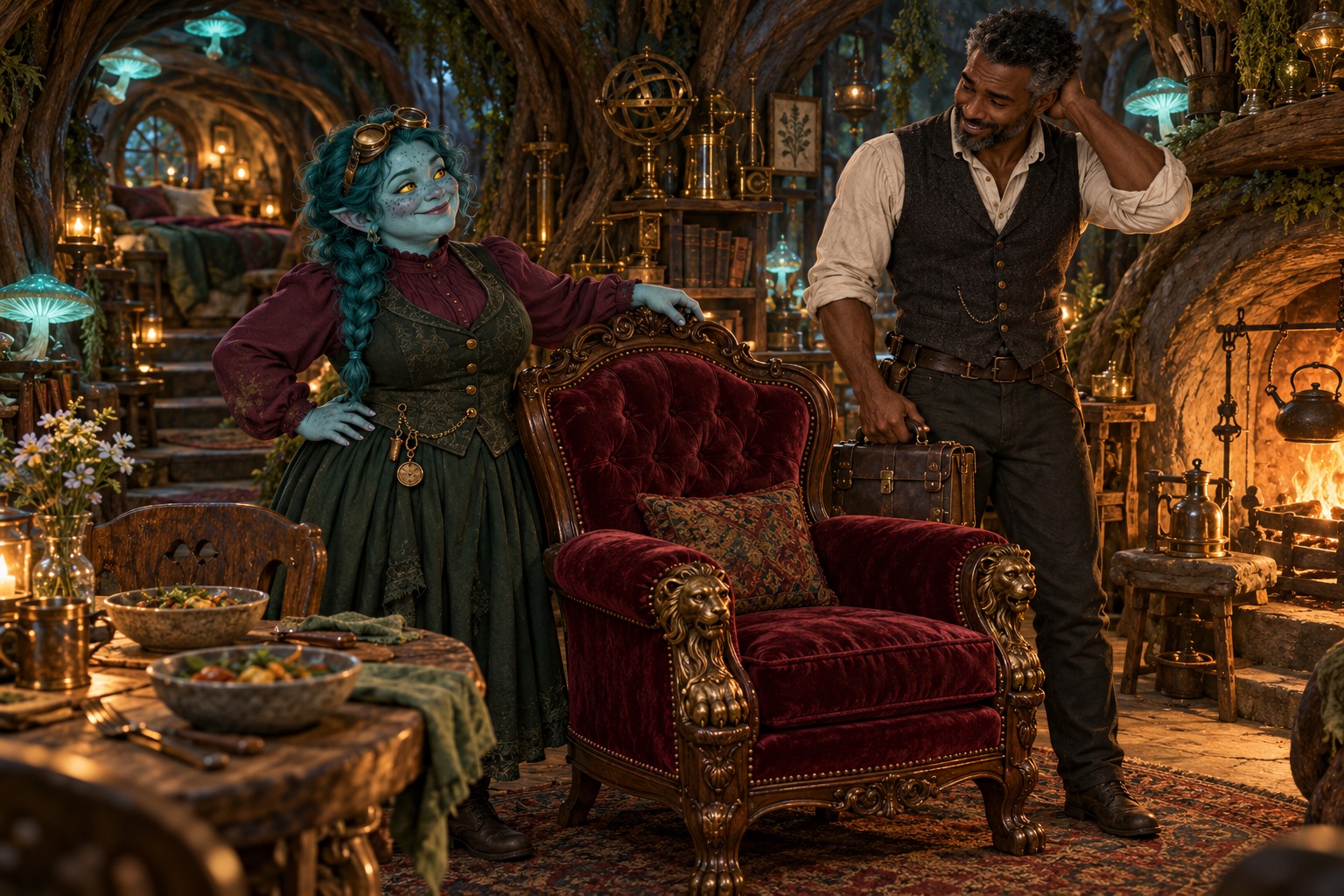
It was a handsome chair: walnut, burgundy velvet, two lions at the arms and a seat worn glossy by forty years of somebody being pleased with himself. Getting it through three locked doors would have troubled an ordinary thief. Tansy carried it straight through the cellar wall.
Oren was waiting in her burrow when she returned.
He looked at the chair. Then at the soil in her hair.
"Please tell me that is a commission."
"An intervention."
She set it beside the hearth. Lamplight caught the blue-green freckles along her cheek. Her goggles were crooked, one sleeve had torn at the elbow, and she wore the expression that had persuaded Oren into several excellent evenings and two very expensive misunderstandings.
"We agreed," he said, "to supper."
"We still have twelve minutes."
She turned the chair upside down.
Beneath the seat, between the rear legs, lay a brass plate no larger than a playing card. Its keyhole was almost invisible.
Oren knelt. His expression changed.
He knew that lock. He had made it.
"The baron said this was for family papers."
"And you believed him?"
"I build locks, Tansy. I cannot interrogate every drawer."
She crouched beside him, her shoulder touching his arm.
"No," she said. "But you can open this one."
He did not reach for his tools immediately.
For three weeks the baron's agents had nailed notices to cottage doors. The village, they said, had failed to pay its forest dues. Timber rights, grazing rights and the old coppice would therefore be sold. Several families had already packed their possessions into carts.
Tansy had listened to them arguing above her kitchen ceiling. She had also watched the baron enter his cellar every evening, sit down very carefully, and count something that never appeared in the public accounts.
"I saw him put the books in here," she said. "Two of them. Same year."
Oren looked down at his maker's mark.
Then he opened his case.
The first ledger contained debts.
The second contained payments.
The names were the same.
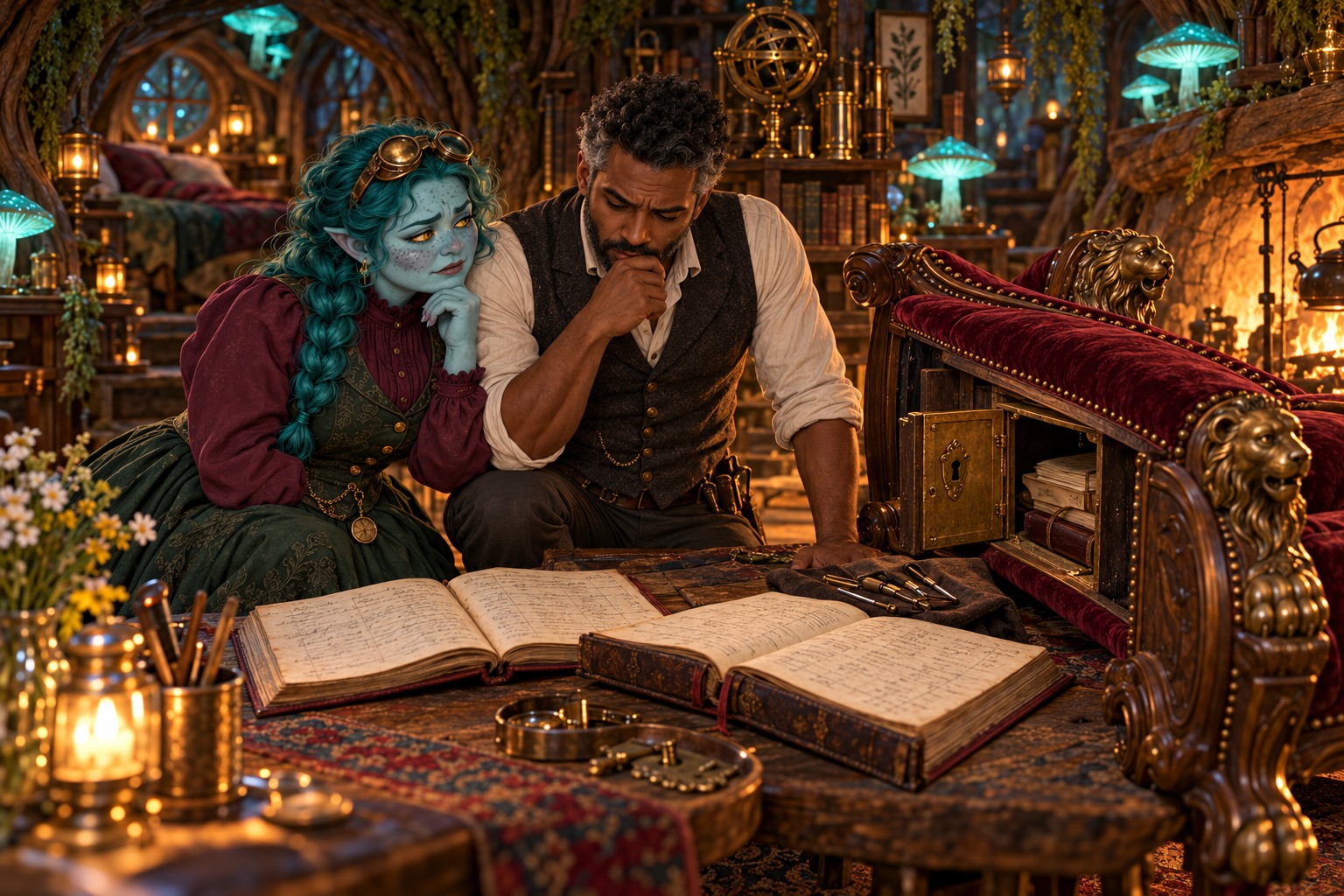
For a moment neither of them spoke. Water ticked through the roots outside. Above them, somewhere beyond the warm earth, the auction bell began to ring.
Oren turned a page. Beside each payment stood the baron's signature.
"You could have brought me these last night."
"I did not have them last night."
"You had suspicions."
Tansy looked away.
"I knew you made his locks."
That hurt more than he expected. He set his pick on the table rather than let her see how tightly he was holding it.
"You thought I would protect him?"
"I thought he could pay you more than I could."
Oren closed the second ledger.
"You have never once paid me on time."
She gave a startled, unwilling laugh.
"And yet," he said, "I keep coming back."
Outside, the auctioneer called for attention.
Oren tucked both books beneath his arm.
"Come on."
The baron saw his chair first.
Two villagers carried it into the clearing, following a gnome with muddy boots and a locksmith who looked unusually disinclined to be polite.
"That," the baron said, "is my property."
"Then you will recognise the compartment," Oren replied.
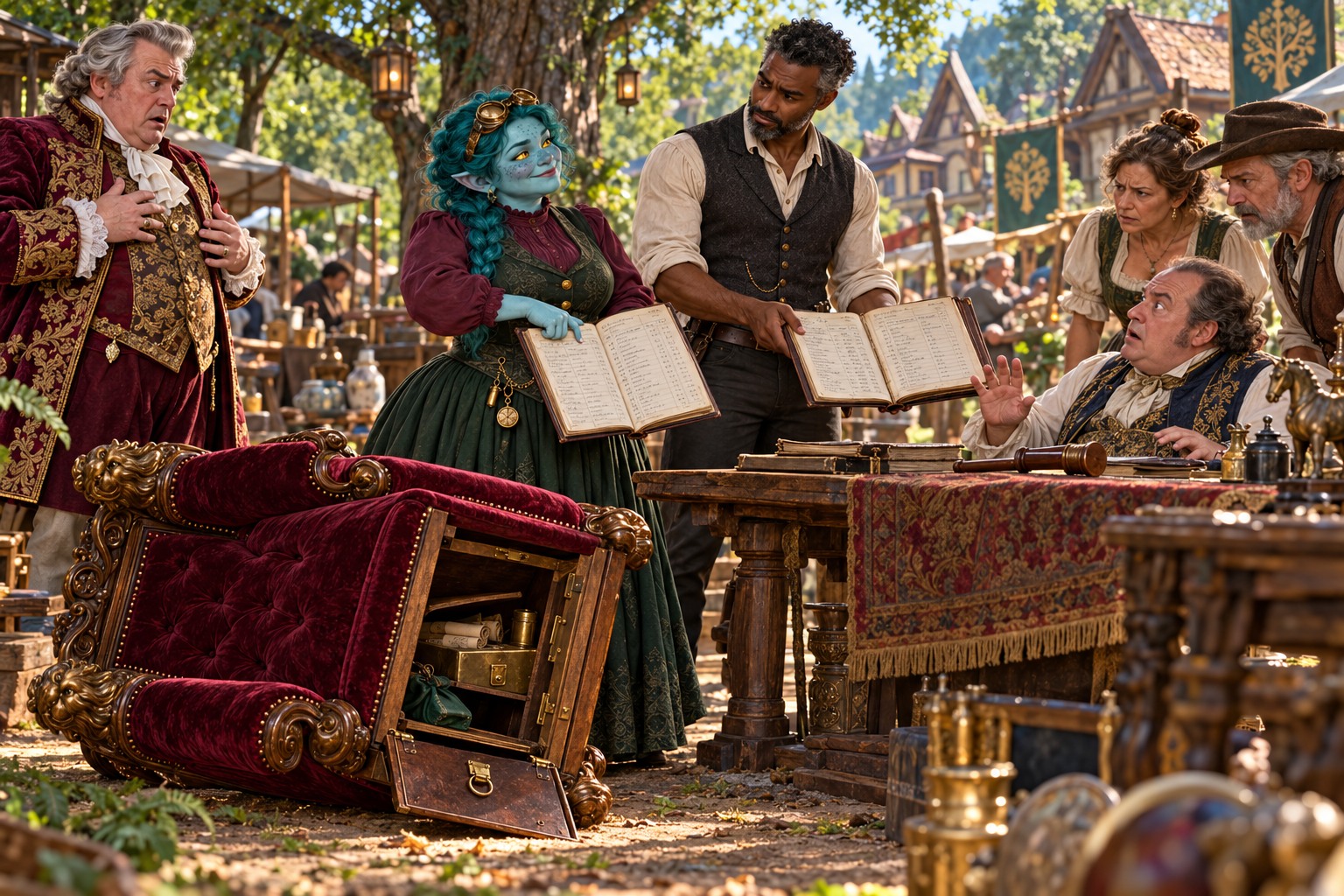
He set the chair on its back before the auction table. Tansy lifted the brass plate. Oren laid the two ledgers beside it, open at matching names.
The auctioneer stopped smiling.
"My private accounts," the baron said.
"Your neighbours' payments," said Tansy.
A miller stepped forward. He recognised the date on which he had sold his horse to settle his dues. A woman beside him found her own name, then her sister's. The auctioneer read the entries twice and put down his hammer.
Nobody bought the forest that day.
By supper, the town magistrate had both books. By nightfall, the baron had discovered how little enthusiasm people have for carrying your furniture when you have stolen their winter money.
He had to fetch the chair himself.
Tansy watched him drag it up the path from her doorway.
"You could have kept it," Oren said.
"Look at those lions. Dreadful taste."
She took his hand before he could answer.
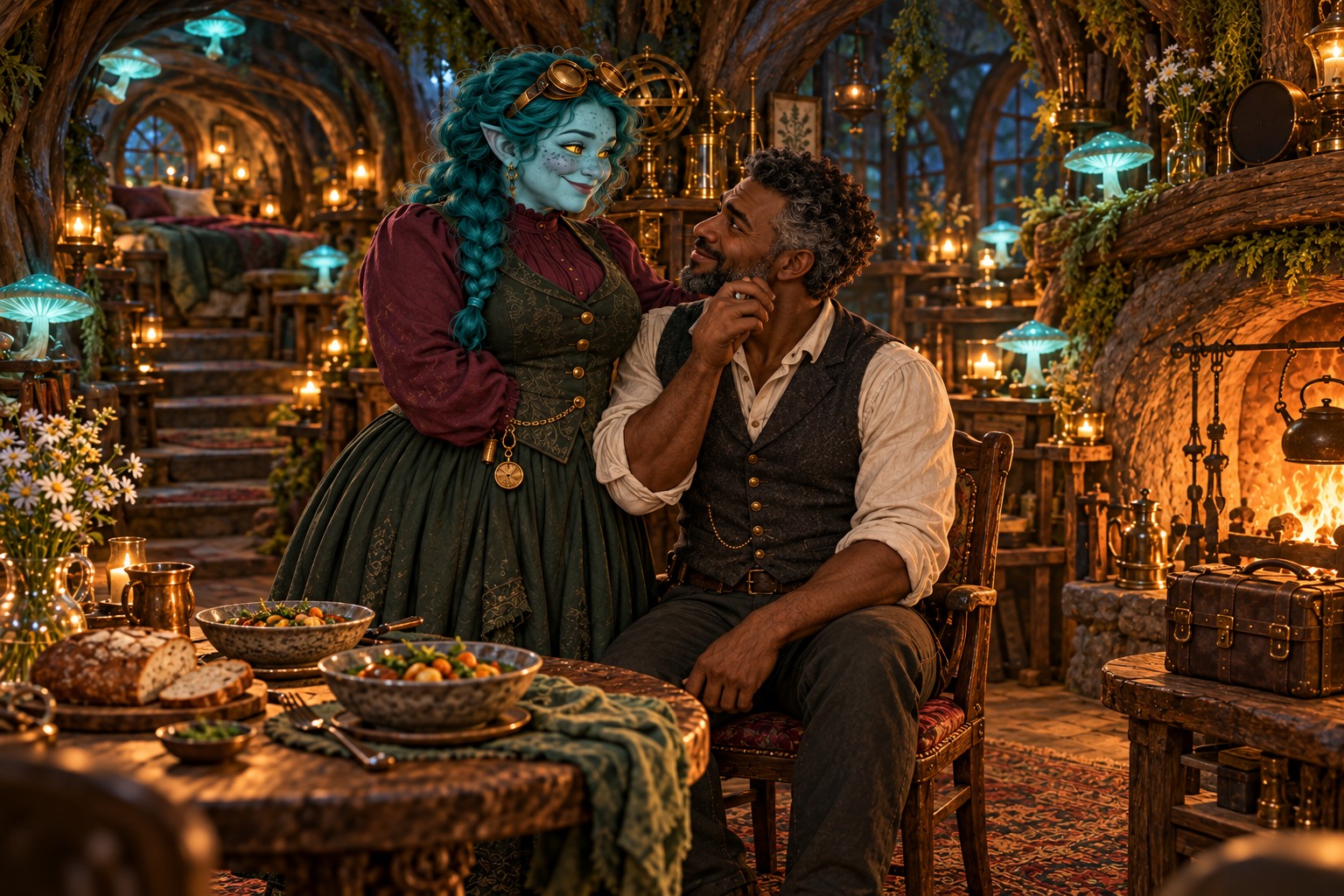
Inside, the supper had survived with only minor damage. She reheated the soup. He mended the sleeve she had torn. For once, neither pretended those small acts were anything other than affection.
When he finished, she caught his wrist and brought his palm to her cheek.
"I should have trusted you."
"Yes."
She accepted that without a joke.
Then she stepped closer. He bent to meet her, and the kiss was familiar enough to quiet the last of his anger. Her fingers stayed curled in his waistcoat after they parted.
"I would like an evening," she said, "in which I am not competing with a baron, a ledger or a malfunctioning hinge."
Oren took the small clock from the mantel and turned its face to the wall.
"Send the hinges away."
Tansy smiled.
She had collected things for longer than the village had possessed a name. That evening, when he stayed, she did not think of it as acquiring anything. She put two bowls on the table.
The Truth Lamp
Two people, one useful invention and absolutely nowhere to hide a little white lie.
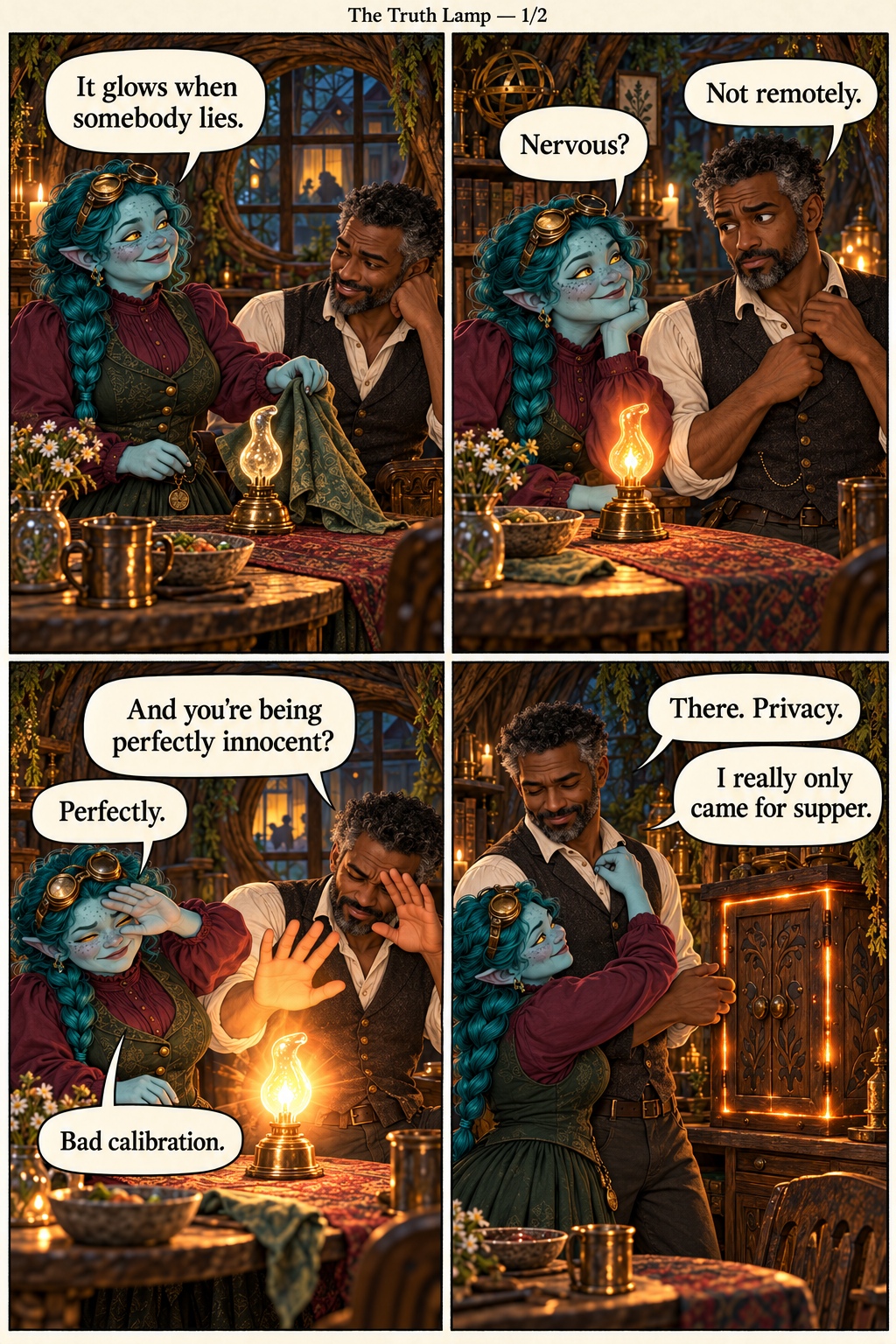
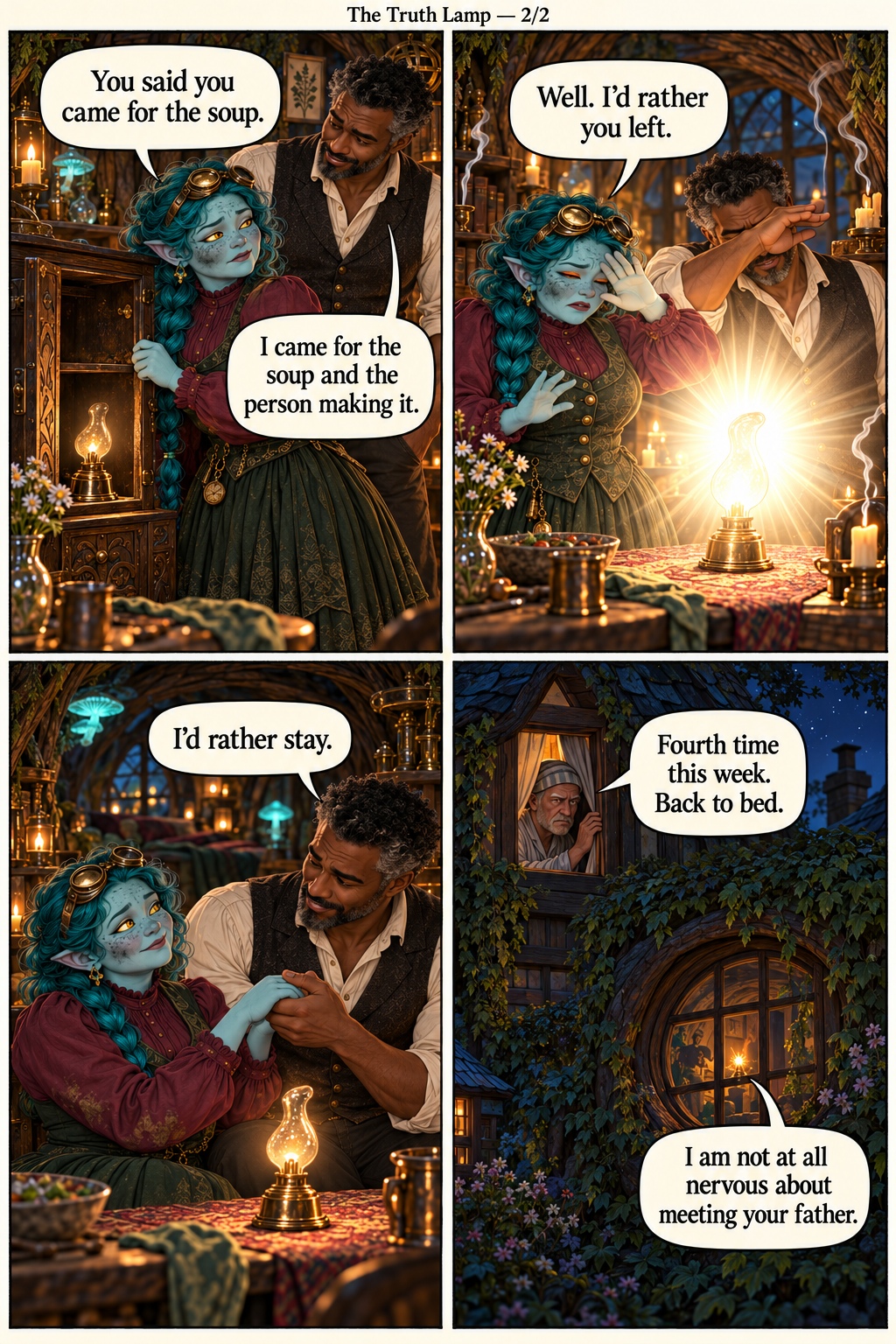
Read the comic transcript
Panel 1. Tansy: It glows when somebody lies.
Panel 2. Tansy: Nervous? / Oren: Not remotely.
Panel 3. Oren: And you're being perfectly innocent? / Tansy: Perfectly. / Tansy: Bad calibration.
Panel 4. Oren: There. Privacy. / Oren: I really only came for supper.
Panel 5. Tansy: You said you came for the soup. / Oren: I came for the soup and the person making it.
Panel 6. Tansy: Well. I'd rather you left.
Panel 7. Oren: I'd rather stay.
Panel 8. Neighbour: Fourth time this week. Back to bed. / Oren, from inside: I am not at all nervous about meeting your father.
Family Resemblance
A garden ornament is a dreadful stereotype. Until somebody clears his throat.
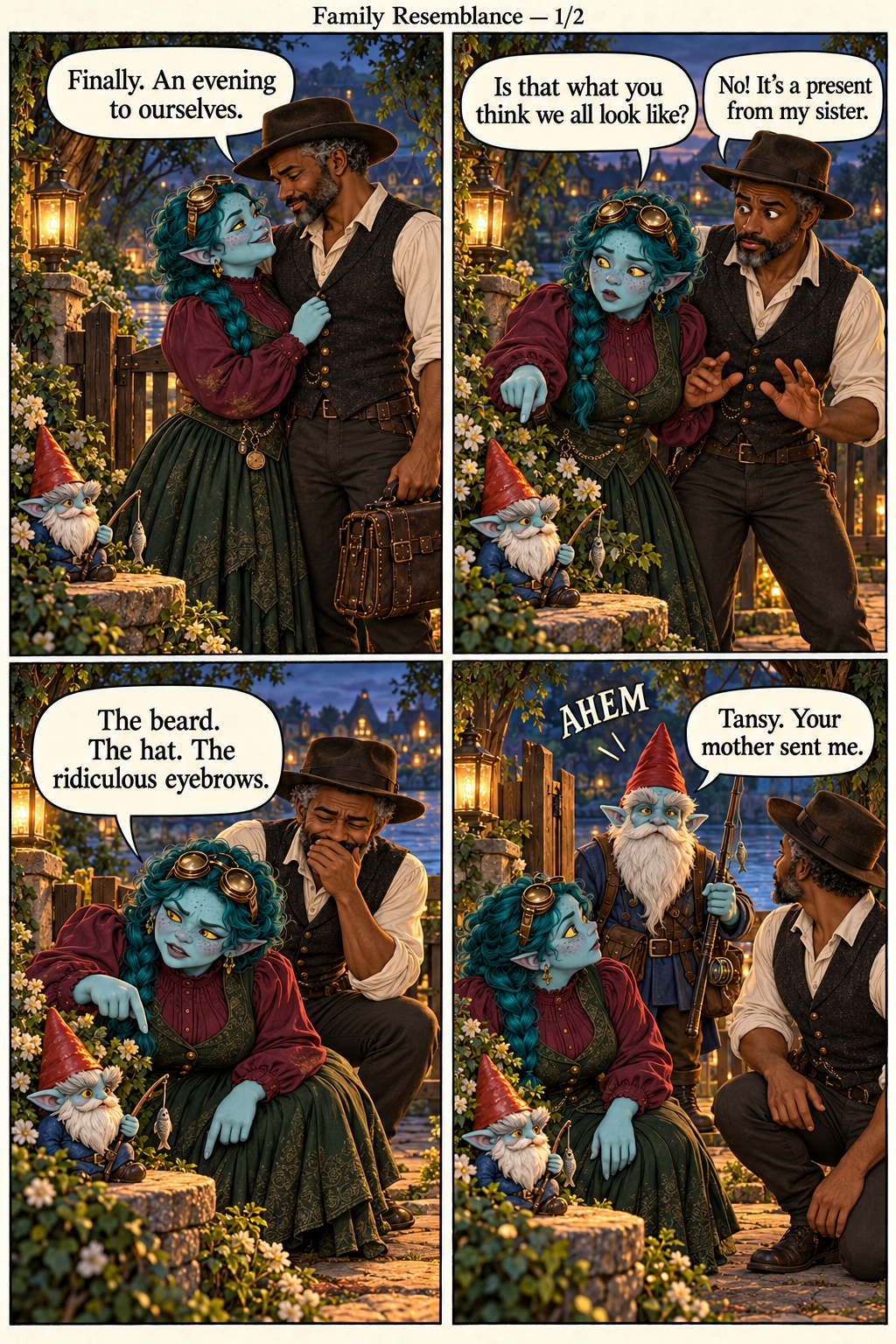
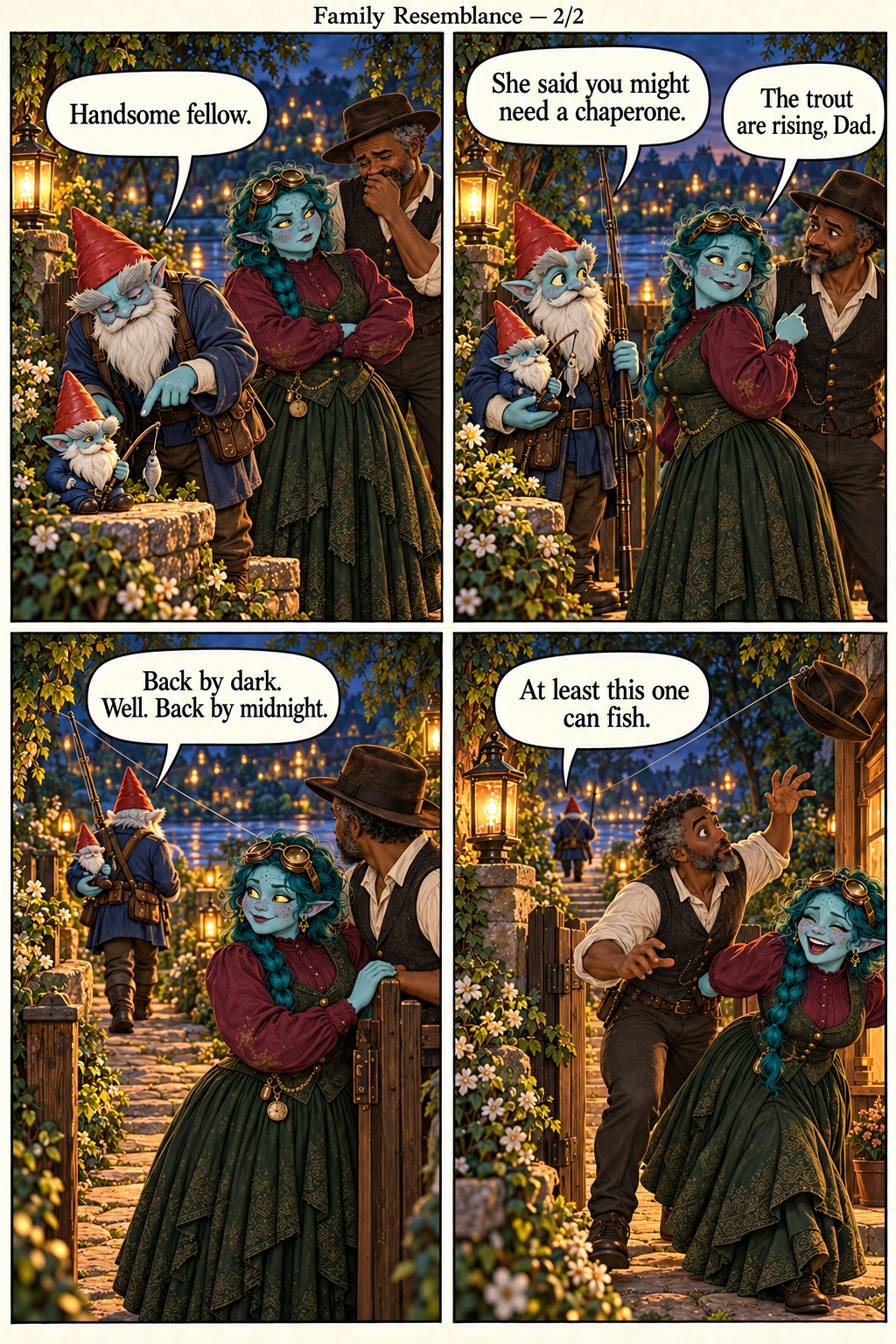
Read the comic transcript
Panel 1. Oren: Finally. An evening to ourselves.
Panel 2. Tansy: Is that what you think we all look like? / Oren: No! It's a present from my sister.
Panel 3. Tansy: The beard. The hat. The ridiculous eyebrows.
Panel 4. Father: Tansy. Your mother sent me.
Panel 5. Father: Handsome fellow.
Panel 6. Father: She said you might need a chaperone. / Tansy: The trout are rising, Dad.
Panel 7. Father: Back by dark. Well. Back by midnight.
Panel 8. Father, off-panel: At least this one can fish.
Comedy in Motion
Scheduled on YouTube for Nov 6, 2026. The player becomes available after release.
Watch on YouTube
Scheduled on YouTube for Nov 8, 2026. The player becomes available after release.
Watch on YouTube
Curator’s Cabinet
For readers drawn to burrow-dwelling mischief, mushroom textures and a little creature-inspired indulgence, this adult design takes the gnome theme beyond the page.
For treasures of a smaller, everyday sort, L’Atelier Époustouflant’s personalised birth-flower jewellery box offers a place for your own keepsakes.
Affiliate disclosure: This page contains affiliate links. If you purchase through them, we may earn a commission at no extra cost to you. Recommendations remain separate from the fiction. Read our disclosure.
Roots of the Tale
- Paracelsus, A Book on Nymphs, Sylphs, Pygmies and Salamanders, Tractatus II — an online transcription of his account of the four elemental dwelling places, including the earth-dwellers’ movement through stone.
- WMODA, The Elementals — the Earth section discusses gnomes, treasure and their interpretation in decorative arts.
Tansy Flint, Oren Pike, Garrick, their setting, the truth lamp and these events are original Velvet Bestiary fiction. The story and comics are not historical accounts of gnome customs. Illustrations are AI-assisted.
Another encounter awaits: The Orc Who Would Not Kneel · The Dungeon Without Locks.
Leave a Reply