The Starwright’s Closed Hand
The city had built a religion around his sacrifice. She brought tools.

The Protoss in StarCraft and the invention of the Starwright
The Protoss are a spacefaring people in Blizzard’s StarCraft, first released in 1998. Aiur is their homeworld. Their distinctive abilities include psionics, the use of the mind as an active force, and technologies built around extraordinary stores of energy. A Starwright is an occupation invented for our tale. For this subject the earliest useful evidence is a game and its manual. Later campaigns, fiction and the developers’ own accounts show how its imagined civilisation changed. [1] [2] [3]
Contents of this guide
StarCraft's Protoss bring together two kinds of power: a sophisticated interstellar civilisation and formidable psionic abilities. Their warriors wield psi-blades, while their technology and psychic strength make them something more unsettling than humans with better weapons. They are a people whose minds are part of how they encounter and influence the world.
They are also physically unlike us. Protoss have no mouths and communicate telepathically. The original StarCraft manual describes this communication as central to the early communal life of their civilisation on Aiur. A conversation need not cross the air to feel intimate, and an expression need not contain a human smile to be understood.
That does not mean every Protoss shares one permanent, universal hive mind. The Khala belongs to a particular tradition and history. In Legacy of the Void, Amon exploits that shared psionic connection to dominate the Aiur Protoss. The struggle to free them gives the setting a question worth carrying into a different story: how much of a person can a civilisation demand in the name of its own survival?
What the Protoss disagree about
Who counts the cost of building a star fleet? Blizzard’s Children of the Void takes that question to Shakuras, home of the Nerazim. Resources there have gone into a fleet intended to reclaim Aiur, the lost home of their Aiur allies. An industrial accident has killed twenty-seven. In the excerpt, Vorazun remembers a funeral Artanis failed to attend and safety measures the leadership has yet to take. Both sides can speak of a Protoss future and mean something different by it. For a reader meeting a telepathic civilisation for the first time, the unshared experience of grief is a good place to begin. Blizzard, Children of the Void
Inside a vessel built to carry a civilisation
The Spear of Adun in Legacy of the Void is an ancient ark ship. The campaign lets the player learn its society by walking between jobs. On the bridge, a celestial display can be used to choose a destination. At the War Council, Rohana, a preserver, advises on the forces being assembled. In the solar core, the phasesmith Karax helps direct power into particular ship systems. A machine vast enough to serve a whole people still needs someone who knows its parts and someone who can advise on the consequences of a decision. Blizzard, Legacy of the Void campaign preview
These are unusually traceable origins for a Bestiary subject. We have the publisher’s fiction, game manual and campaign descriptions, each answering a different question about an authored world. The short story shows what it costs to give an order. The campaign lets a player make one. In Orison we narrowed that scale to a single worker. Tharuun’s hand has been keeping a city aloft long enough for its citizens to grow up taking the miracle for granted. The word Starwright names his calling here. Blizzard’s account of the setting and its history
Who are the Protoss among the three peoples?
The original game sets the Protoss alongside the human Terrans and the Zerg. One way to tell their stories apart is to ask how an individual relates to a larger whole. The Zerg Overmind seeks to absorb the Protoss into the Swarm. The Protoss have their own ways of sharing thought and organising collective action, and the difference between voluntary association and imposed control becomes decisive. The original conflict reaches Aiur itself. A reader who begins with the later effort to reclaim the planet is seeing the consequence of a defeat in the first game. [3] [1]
The campaign puts a society’s disagreements into the player’s hands. Tassadar comes into conflict with the Protoss leadership over his dealings with the Dark Templar. The use of their power becomes vital to defeating the Overmind. By the end, the destruction of the enemy does not undo the loss of the homeworld. For the people who survive, victory and displacement can be true at the same time. This is the history behind later arguments over resources, refuge and a return to Aiur. [1] [3]
What the Khala connects and what it leaves open
The Khala is a shared psionic bond associated with the Protoss of Aiur. Other Protoss, particularly the Nerazim or Dark Templar, have lived outside it. That distinction explains why calling the entire people a single mind produces such a poor description of the dialogue in the games. Communities can maintain different memories and obligations even while their members possess extraordinary powers of communication. A leader still has to persuade people whose forebears made another choice. [2] [4]
In Legacy of the Void, Amon exploits the Khala to exert control. Severing the physical nerve cords that sustain the connection is a possibility with consequences for identity and grief as well as survival. To a people who grew up with a shared mental life, safety can come at the price of suddenly being alone with one’s own thoughts. To someone from a community that has long refused the link, its absence has a different history. These contrasting positions are part of the plot. Telepathy supplies the problem as often as it supplies the solution. [3] [4]
Can a Protoss personality survive its body?
The Purifier material takes up another problem of continuity. Blizzard’s account of the cooperative commander Fenix describes a stored artificial personality able to occupy different combat suits. Other champions in this part of the game can transfer into compatible units. If a champion falls and a suitable body is available, the player can see the personality return. The model separates three things science fiction often bundles together: a remembered person, the intelligence operating now and the replaceable machine the player sees. [5]
This source has a particular status. It is a design preview explaining what a player will do in cooperative mode. It gives direct evidence for a mechanic and for the developers’ intention to dramatise transferable consciousness. A short story spoken from Vorazun’s perspective supplies something else: what a death means to someone expected to represent the people who mourn. A campaign briefing can tell us why an ark ship needs warriors. A grieving character can tell us what it costs to build the fleet in the first place. [5] [4] [6]
What belongs to the Starwright?
In our story the public sees a task being performed and mistakes that continuity for a guarantee that its worker can perform it forever. Tharuun’s hand and the floating city of Orison give that question physical form. A reader tracing the influences can take two different routes back through the sources. Follow the manual and campaign to understand how a psionic civilisation operates. Follow the fiction of Shakuras to see how people within such a civilisation disagree about whom their technology serves. Tharuun’s office and his responsibility for the city begin with the Velvet Bestiary. [2] [4]
The tale below is original science fantasy inspired by that meeting of psychic power, advanced technology and individual duty. Tharuun, Delia Sorn and Orison are our own creations, not characters or places from StarCraft.
Explore the source material: Blizzard’s Protoss unit spotlight · the original StarCraft manual · Creative Development Q&A, Part 12 · the StarCraft story primer.
Sources and further reading
- Blizzard, The Story of StarCraft, from the 1998 game through Wings of Liberty
- Blizzard, original StarCraft manual, 1998, preserved PDF of the printed guide
- Blizzard, StarCraft Story Primer, campaign chronology
- Blizzard, Children of the Void, Vorazun's account of Shakuras
- Blizzard, Patch 3.13 preview, Purifier personalities and Fenix
- Blizzard, Legacy of the Void campaign preview, systems aboard the Spear of Adun
The Starwright’s Closed Hand
On the morning Orison unveiled a statue of his left hand, Tharuun could no longer feel two of its fingers.
The statue was thirty feet high. Children had hung flowers around its wrist. The inscription called him tireless.
Delia Sorn stood beneath it with a tool case and swore.
She found him in the suspension chamber, seated among blue threads of light. A removable graphite-and-copper gauntlet enclosed his left wrist. From its forward edge, a blade of blue psionic light reached beyond his clenched knuckles. The gauntlet focused his own power; it did not replace the alien hand beneath it.
From that point, the threads ran into the walls and out towards the floating terraces of the city.
He had held their failing anchors together for eighty-three years.
He could take the gauntlet off. But not while it carried the city's load.
He could move within the chamber. He could sleep, briefly, while the old resonators maintained his pattern. But if he left the circuit, or opened that hand, the machines could no longer keep the terraces steady. They had been patched around his particular resonance. No other Starwright could simply sit down and take his place.
He had once been promised repairs within a season.
Delia stopped beside his chair. His mouthless face turned towards her, and a familiar greeting reached her without crossing the room.
"They have made you very handsome," she said.
"A generous use of public money."
She set down her case. "I asked for replacement bearings. They gave you cheekbones."
His free hand reached for her. She stepped into it, kissed his brow, and stayed close enough to feel the tremor he was trying to hide.
"How long?" she asked.
He looked at the two unresponsive fingers.
"Since last night."
For six months Delia had been repairing the original anchor towers. Not shrines, whatever their custodians called them: machines. Their crystal seats had cracked. Their counterweights had seized. Each old repair had been designed to preserve his connection rather than replace it.
Orison had become very good at maintaining him. It had forgotten how to repair what made him necessary.
Nine towers now worked. The tenth would be ready that evening.
The council had scheduled the transfer for spring.
"No," she said.
He knew which decision she meant.
"The eastern terrace holds a hospital."
"I know what it holds. I designed the test loads."
Beyond the window, laundry stirred above a gulf of cloud. A woman watered flowers on a balcony whose foundations she had never needed to consider.
"If I am wrong—"
"Then we restore the circuit. One tower at a time. As we rehearsed."
Delia took his free hand and put it against her cheek.
"You don't have to trust a ceremony. Trust the work."
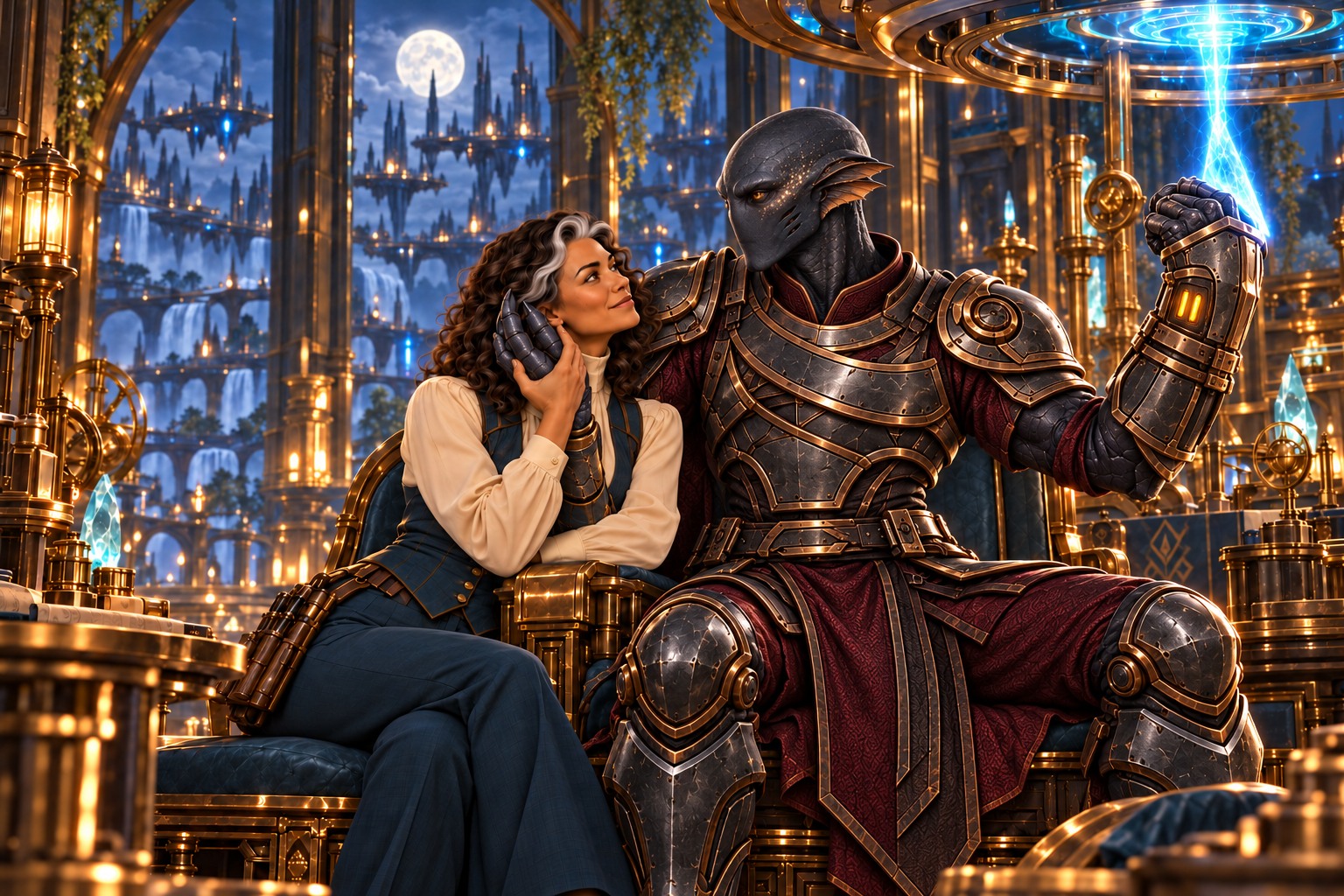
At dusk, the city gathered to light candles around its new monument.
Delia's crews gathered beside ten much older machines.
She stood in the suspension chamber when the first tower answered. A needle rose into its marked band. The corresponding thread of blue light slackened.
The glare around Tharuun's wrist eased.
The second tower took its load. Then the third.
At the seventh, a tremor rattled dust from the ceiling. His fist tightened.
"Wait," Delia said.
The counterweight descended through its last span. The needle steadied. A voice in her receiver confirmed the clearance.
She nodded. "Now."
By the ninth tower he was shaking hard enough that she knelt beside his chair. His right hand gripped her shoulder. She held his left wrist below the luminous junction, where the skin was still safe to touch.
The tenth crew called in.
Nothing moved.
Outside, the candle-lighting bell began to ring.
Delia raised her receiver. "Report."
The reply came through a storm of hammering. A temporary locking pin would not clear its housing under load. They needed the terrace lifted a fraction.
Tharuun heard it.
"I can do that."
He stood. Blue light filled the chamber. Along his clenched palm, old skin split, and a dark line ran over his wrist.
Delia stayed on the channel, counting the clearance aloud. She did not tell him to be brave. She gave him the measurements he needed.
Across Orison, a hammer rang once, then twice.
"Clear!"
The final counterweight dropped into motion.
Ten needles held steady.
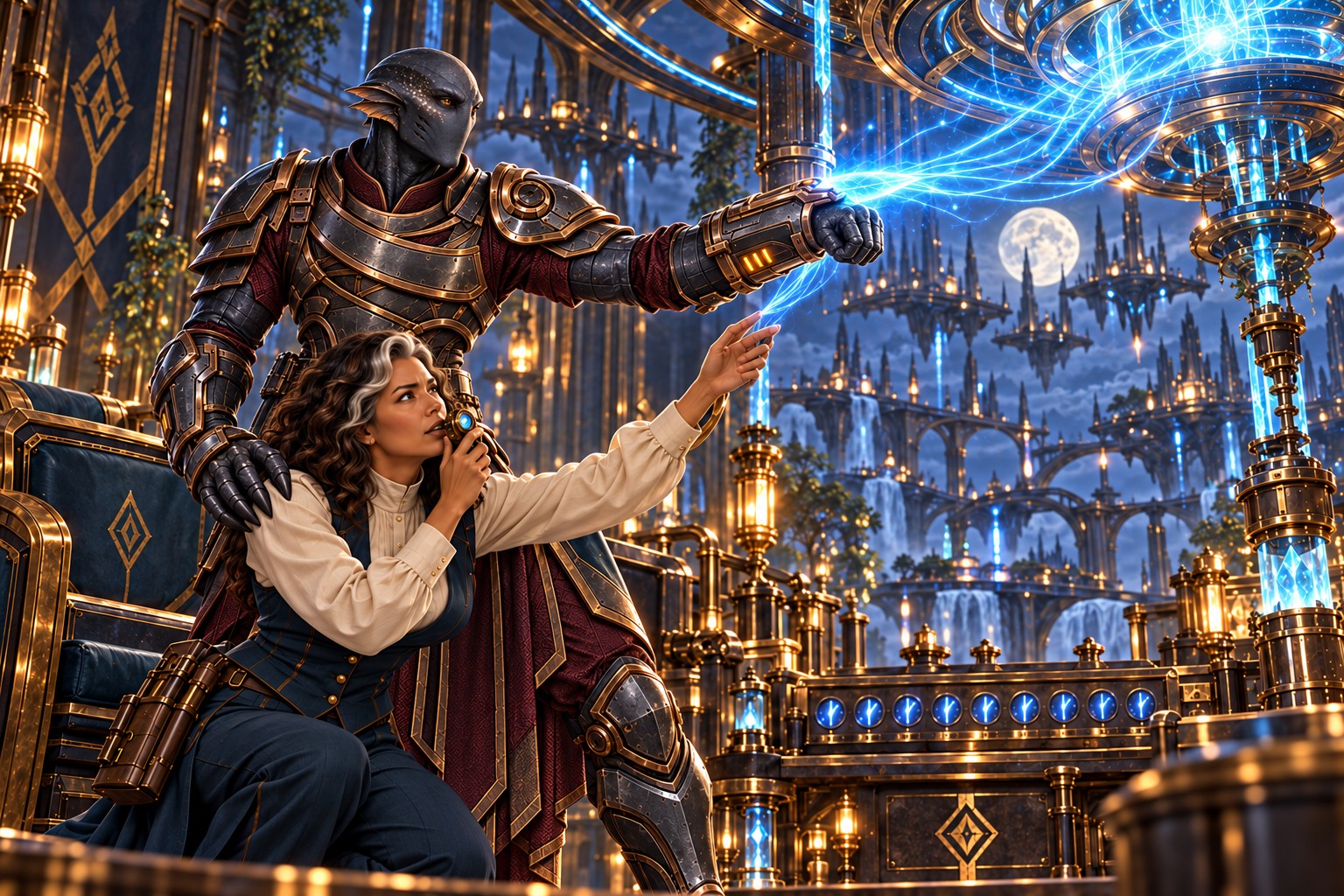
The blue blade at the gauntlet's edge shortened. The threads loosened and withdrew.
Tharuun's fingers opened.
For a moment he stared at the hand as though he had forgotten what else it could be for. Then his knees gave way, and Delia helped him into the chair.
Outside, nothing fell. Someone continued ringing the bell.
She released the gauntlet's wrist catches and eased it off. His own hand lay bare in hers: three long fingers and a heavy thumb, still trembling.
She cleaned his palm with a cloth from her case. He flinched when she worked near the smallest finger.
"Sorry."
"You have wanted to say that for months."
She laughed, unexpectedly close to tears.
Later, after the crews had checked the towers again, she took him to her apartment. He stopped in the doorway. He had seen its window for six years. He had never been inside.
Delia hung up her coat. She set the gauntlet beside the ridiculous brass bird on the shelf. "No speeches. There are leftovers."
He looked past her at a room full of things he knew only from her descriptions: the blue chair, the crooked shelf, the ridiculous brass bird she refused to throw away. She had cleared a place opposite her own chair, though she had not expected him to be able to come.
"You kept a place for me."
"I was becoming very tired of looking at an empty chair."
He reached for her with his uninjured hand. She turned into it willingly.
His palm settled at her waist. She undid the heavy clasp at his collar, placed it on the table, and kissed the skin it had covered. When she looked up, the grave composure of Orison's celebrated guardian had deserted him completely.
"I had imagined," she said, "that you would be more patient."
His answer touched her thoughts, warm and unmistakably amused.
"I have been patient for eighty-three years."
"Only six of those involved me."
"By far the most difficult six."
Delia drew him away from the doorway. He followed, bringing his bandaged hand carefully between them.
Above her roof, the terraces held their places against the night.
For the first time in eighty-three years, the city kept itself.
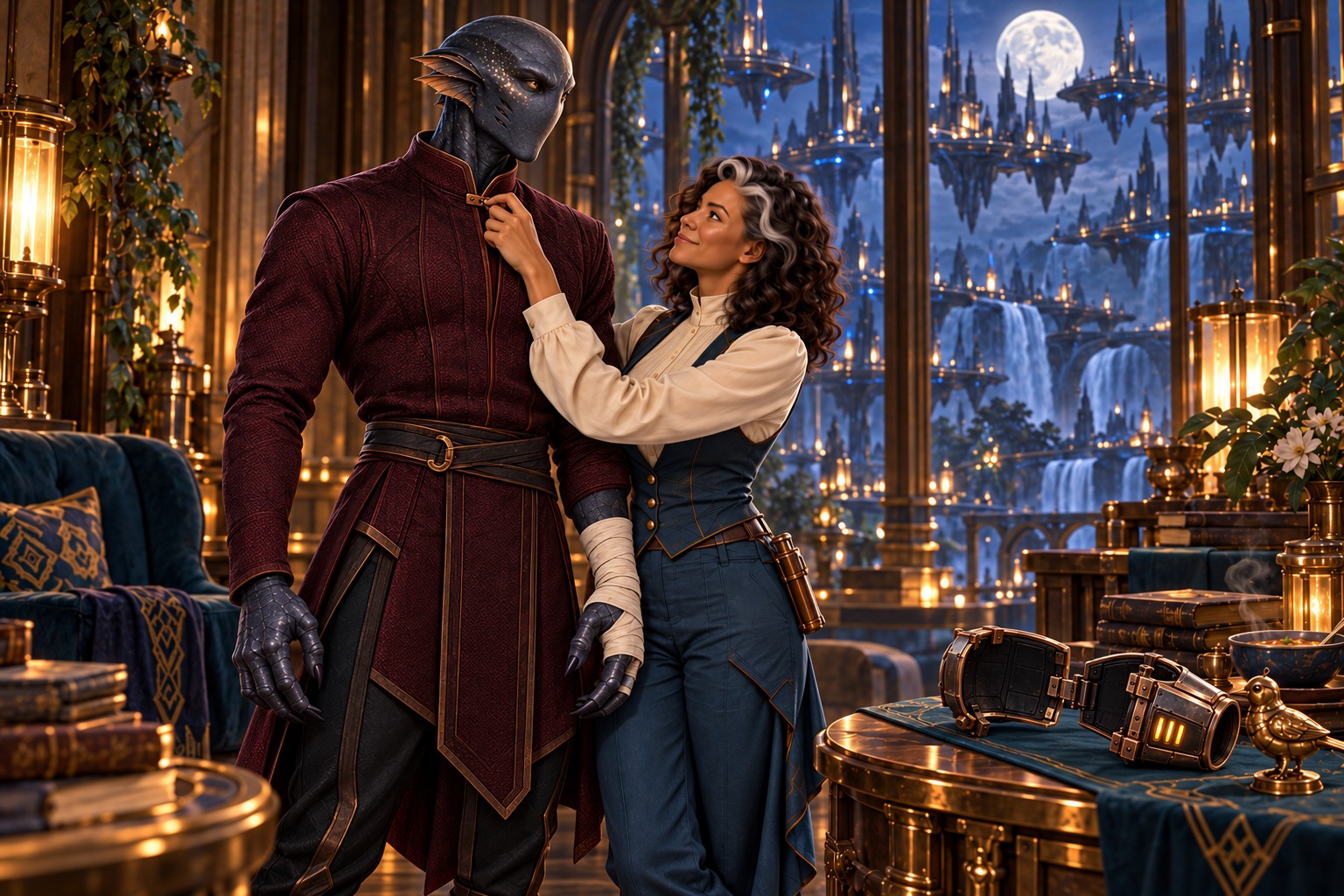
Good Vibrations
An engineering demonstration. A perfectly reasonable follow-up question.

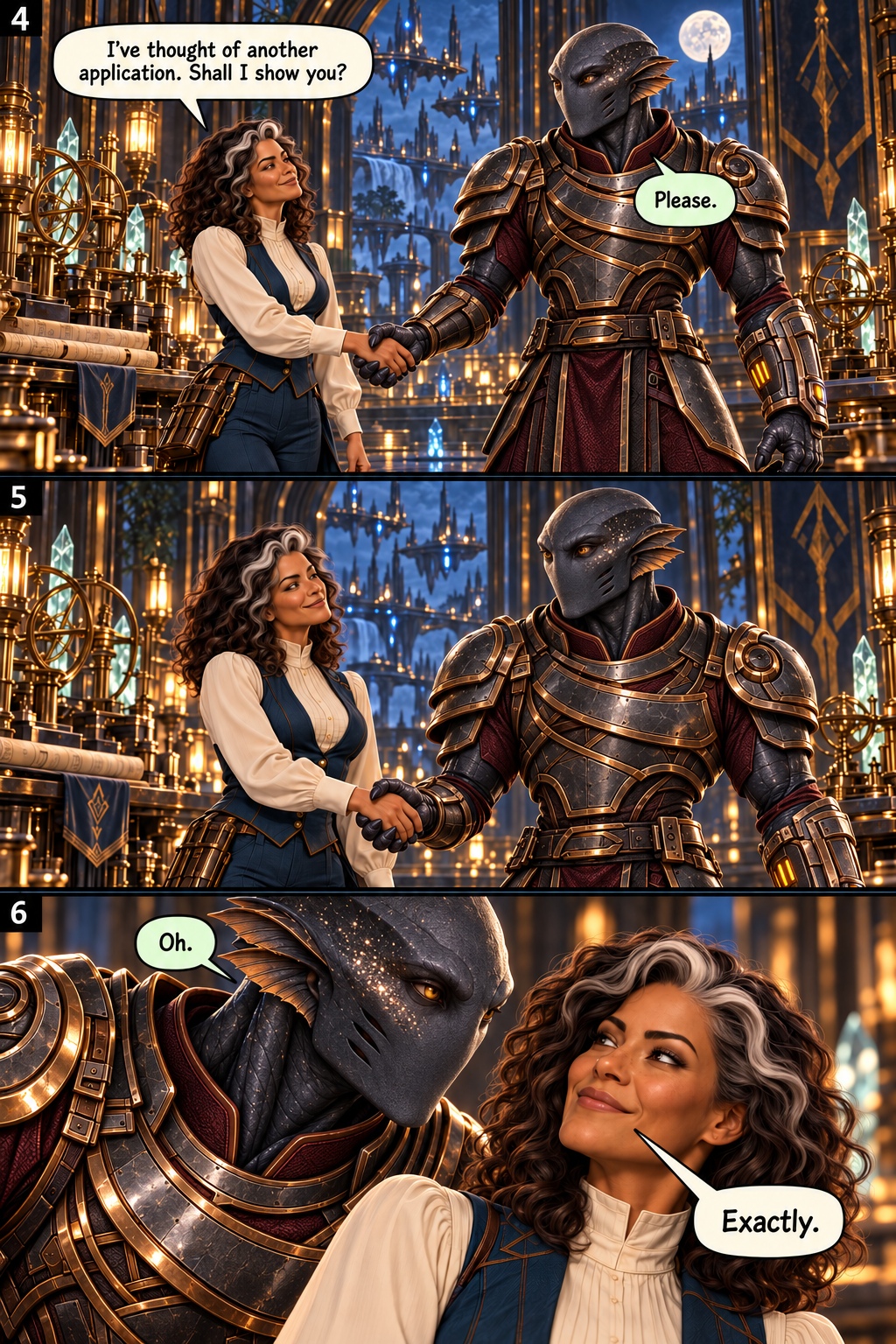
Read the comic transcript
Panel 1. Delia: So what can that famous gauntlet actually do?
Panel 2. Tharuun: Precisely controlled vibration.
Panel 3. Delia: Can you keep that up? / Tharuun: For hours.
Panel 4. Delia: I’ve thought of another application. Shall I show you? / Tharuun: Please.
Panel 5. A private thought, an interrupted hum and a sudden understanding.
Panel 6. Tharuun: Oh. / Delia: Exactly.
Glorious Victory
Even the most dignified warriors occasionally need a discreet appointment.


Read the comic transcript
Panel 1. Tharuun: I need you to adjust something. / Armourer: More power? / Delia: Absolutely not.
Panel 2. Armourer: Then what’s the problem? / Tharuun: The victory announcement.
Panel 3. Gauntlet announcement: ANOTHER GLORIOUS VICTORY! / Delia: Does the whole building have to know?
Panel 4. Armourer: Ah. Domestic use.
Panel 5. Armourer: We can suppress the battle cry. And the ceremonial fanfare. / Delia: There’s a fanfare?
Panel 6. Tharuun: You’ve had this request before?
Panel 7. Armourer: You’re the first to bring a witness. / The waiting room is full of solemn warriors with removed gauntlets. None has brought a partner.
Comedy in Motion
Scheduled on YouTube for Nov 10, 2026. The player becomes available after release.
Watch on YouTube
Scheduled on YouTube for Nov 12, 2026. The player becomes available after release.
Watch on YouTube
Curator’s Cabinet
For readers drawn to the Starwright’s otherworldly aesthetic, Galactic Fist by Love Smiths carries the luminous alien-hand theme beyond the page.
For the workbench: a personalised photo-or-logo mug from L’Atelier Époustouflant.
Affiliate disclosure: This page contains affiliate links. If you purchase through them, we may earn a commission at no extra cost to you. Recommendations remain separate from the fiction. Read our disclosure.
Roots of the Tale
The lore above draws on Blizzard’s published StarCraft material. Tharuun, Delia Sorn, Orison, the Starwright profession, his gauntlet and these comic events are original Velvet Bestiary inventions, not StarCraft canon. Illustrations are AI-assisted.
Another encounter awaits: The Gnome Who Kept the Receipts · The Orc Who Would Not Kneel.
Leave a Reply