The Goblin Queen: The Dungeon Without Locks
Ancient legends, dangerous hospitality, and a queen who knows that longing is more profitable than gold.
Goblins, hobgoblins and the literary goblin queen
A goblin can be the spirit who interferes with the churning, one of the merchants who set up a fruit market in a glen, or a subject of a subterranean kingdom. Those are three different encounters in English-language storytelling. The word stayed useful while authors changed the creature’s size, company, habits and means of making a living. For a goblin queen with a recognisable court, George MacDonald’s nineteenth-century children’s novel offers a much closer comparison than a list of presumed fairy monarchs. [1] [2] [3]
Contents of this guide
The goblin has not always been the green, treasure-hoarding creature of modern fantasy.
In the traditions Thomas Keightley collected in The Fairy Mythology, English hobgoblins and Robin Goodfellow are household spirits of uncertain temper. They perform work, accept food, upset domestic routines and mislead travellers. Help and harm can belong to the same being, and hospitality may carry expectations of its own. These accounts describe varied traditions, not one universal goblin species or an established Goblin Queen.
A fairy with the run of the house
The household spirit moves through spaces a stranger ought never to reach. In the English material gathered by Thomas Keightley, Robin Goodfellow and the hobgoblin turn up around work left to be done at night. One memorable image is the great drudge who does the work of several people in exchange for cream. Another is the misleading light that draws a night traveller off the path. The person grateful for a clean floor in the morning and the traveller stranded in the dark might have quite different opinions of the same helper. Keightley gathered earlier writing as well as stories. His collection gives us several voices, including poets remembering what country people said. Keightley, The Fairy Mythology, England
A closer literary ancestor is Christina Rossetti’s Goblin Market (1862). Its goblin merchants sell fruit so sweet that one taste ruins every other taste. Laura pays with a lock of her hair, then wastes away craving what she can no longer have, until her sister Lizzie risks everything to save her. The poem’s horror is that the trap never looks like one. The cost appears only after the appetite has set in.
The bargain Lizzie refuses
Listen first to Rossetti’s sellers. They come down the glen calling their wares, rather like traders who need to be heard before they can be seen. When the sisters look, they see a crowd of unlike bodies. There is a cat face, a rat-like figure and one that goes at its business like a snail. What makes them a company is the cry they share. After Laura has eaten, one of the cruellest changes is that Lizzie can still hear the call and her sister cannot. The market is open within earshot of a customer it has already ruined. Christina Rossetti, Goblin Market
Laura saves a fruit stone and tries to grow it. Nothing comes up. Lizzie tries another ordinary transaction, offering a penny to buy something she can take home. The sellers demand that she eat with them. When she keeps her mouth closed, they crush the fruit against her and fling the money back. The juice she carries home on her skin becomes the one thing she could never have obtained by agreeing to their terms. Veyra’s luxuriant court takes its cue from that precise moment when a guest discovers that a host will accept only one kind of yes. Rossetti, Lizzie’s visit to the glen
How a household recognises a hobgoblin
Listen to the questions a fairy asks Robin Goodfellow in A Midsummer Night’s Dream. She recognises him by his work: frightening village girls, getting into the dairy, thwarting a woman at the churn, spoiling drink and leading travellers astray. She also knows that those who give him pleasing names receive help. It is a remarkably practical introduction to a spirit. A person who has never seen him might already know both the cost of offending him and the possible benefit of being on good terms. [1]
Robin supplies his own examples, including taking the form of a stool that slips away just as an elderly storyteller sits down. Later work for Oberon makes him part of a fairy court, with orders to carry out and opportunities to misunderstand them. In a single stage role Shakespeare connects two scales of activity: a very local reputation for spoiling an evening and service to a ruler whose quarrel has disturbed the seasons. The label hobgoblin tells the audience something about Robin. It does not establish that every goblin answers to the same king. [1]
What do Rossetti’s goblins actually look like?
In Christina Rossetti’s Goblin Market, the merchants can be recognised by movement and sound as well as by individual animal features. One resembles a cat, another goes at a rat’s pace, one crawls like a snail. Their voices invite customers to inspect a bewildering abundance of fruit. Laura and Lizzie can hear the trade before either sister has transacted any business. When Laura returns longing to buy again, her inability to hear the sellers is one sign that the rules of the market have changed for her. [2]
The sisters’ different means of payment matter. Laura gives part of herself, a lock of hair. Lizzie takes a coin with her. The sellers’ refusal to let Lizzie take her purchase home exposes a concealed condition: what they require is consumption on their terms. When Lizzie brings back juice on her body, Laura has to receive it from someone who cares whether she lives. A market with a chorus of animal-faced traders is a different imaginative institution from the lone helper in a farmhouse. Read the poem through to the sisters’ later lives to see which relationship outlasts the sellers. [4]
A goblin kingdom underground
George MacDonald’s The Princess and the Goblin, published in 1872, imagines people who have retreated underground and developed a society there. Miners and goblins work or travel on different sides of the same rock. The boy Curdie acquires information because he can hear talk through the workings and knows his way underground. The goblins have families, a council, grievances about those above and a plan involving the human princess Irene. A child who knows enough about a neighbour’s language, fears and routes has advantages that a surface ruler lacks. [3]
One of the kingdom’s oddest political secrets concerns feet. Goblin feet are vulnerable, improvised rhymes upset the creatures, and Curdie knows how to exploit both facts. The queen wears shoes, a distinction bound up with the memory of the king’s previous wife and with what she wants others to think about her. The revelation about her toes is a joke that depends on the royal couple having a private life. The goblins’ vulnerability and their concern with fashionable appearances make sense within MacDonald’s novel. Neither should be imposed on a medieval household spirit or Rossetti’s fruit sellers. [3]
How to identify a goblin queen in a new tale
Begin by asking what makes her a queen. Does she command subjects who can disobey? Does she control access to a place or to something visitors desire? What can an ordinary visitor offer in return? In the literary examples those questions lead to different answers. Oberon sends a servant after a flower. MacDonald’s monarchs have subjects beneath a human kingdom. Rossetti’s merchants achieve coercion together without enthroning a ruler. Veyra’s court draws upon the problems of bargains and authority in these stories, while the office she occupies and the unusual terms of her dungeon belong to the Velvet Bestiary. [1] [3] [2]
Our story keeps that mechanism and changes the merchandise. Veyra sells no enchanted fruit. She sells the feeling of being chosen.
Veyra, her court and the story below are original inventions, not traditional goblin legend.
Sources and further reading
- William Shakespeare, A Midsummer Night's Dream, act 2, scene 1, Folger Shakespeare Library
- Christina Rossetti, Goblin Market, complete text at the Poetry Foundation
- George MacDonald, The Princess and the Goblin, complete text, Standard Ebooks
- Christina Rossetti, Goblin Market, Victorian Poetry edition, Texas A&M University
The Dungeon Without Locks
The first thing Julien noticed was that the prisoners were laughing.
He had expected chains. Instead, beneath the Goblin Queen’s palace, he found Persian carpets, silver lamps and iron-barred chambers furnished better than the finest rooms in his own house. An old gentleman ate oysters beside a marble bath. Two men argued over an amber chessboard. Behind a velvet curtain, someone played a slow, melancholy tune.
The laughter was a little too bright, and it stopped a little too quickly when footsteps approached.
"These are the dungeons?"
The steward inclined his head. "We retain the historical name."
"And the prisoners?"
"Guests."
"Why the bars?"
"Her Majesty appreciates the atmosphere."
Julien was thirty-eight, a prosperous wine merchant, accustomed to being welcomed wherever he could afford to go. The steward was a grey goblin named Mott, with immaculate cuffs and the expression of someone who could price a funeral before the mourners arrived.
Mott showed him to a chamber overlooking an underground orchard. Pale pears hung among roots that threaded the vaulted ceiling. On the table sat a bowl of fruit, a decanter and a small brass key.
"What does that open?"
"Your wardrobe."
"And the chamber?"
Mott pushed the iron door. It swung freely. "Never locked."
At the end of the corridor, stairs climbed toward daylight. Julien could see the sky. Folded inside his coat, against his ribs, he could feel the deed to his hillside vineyard. He had meant to discuss a sale elsewhere.
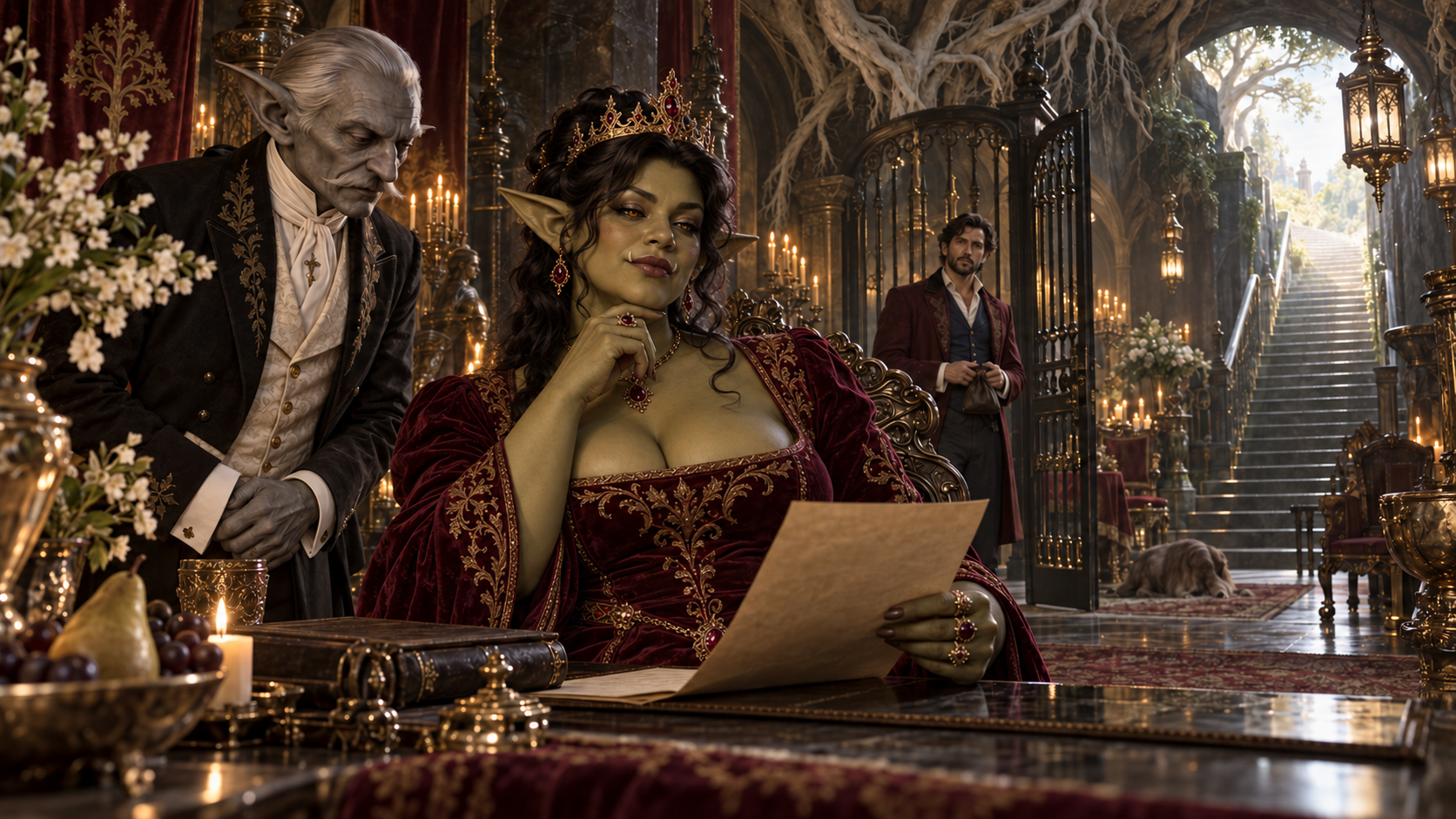
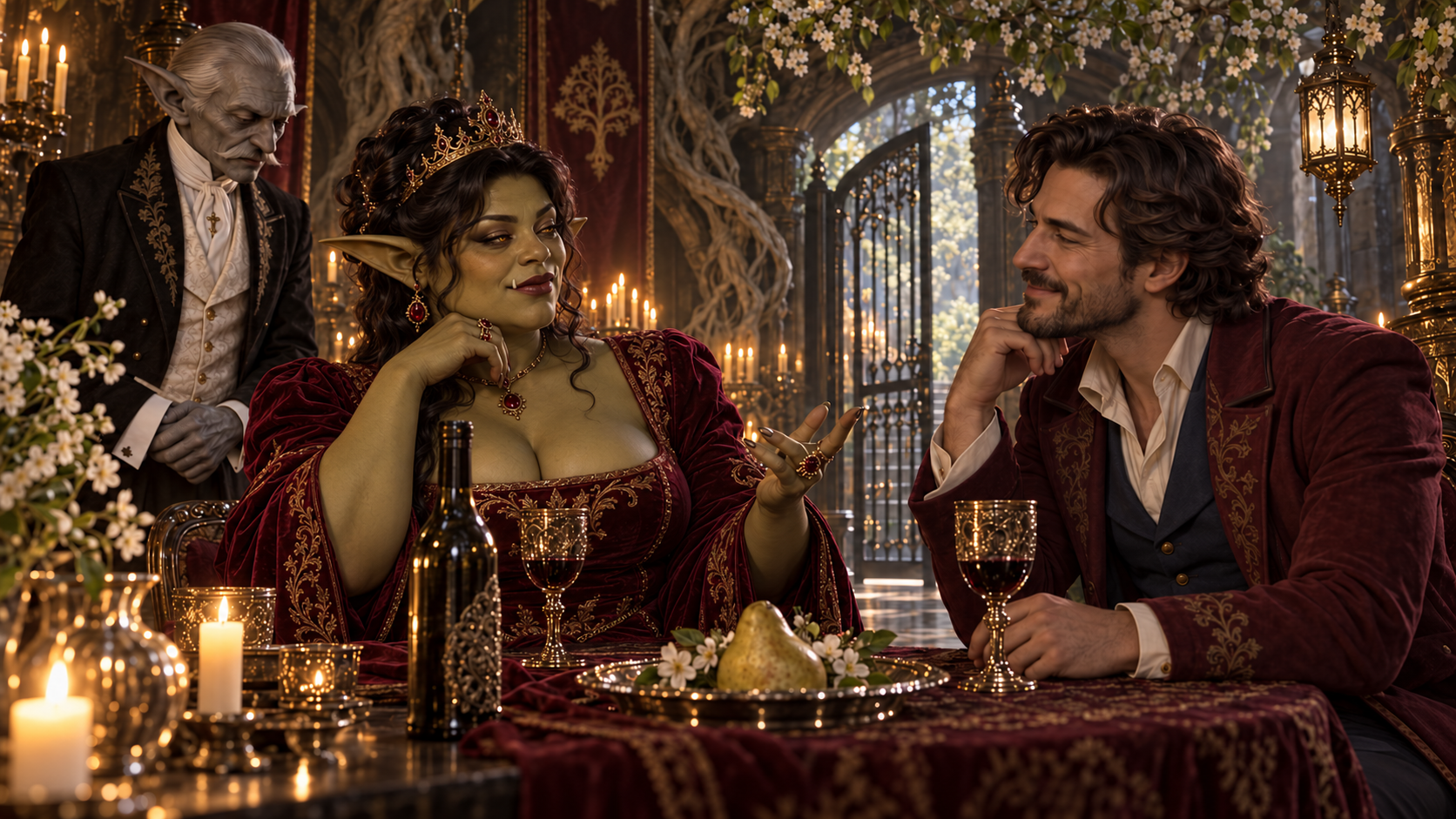
Veyra arrived after supper, her full figure wrapped in burgundy velvet, a crooked gold crown nestled in her black curls. Lamplight warmed her rounded green cheeks; her smile was beautiful, unhurried, and much too sure of its welcome. Rings clicked against her goblet. Her expression suggested she had already heard every impressive thing he might say about himself.
Nevertheless, she listened.
He told her about his vineyards. She asked which hillside caught the last evening sun.
He told her about the wines served at royal weddings. She asked which he drank when nobody important was watching.
By the time the candles burned low, he had abandoned the speech he’d prepared.
"Most people ask what my wine costs," he said.
"Most people are dull." She chose a pear.
"And you are not?" he asked.
"I am extremely expensive," she said.
He laughed. She smiled, and for a moment he forgot the twelve other guests.
At the door she touched his hand. "I should like to hear more about that hillside."
Down the corridor, someone else’s door opened.
In the morning Mott presented the account.
Accommodation. Meals. Musicians. A private evening with the Queen.
Julien read the final figure twice.
"She did warn you," Mott observed. "Shall I arrange your carriage?"
From the next chamber came Veyra’s laughter. It was the same laugh she had given him, to the note.
Julien looked at the wall. "Not yet."
He noticed the musician that afternoon. The man behind the velvet curtain wore a guest’s coat gone shiny at the elbows, and he played without looking up.
"He was a guest," Mott said, following his gaze. "He found the account difficult to settle. The Queen was generous about the arrangement."
"Can he leave?"
"The door is not locked."
The musician’s bow did not falter.
At breakfast Julien met Lord Renaud, a former ambassador in a beautifully tailored coat with a fraying lining, who studied the corridor whenever footsteps approached.
"How long have you been here?"
"Long enough to understand her. She despises flattery. Everyone assumes she wants jewels, but she values intelligence."
That evening Julien watched him present her with an emerald the size of a walnut. Veyra held it to the light. "Lovely." She passed it to Mott and asked another guest to dance.
Renaud smiled through it. His hands were shaking.
Julien’s first gift was modest: a bottle from his oldest cellar. She opened it at once, tasted it, closed her eyes, and sat beside him all night.
The next night she did not come.
On the third he sent another bottle. Mott returned with thanks, and nothing else.
He began measuring his gifts against those carried past his door. A jewelled comb. A hunting estate. A little ivory box whose contents made Mott raise both eyebrows. Julien came to hate the man who owned that box, whom he had never met, with a purity he had never felt for anyone he knew.
He stopped sleeping well. He listened to the corridor instead.
One afternoon he climbed the stairs. There were no guards. Outside, carts rattled through the market, a woman argued with a fishmonger, and rain dripped from a striped awning. Ordinary life went on with offensive indifference.
He could return to his vineyards. He could dine with friends who had never billed him for listening.
Then he imagined the ivory box being opened. He imagined the Queen smiling.
He went back down. He told himself he had only gone for air.
Veyra never said she loved him. He noticed that later. At the time he noticed everything else: that she remembered his wine, that she drew her chair closer when he spoke quietly, that one evening she straightened his collar and said the colour suited him.
Once, dancing, he asked whether she treated every guest like this.
"Like what?"
He could not answer without admitting how much it mattered. She let the silence stand and watched him sit in it.
Then the music changed.
Renaud’s emerald was followed by his summer house, and his summer house by the income from two farms. Soon Julien stopped seeing him at the larger suppers. One morning he found him turning an empty purse in his hands.
"An unfortunate delay," Renaud said.
Julien pretended to believe him. He was already calculating how long his own money would last.
That evening the Queen visited Renaud’s chamber. Julien heard only the end.
"I have nothing left."
A pause.
"Your carriage is waiting."
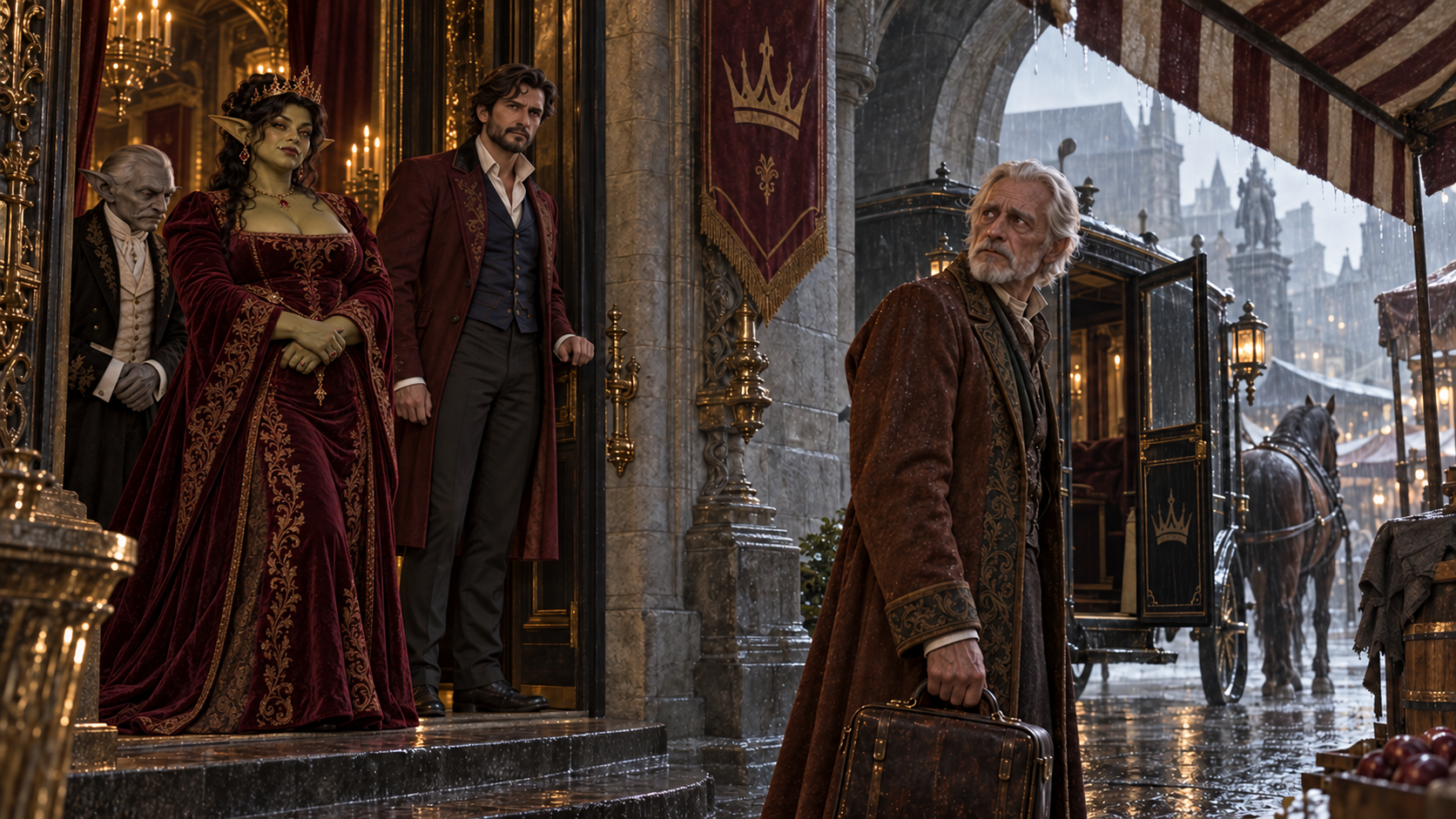
Renaud emerged in his old diplomatic coat. Mott carried a small travelling case. Veyra stood beneath a silver lamp. She had not raised her voice. She had not called the guards.
"I thought I mattered to you."
"You did."
"Then let me stay."
"On what arrangement?"
He stared at her. For the first time there was nothing in his hands. No gift, no proposal, no number. Only the expectation that she would become someone else.
Veyra waited, kindly, the way one waits for a clock to finish striking.
Eventually he took the case from Mott.
Julien followed him to the stairs. Renaud turned. "You should leave."
"I can afford—" Julien began.
"So could I."
"I’m not asking her for the same thing."
Renaud regarded him with exhausted recognition. "That is what makes this place work."
Through the open doorway Julien saw Renaud’s carriage waiting beneath a stone arch. The crest above it belonged to the Queen.
So did the carriage. Renaud had sold both.
Outside, Renaud did not climb in. He stood in the rain beneath the striped awning, looking back at the doorway, and Julien understood that he would still be there in the morning.
That night Julien found Veyra alone in the orchard, reading a contract rather than a love letter.
"You sent him away."
"Yes."
"He believed you cared."
"I enjoyed his company."
"That is not the same thing."
"No."
She set the paper down and offered him no comforting ambiguity.
"Perhaps I should go," Julien said.
"Perhaps."
"You would let me?"
She frowned slightly. "Julien. The door has always been open."
He waited for her to ask him to stay. She did not. That was the cruelty of it, and the whole of the design.
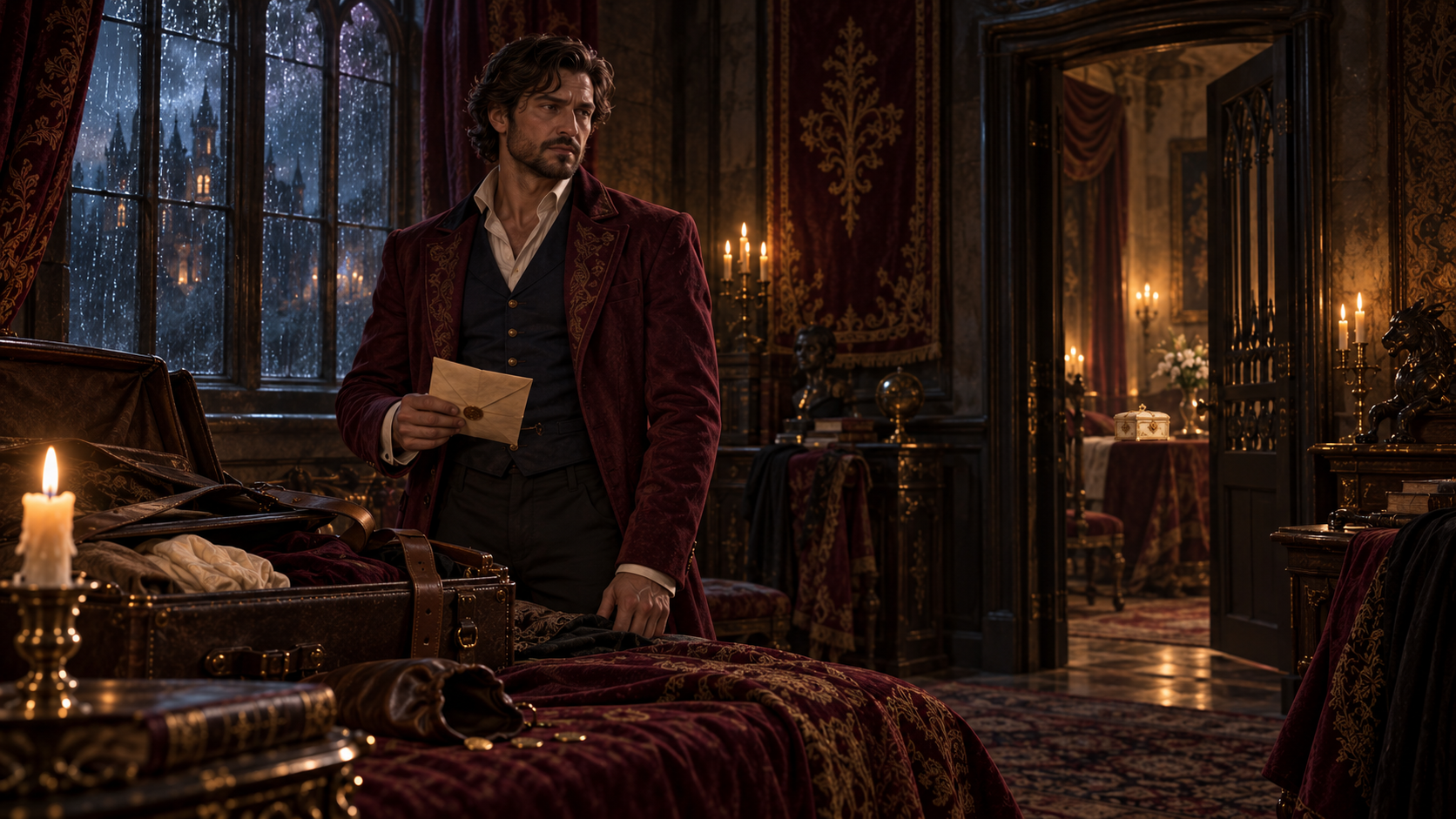
He went to his chamber and began to pack. Footsteps passed. Another door opened. Veyra said something too quietly to hear, and a man laughed.
Julien stood motionless over his travelling case.
Then he took the deed from his coat.
Near midnight Mott laid it beside her ledger. Veyra read the name of the vineyard.
"The hillside?"
"Yes, Majesty. Shall I prepare another chamber?"
She looked at the thirteen names written in the book. Renaud’s had already been struck through.
"No." She turned to a fresh page. "Prepare another palace."
In the morning, Julien received an account.
He read the final figure twice.
"Shall I arrange your carriage?" Mott asked.
Down the corridor, a door opened. A new guest, fresh from the stairs, was laughing too brightly.
Julien looked at the wall.
"Not yet."
Above them the dungeon doors stood open. Veyra had never needed to collect keys. She collected the moment a man mistook being welcomed for being irreplaceable, and she kept him for as long as he could pay to believe it.
The Queen’s Complimentary Breakfast
Lord Hugo has discovered a rare bargain at court: breakfast is included. Unfortunately, the Queen has an excellent understanding of the small print.
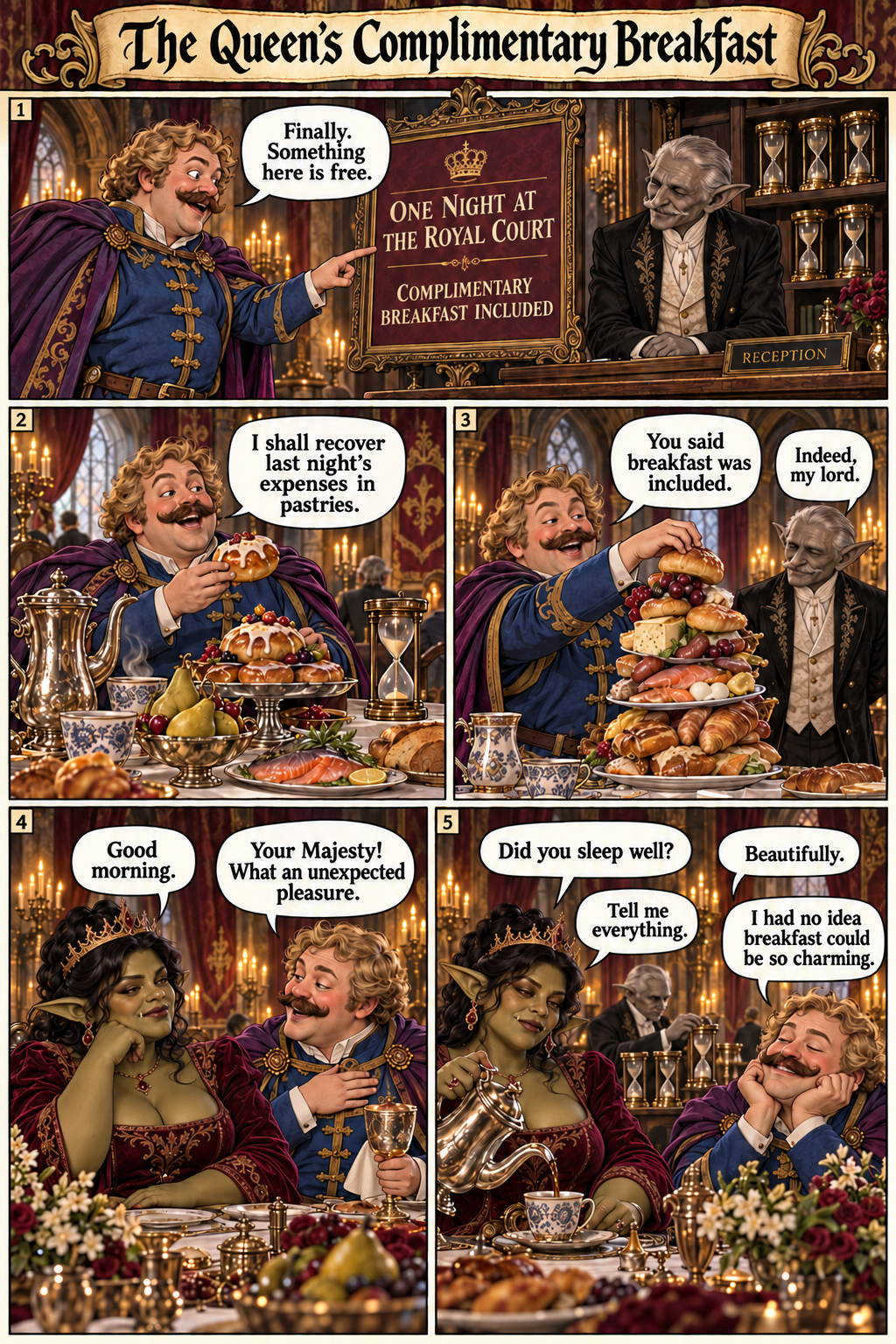
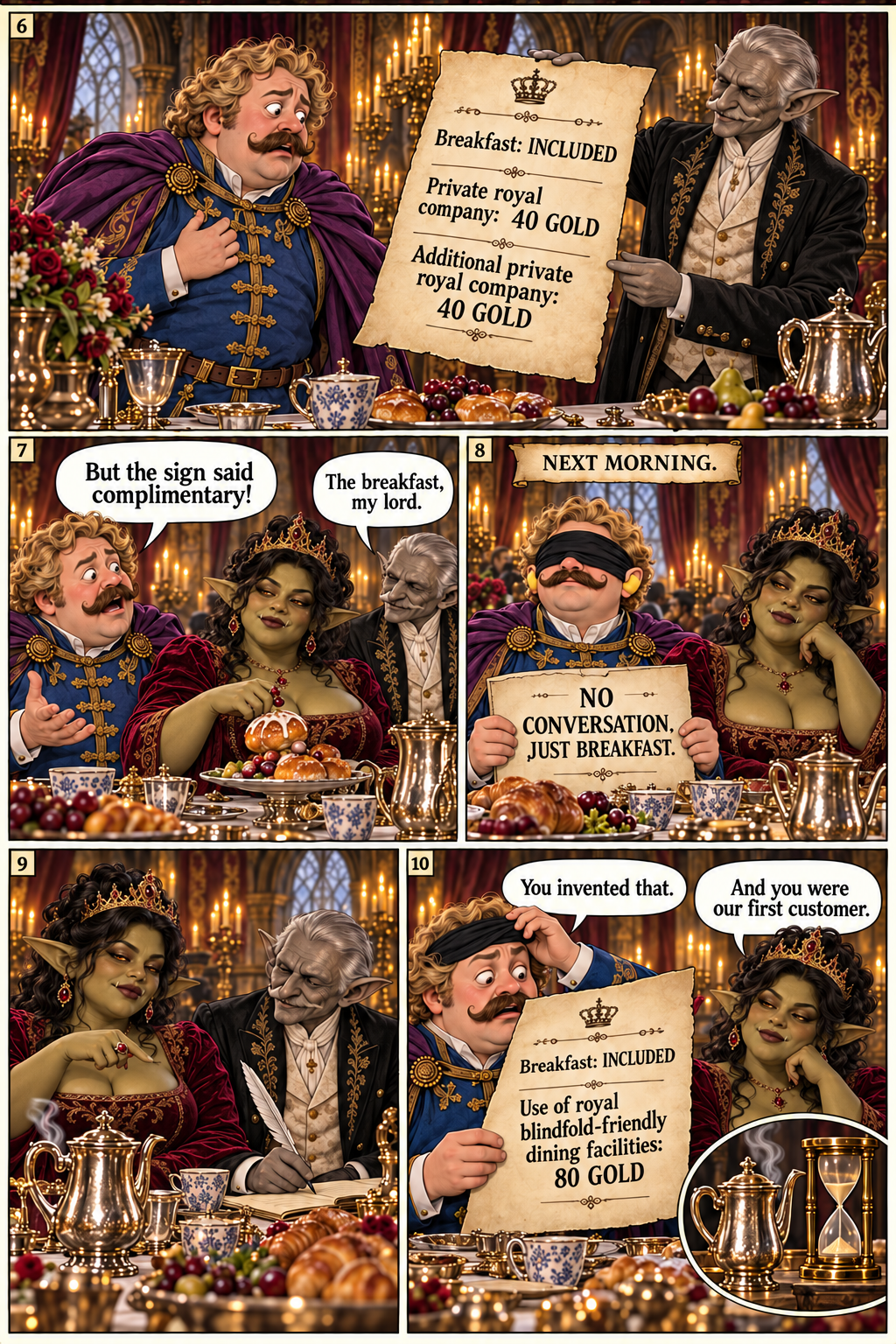
Tap either page to open the larger comic.
Watch the Moving Tale
Watch on YouTube
Watch on YouTube
Curator’s Cabinet
For readers drawn to goblin courts and their dangerous bargains, Love Smiths’ Goblin Queen — The Greedy One carries the creature motif into an adult fantasy design. This recommendation is separate from Veyra’s fictional court.
Bring a little courtly mischief to breakfast with L’Atelier Époustouflant’s personalised mug, printed with your own photo or logo.
Affiliate disclosure: This page contains affiliate links. If you purchase through them, The Velvet Bestiary may earn a commission at no extra cost to you. Recommendations remain separate from the fiction. Read our disclosure.
Threads of Origin
- Thomas Keightley, The Fairy Mythology — collected traditions concerning household spirits, hobgoblins and Robin Goodfellow.
- Christina Rossetti, Goblin Market — the 1862 poem of goblin merchants, temptation and its hidden price.
Veyra, her court, the story and the comic are original Velvet Bestiary fiction. Illustrations are AI-assisted. This tale is not an account of a traditional Goblin Queen legend.
Another threshold awaits: The Drider’s Eighth Thread · The Wolfskin at Widow’s Ford · The Ogre Dragon Beneath Stormgate.
Leave a Reply