The Drider’s Eighth Thread
Seven threads can capture a stranger. The eighth can only invite one home. Enter Hollowglass, where a stolen cure, a listening web and a forbidden truth wait beneath the city.
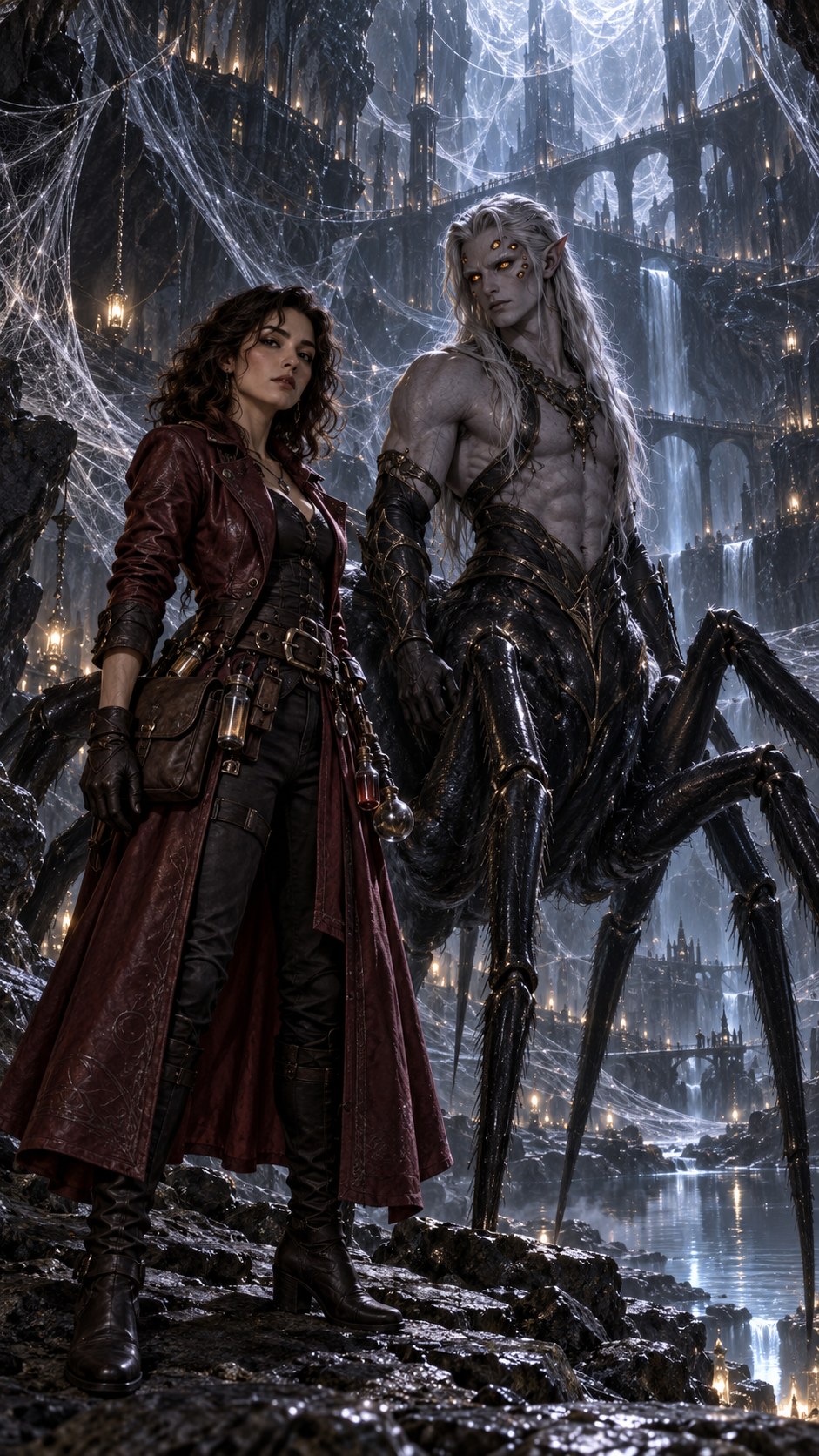
The drider in fantasy and Arachne in classical myth
A drider is a modern Dungeons & Dragons creature with the upper body of a drow, one of the game’s elves, joined to the body of a giant spider. In the fifth-edition account it was once a drow tested by Lolth, the Spider Queen. Its closest ancient comparison in this article is Arachne, a human textile artist from Lydia. You can recognise the difference even without the names. Arachne has a loom and a finished work of art before her body changes. The drider has a previous life in a community that can read the shape of its new body as a verdict. [1] [2]
Contents of this guide
- Two pictures woven at the same loom
- What a ceiling means to a drider
- What happens to Arachne after the contest?
- The half-spider in medieval art and poetry
- The drider's senses, speech and social position
- Who is the spider goddess in each story?
- Arachne and the Drider: the difference at a glance
- Sources and further reading
Long before fantasy gave a spider an elven face, Arachne challenged a goddess with a loom. In Book VI of Ovid’s Metamorphoses, the mortal weaver refuses to credit Minerva, the Roman counterpart of Athena, for her skill. They compete. Minerva depicts divine authority; Arachne depicts the gods’ deceptions and abuses, including sexual violence. Her workmanship is faultless, but the goddess tears it apart and strikes her. Arachne attempts to hang herself; Minerva transforms her into a spider, condemned to keep weaving.
Two pictures woven at the same loom
Ovid gives Arachne a trade and a hometown before he gives her eight legs. She comes from Lydia. Her father, Idmon, dyes wool, and people come to watch what his daughter can do with it. The poet pauses over the work before the finished image, from handling loose wool to drawing out a fine thread. Nymphs leave their usual haunts to watch. When Minerva first visits, she takes the shape of an old woman and offers advice. Arachne’s refusal to yield is public, and by this point the audience has seen why she trusts her hands. Ovid, Metamorphoses VI, the Lydian weaver
Look at the edges of the rival tapestries. Minerva gives the corners of hers to mortals punished for challenging gods. The warning is woven into the design. Arachne surrounds her scenes with flowers and ivy. Inside the border, Europa turns towards the shore as the bull carries her out to sea. From the edge of one cloth to the centre of the other, the question changes. What looks like divine victory to the seated gods might look like an abduction to the woman trying to keep her feet clear of the water. When Minerva destroys the work, the reader has already had time to look at both pictures. Ovid, the weaving contest
One way to read that ending is as an artist’s refusal to disappear: even a punishment cannot stop the work. The web becomes a record of what power would rather keep hidden.
A Drider, however, is not an ancient Greek creature. The half-drow, half-spider being belongs to modern Dungeons & Dragons fantasy, where its transformation is associated with the spider goddess Lolth, as described in D&D Beyond’s creature account. Arachne and the Drider are different traditions—not interchangeable names for the same myth.
What a ceiling means to a drider
The 2014 Dungeons & Dragons rules give the modern drider two wonderfully concrete abilities. A sheer wall or the underside of a ceiling is a surface it can climb. Webbing that checks another traveller’s movement leaves its own passage clear. Imagine two people entering the same cavern. One sees a floor cut off by a web, the other a room with several perfectly serviceable exits overhead. That difference in bodily experience helps explain what makes a drider encounter distinctive at the gaming table. The listening threads in Hollowglass give our weaver a further sense that belongs to this story. D&D Beyond, 2014 drider creature entry
What happens to Arachne after the contest?
Ovid places Arachne at Hypaepa in Lydia, in western Asia Minor. News of her weaving reaches the nymphs, who come to watch her work. Her fame rests on the processing and handling of wool as well as the finished cloth. Minerva first approaches her disguised as an old woman and gives her a chance to retreat. Arachne persists. The goddess drops the disguise, and the two set up their work side by side. It is worth noticing just how long Arachne remains a human expert. Her skill precedes divine intervention. [2]
The ending has more than one act. Minerva finds no fault in the workmanship, destroys the cloth and strikes the weaver. Arachne tries to hang herself. The goddess intervenes, sentencing her and her descendants to hang and spin. The transformation carries an occupation across generations, and Ovid draws attention to what shrinks, what vanishes and what the remaining limbs can still do. A single spinner becomes the first in a long line. The game drider, by contrast, involves the transformation of an individual drow in a setting already inhabited by spiders. [2] [1]
The half-spider in medieval art and poetry
There really is a premodern text that invites a reader to picture Arachne halfway to becoming a spider. In canto 12 of Dante’s Purgatorio, the pilgrim looks down at images of pride brought low. Arachne appears on the pavement amid the remnants of her own weaving, caught partway through the change. The pilgrim walks above the images. Looking down is both how one sees the story and the posture appropriate to this part of his moral education. [3]
This is a useful comparison for anyone trying to identify a picture of a woman with spider limbs. The fabric, the other examples around her and the setting on the terrace of pride point to Dante’s Arachne. An underground encounter with an armed elven figure bearing Lolth’s punishment points to a much later fictional tradition. A similar outline can come from artists choosing to freeze a metamorphosis at its most legible moment or from a game which needs an enduring creature for characters to meet. [3] [1]
The drider’s senses, speech and social position
The 2014 fifth-edition rules give the drider darkvision, knowledge of Elvish and Undercommon, and difficulty operating in direct sunlight. Its spell list includes a small light-making effect and powers involving darkness or outlining a target with light. The creature can carry a sword or a bow. These details let a reader reconstruct an intelligent inhabitant of a particular environment: it can discuss terms, use manufactured tools and control what someone else sees. Counting its legs tells you much less about an encounter than knowing which of those abilities it still possesses. [4]
The official creature overview describes the transformed drow’s isolation and the possibility of giant spiders accompanying it. The stigma is social as well as physical. Other drow recognise the judgement associated with its body, so the transformation continues to act upon it long after the original test. That account belongs to a particular game tradition. The text of the 2014 rules and a later publisher’s feature are separately identifiable sources, useful if an illustration or an adaptation gives the drider different equipment, allegiances or circumstances. [1] [4]
Who is the spider goddess in each story?
In Ovid the goddess is Minerva, whose authority as patron of crafts makes the challenge intelligible. She can weave the counterargument herself. In the modern game Lolth’s power is bound up with worship, tests and the organisation of particular drow societies. The publisher’s account of the development of the drow traces a history through named adventures and later writers. Other elves, other drow communities and the weaver of Lydia all have histories of their own. That is why this guide begins at a loom but identifies the creature in the tale as modern fantasy. [2] [5]
Our tale borrows the older questions of transformation, punishment and forbidden truth, then spins an independent world around them. Vael, Sera and Hollowglass are original fiction, not an account of historical folklore or a retelling of game canon.
Arachne and the Drider: the difference at a glance
| Figure | Source | What belongs to that source |
|---|---|---|
| Arachne | Ovid’s Metamorphoses, Book VI | A mortal weaver challenges Minerva and is transformed into a spider. She is not described as a drow-spider hybrid. |
| Drider | Modern Dungeons & Dragons fantasy | A drow-spider hybrid associated with Lolth. Its setting and history belong to the game tradition. |
| Vael | The Velvet Bestiary’s original Hollowglass | The listening web, stolen venom, Sera and the eighth thread are inventions of this story. |
Read the ancient transformation account and the official D&D creature overview separately. For another old name with a different modern life, compare orcneas in Beowulf and the modern orc.
Sources and further reading
- D&D Beyond, Face Off Against Classic D&D Monsters, drider section
- Ovid, Metamorphoses 6.1–145, University of Virginia Ovid Collection
- Dante, Purgatorio 12.43–45, parallel text and English translation
- D&D Beyond, Drider, 2014 fifth-edition creature entry
- Wizards of the Coast, The Spider Queen's Web: The Truth About the Drow
The Drider’s Eighth Thread
The Web That Listens
Sera Marr has steady hands and a bad plan. A fever is tearing through the city, the physicians have no cure, and so they have sent an alchemist into the abandoned Hollowglass mines to ask a monster for his venom. She carries empty vials, a knife, and a promise from the physicians that she already suspects is false.
The tunnel opens into a cavern lit like a cathedral. Silver webbing covers every wall, and her lantern light slides along the threads ahead of her, as if the web is reading her before she arrives.
“Nobody knows I came here,” she tells the dark, when the first strand brushes her sleeve.
The thread hums, low and sour, like a string pulled out of tune. She stops. The physicians know. Whatever waits below knows a lie when it hears one.
“The physicians sent me,” she admits. “I don’t trust them. But I couldn’t watch another child burn with fever.”
The sour note fades.
Then silk closes around her wrists. It is not violent. It is precise, a neat loop on each, and her knife hand is left free. A trap would have taken the knife first. Whatever lives here does not want helpless prey. It wants a conversation.
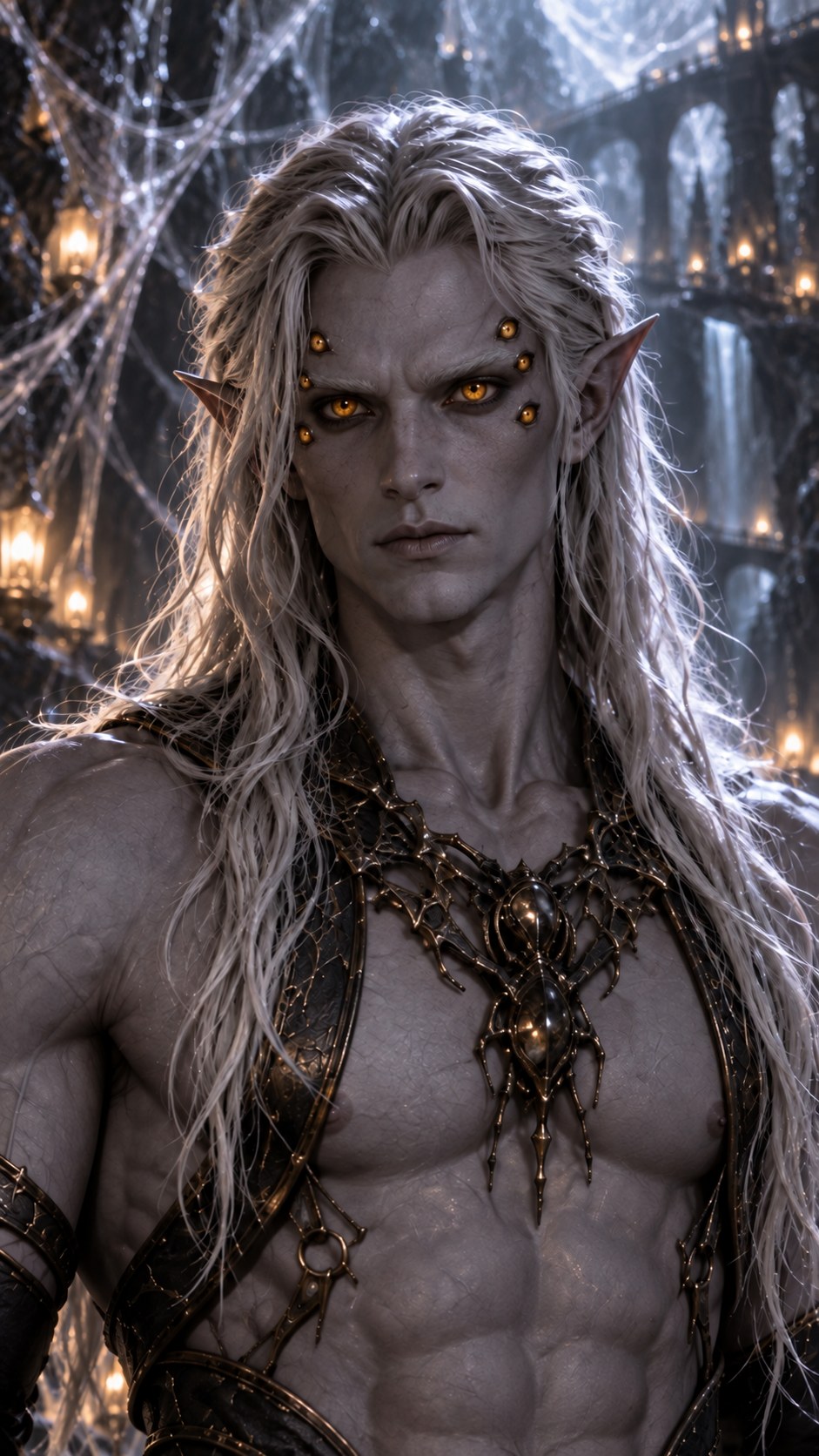
Something descends from the ceiling, upside down: an elegant elven torso joined to a massive spider body, eight amber eyes opening one by one to catch her lantern light. His voice seems to travel through every thread at once.
“If I meant to eat you, alchemist, you would not still be holding the knife.”
Her heart is hammering, but her voice holds. “I need your venom. Enough to cure the city.”
“Everyone who enters my web says they came for medicine,” says the Drider. “Their cages usually arrive behind them.”

What the Web Remembers
His name is Vael, and he circles her slowly while he talks, one deliberate leg at a time.
He was an elven sorcerer, once, brilliant and curious, until he discovered that the temple above the city was distilling his work into a drug and feeding it to the people to keep them obedient. The priests did not argue with him. They cursed him into this body, sealed him beneath the mines, and have been harvesting his venom in secret ever since.
Old binding runes glow under the cavern’s stone. Beyond their circle, his limbs lock and his breath fails. The temple’s siphon is bolted to the rock beside them: tubing, iron restraints, a glass vessel scrubbed so clean that it looks almost innocent.
The silk, he explains, is how he survives down here. He touches a strand and it sings.
“Seven threads. One to hunt, strung invisible across every tunnel. One to warn, taut and humming at the first lie. One to remember; I read old footsteps through it like a diary. One to heal, warm and soft enough to close a wound. One to restrain, strong but never cruel. One to protect, woven in layers. And one to execute, thin as wire. I have used that one exactly once.”
“I came alone,” Sera says, to test him, and the web goes quiet and steady. As far as she knows, she is telling the truth.
Something in the room softens.
“Seven,” Vael adds, almost to himself, “and one more I have never spun.”
He does not say what it is.
Venom and Truth
His venom, Vael tells her, does not simply poison. A carefully measured drop sharpens the senses and makes fear difficult to disguise. Too much, or too often, does something far uglier. The temple has built its fortune on that difference.
Sera wants to understand the substance before she carries it back to her laboratory. Vael offers a single measured drop. There is no price attached to the vial, and no demand that she accept.
“You can say no,” he tells her.
“I know.”
He cuts the silk from her wrists. Only then does she set down the knife and loosen her collar herself.
“Yes.”
The bite is barely a pressure near her shoulder. Warmth follows; the cavern sharpens into the hum of every thread, the flicker of candlelight, the tremor in his hand when he steps away. She has spent the journey teaching herself not to fear him. Now she discovers that fear was never the whole story.
“I dreamed about you,” she whispers, “before I knew your name. Ever since I touched one of your discarded threads.”
“The thread remembers,” Vael says quietly.
“Does it remember this?”
She takes his hand. For all his careful stillness, he looks startled.
There is an open tunnel behind her and nothing around her wrists. She stays. His hand rests against her face, waiting until she closes the distance herself. Their first kiss is brief, almost disbelieving; the second is not.
Then a burning bolt tears through the silk.
The Hunters Become the Hunted
The hunters pour into Hollowglass with iron hooks, replacement tubing, collection bottles, and temple orders to take him alive. They have followed Sera without her knowing. Fire runs up the web like a fuse.
Vael is gone from her side in an instant. He climbs the wall, crosses the ceiling in a blur, drops on a line of silk and stops dead above a hunter’s head. Sera hurls her glass bombs one after another. Each bursts into blue light and smothers a patch of flame.
“Stand aside,” the leader shouts. “The creature belongs to the temple.”
“He belongs to himself,” says Sera.
An iron hook catches Vael below the ribs. Black blood streaks the pale stone. He strikes the attacker against a pillar; something cracks, and the man folds to the floor, still breathing.
A second hunter raises a torch toward the healing threads. A strand flashes so thin that Sera sees it only when it catches the light.
The torch falls. So does the hand holding it, with the forearm still attached. Blood spatters the silver web. The hunter’s scream turns the cavern into a place no one will mistake for a sanctuary again.
“You said you used that thread once,” the leader whispers.
Vael lands between him and Sera.
“Now it is twice.”
Beside the old siphon, a collector fastens fresh tubing to bottles stamped with the temple’s seal. Sera recognizes the cloudy residue in the glass. She has tested that same residue in the medicine given to the city’s sick.
The truth lands all at once. The fever is not a plague. It is withdrawal. For years the temple has diluted stolen venom and sold dependency as healing.
The leader sees her understand and opens a purse heavy with coins.
Sera looks at the money, then at the iron around the siphon. She drives her knife under its locking plate and tears the tubing free. Glass breaks across the floor. Her blue solvent eats through the painted runes; their light gutters out, one after another.
For the first time in years, Vael can cross the cavern without pain.
He does not chase the fleeing men. Silk catches them at the tunnel mouth. The wounded hunter is bound separately, with healing threads pressed against the stump until the bleeding slows. The leader hangs beside the temple’s ledgers, alive and suddenly very interested in mercy.
“Let the city find them,” Vael says. “Let the city read.”
The Eighth Thread
Vael lowers his fang over Sera’s empty vial and fills it himself, drop by drop, glowing like starlight.
“Stolen, it was a chain,” he says. “Given, it can be a cure.”
She studies the light. Unspoiled venom can seed an alchemical culture; she has the equipment, and now she has the missing ingredient. One vial will become thousands of measured doses, a treatment that can be reduced gradually rather than another bottle to need forever.
This is not a miracle that saves her the work. It is a chance to do it.
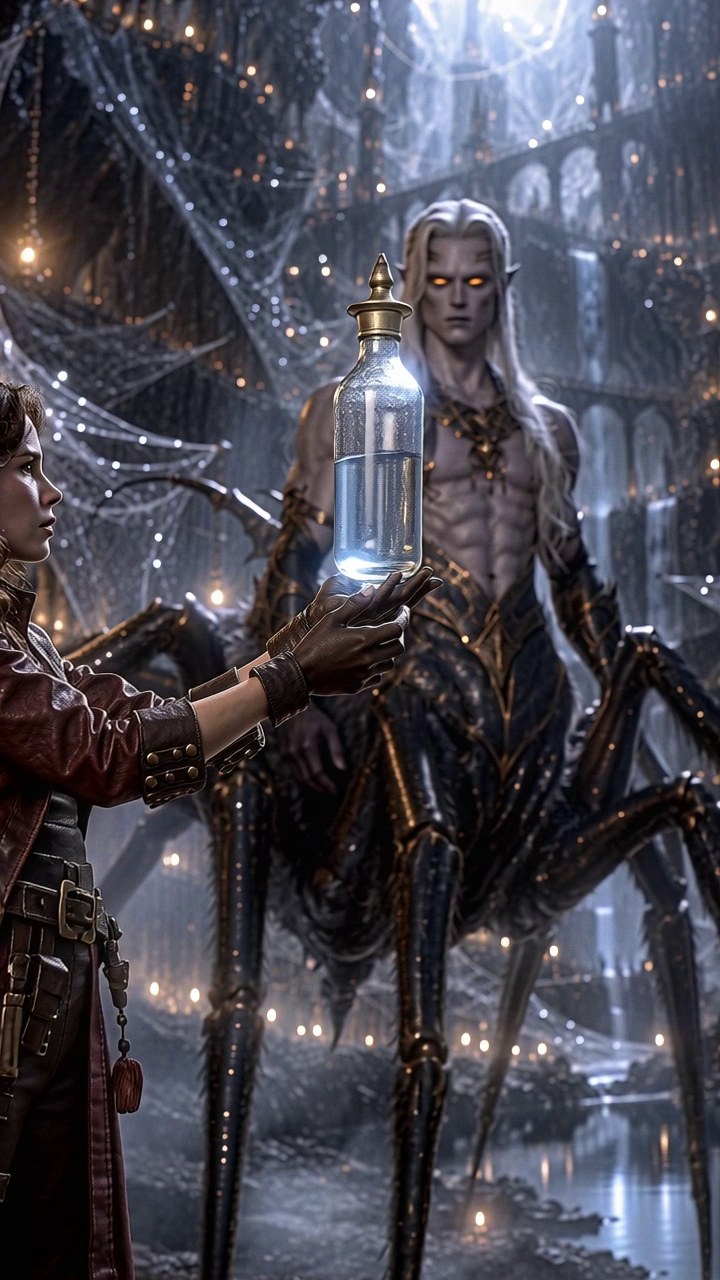
Before dawn, she checks the wounded hunters again. Vael binds his own injury while she packs the ledgers. The cavern has gone quiet, but not empty. Every unburned thread seems to listen.
“Will you come back?” he asks.
“Ask me when the city is well.”
His smile is the first unguarded thing she has seen in Hollowglass.
The kiss at the tunnel mouth is slower than the one the hunters interrupted. She holds the vial carefully in one hand and his face in the other. For a little while, the city must wait.
Sera returns with proof, not merely accusations. She cultures the venom in her laboratory, works with physicians who had known nothing of the harvest, and carries the treatment from house to house. The fever breaks over days, not minutes. The temple’s ledgers are read aloud in the square. Its medicine stops being holy the moment the city learns what was inside it.
Weeks later, standing at her window, Sera feels a silver thread settle gently around her wrist. It is not a leash. It pulls at nothing. It only waits.
She follows it back down to Hollowglass, not because she owes him anything, but because she wants to see him. At last she understands the thread Vael would not name: the eighth, which he can spin only for someone free to leave.
It cannot bind and it cannot trap. It only says: go anywhere, and I will still be here.
Seven threads belonged to the hunter. The eighth belonged to whoever was free to follow it home.
The Web Designer
Corvin needs more traffic in his shop. Vael has eight legs, impeccable confidence, and a dangerously literal understanding of customer retention.
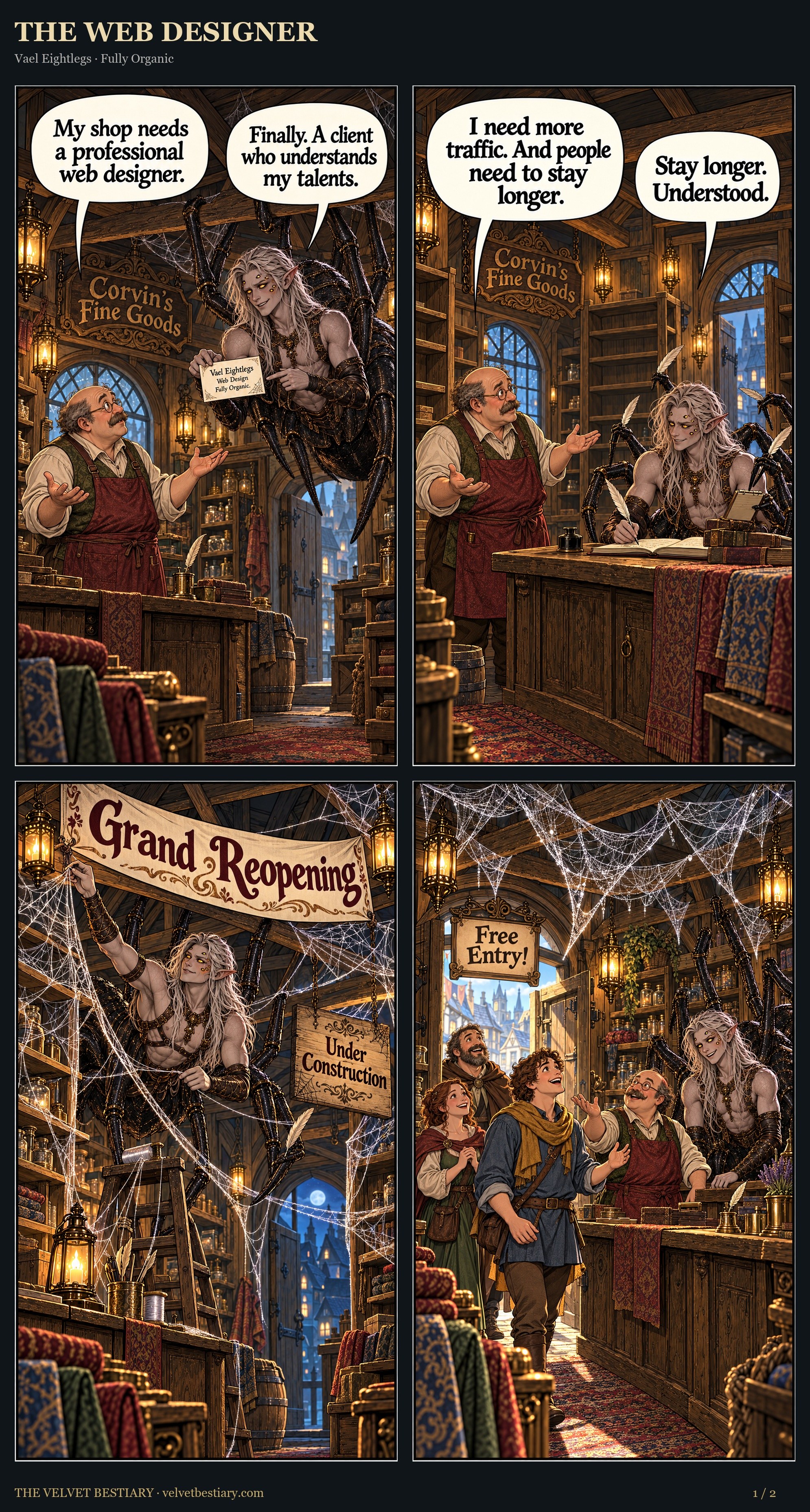
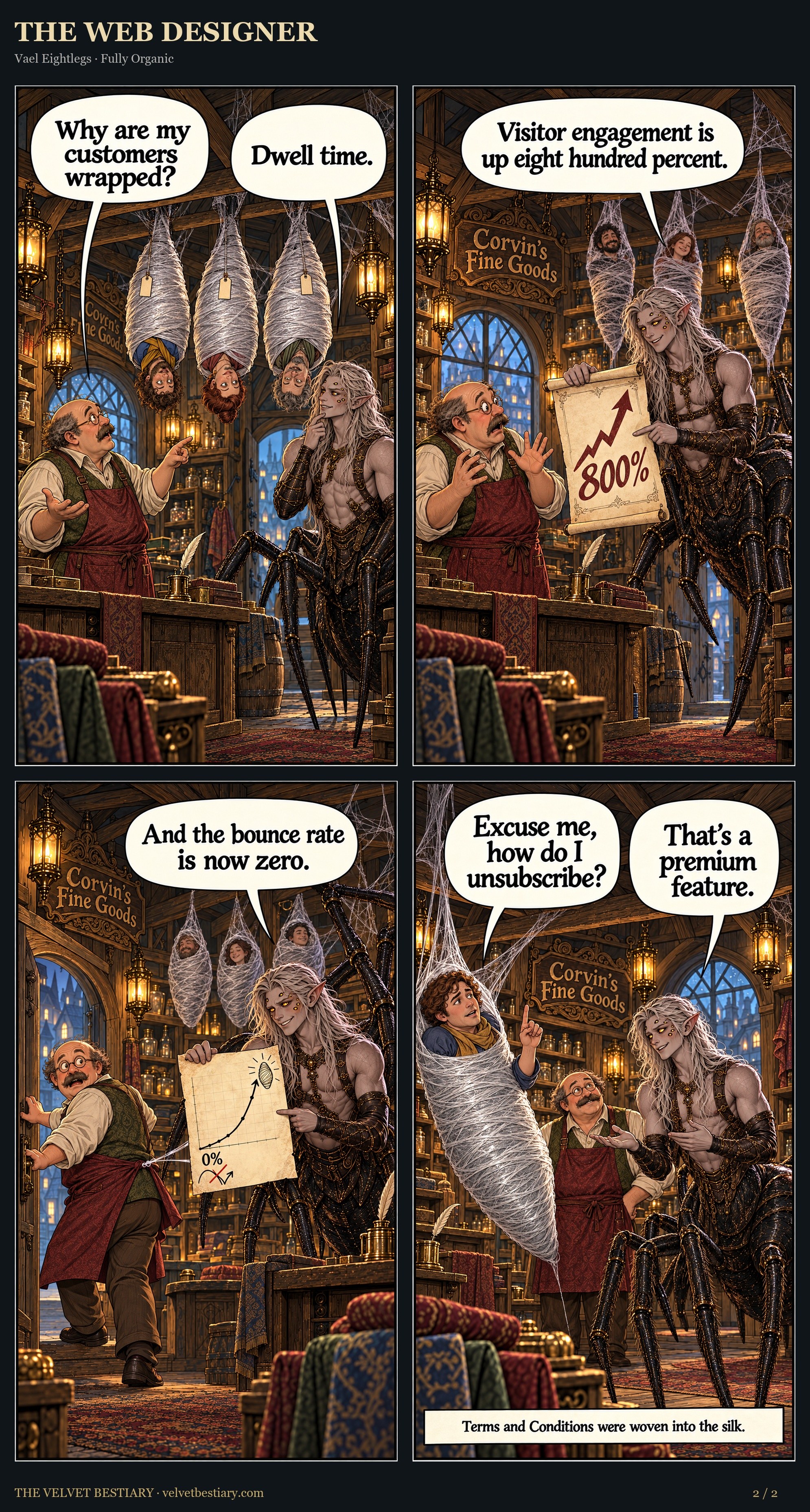
Tap either page to open the larger comic.
Dessert or Death?
A quiet dinner in Hollowglass. One nervous Drider. A family tradition Sera really wishes he had explained before the dessert course.
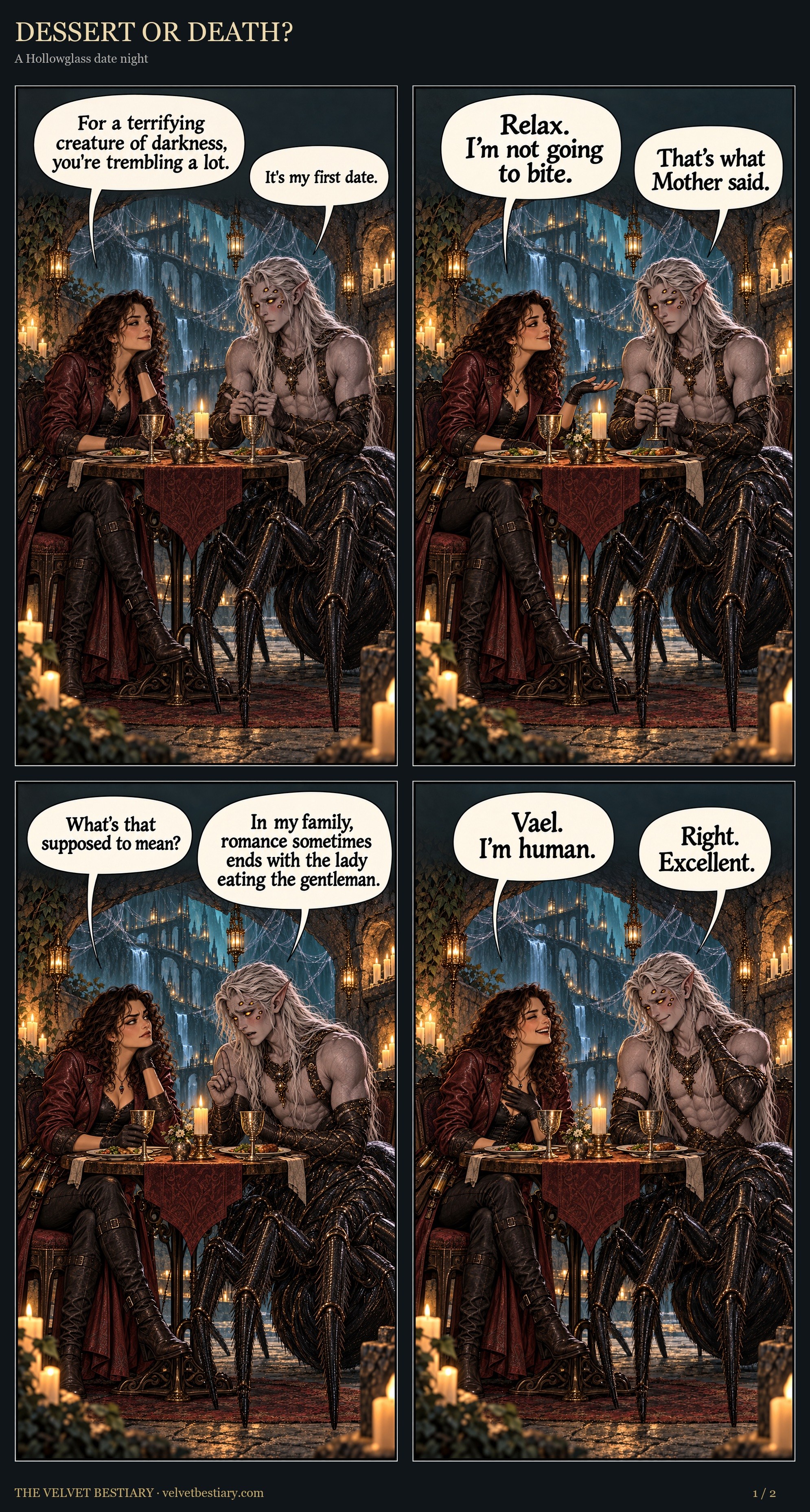

Watch the Moving Tales
Watch on YouTube
Watch on YouTube
Watch on YouTube
Scheduled on YouTube for Nov 18, 2026. The player becomes available after release.
Watch on YouTube
Curator’s Cabinet
For readers drawn to the Drider’s web, this creature-inspired piece carries the motif beyond the page. Love Smiths’ Drider design pairs web-like details with a tube-and-syringe feature. The maker describes it as hand-poured platinum-cured silicone, crafted in France.
This is an adult product, separate from the story and its fictional alchemy. Follow the maker’s care and use instructions.
For a quieter touch of web-inspired fantasy, personalise L’Atelier Époustouflant’s illustrated coasters with your own design.
Affiliate disclosure: This page contains affiliate links. If you purchase through them, The Velvet Bestiary may earn a commission at no extra cost to you. Recommendations remain separate from the fiction. Read our disclosure.
Threads of Origin
- Ovid, Metamorphoses, Book VI — the weaving contest between Arachne and Minerva, in the translation hosted by the MIT Internet Classics Archive.
- D&D Beyond: Face Off Against Classic D&D Monsters in Baldur’s Gate 3 — the Drider’s place in modern fantasy.
The Hollowglass story and comics are original Velvet Bestiary fiction. Illustrations are AI-assisted. The venom and cure are imaginary, not medical advice.
Another threshold awaits: The Wolfskin at Widow’s Ford · The Ogre Dragon Beneath Stormgate.