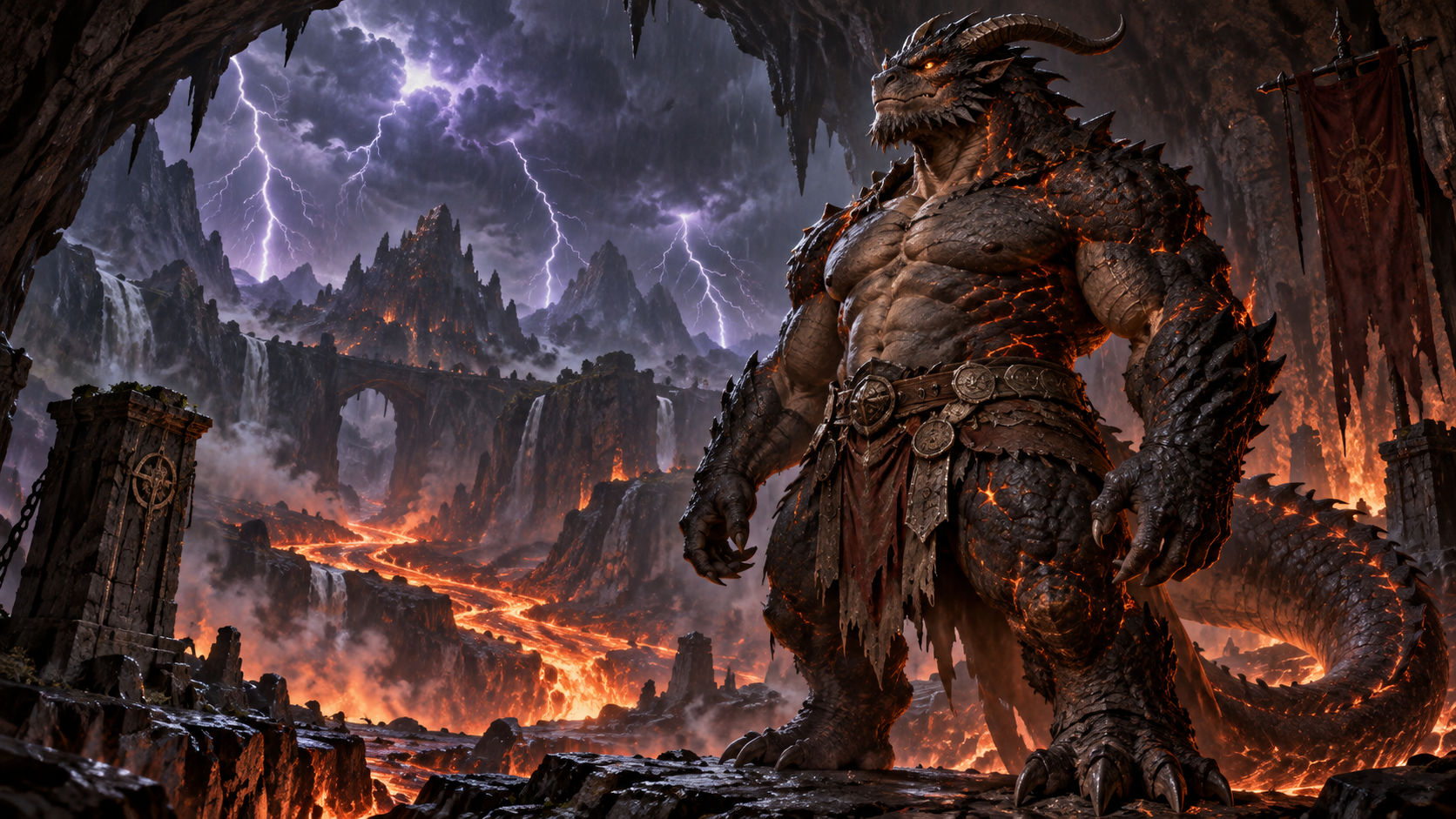
The Ogre Dragon Beneath Stormgate
Trace the old ogre’s appetite and descend beneath Stormgate in a dark fantasy tale of magma, buried thunder, hunger and dangerous recognition.
Ogres, hoard dragons and the invention of the Ogre Dragon
An ogre in the French literary fairy tale can marry, inherit land, employ servants and eat people. A hoard dragon in northern European poetry occupies an older and stranger household: somebody once put wealth in the earth, and a creature now holds everyone else away from it. Our Ogre Dragon joins those figures. To identify what each contributes, follow the food through the ogre stories and the ownership of the gold through the dragon stories. [1] [2]
Contents of this guide
The ogre of European fairy tale is not merely large. He is appetite given a house, a title and enough power to decide who is guest and who is meat.
Charles Perrault helped fix that figure in the literary imagination. His ogres possess estates, treasure and impossible gifts. One wears seven-league boots. Another changes shape. The terror is domestic: a warm fire, a locked room, a host whose hospitality can turn carnivorous without warning.
Two ogres at two very different tables
In Charles Perrault’s Little Thumb, seven brothers reach a house where the ogre’s wife understands their danger and tries to hide them. Her husband knows there are children in the house because he can smell them. His seven daughters sleep in crowns. Little Thumb exchanges the girls’ crowns for the boys’ caps, and the ogre makes a terrible mistake in the dark. The crowns matter as much as the teeth. This household has dinner, beds, anxious parents and the habit of putting children to sleep in the same room. A guest can understand its ordinary arrangements well enough to turn them against the host. Perrault, Little Thumb, edited by D. L. Ashliman
The landowner in The Master Cat has a different weakness. Puss pays him a flattering visit and asks for a demonstration of his ability to change shape. A lion sends the visitor scrambling for safety. When the ogre obligingly becomes a mouse, the cat eats him. By the time the king arrives, the castle can be presented as somebody else’s property. Read the two hosts side by side and appetite changes hands. One ogre thinks he can identify a meal by its smell. The other is so keen to impress a guest that he makes a meal of himself. Perrault, The Master Cat, or Puss in Boots
The dragon brings a different inheritance. It belongs to the mountain, the hoard and the deep furnace beneath the world. Where the ogre consumes, the dragon possesses. Where the ogre’s hunger is blunt, the dragon’s patience can last centuries.
Why a dragon wakes
The hoard in the Old English poem Beowulf already has a human history before the dragon finds it. A last survivor buries treasures that his dead companions can no longer use. The dragon occupies the barrow for three hundred years. One stolen cup is enough to bring it out by night, burning the homes of people who never touched the gold. By the end of the poem treasure is being buried again, this time with Beowulf. Beneath Stormgate, the dangerous host and the guardian underground share a single body. Perrault’s tales and the Old English poem give that invented creature two different reasons to mind who comes through its door. Beowulf, the hoard and the dragon
The ogress who governs a kingdom
In Perrault’s Sleeping Beauty in the Wood, the wedding and the awakening are only the first half of the tale. The prince conceals his family from his mother, who comes of ogre stock. When he eventually becomes king and goes to war, she exercises authority in his absence. She orders a steward to prepare her own grandchildren, Dawn and Day, for dinner, then demands the young queen as well. The steward can defeat the order because the ogress has delegated the work. He hides the children and their mother and substitutes animals in the kitchen. [3]
The danger here would survive a change of costume. The ogress could lose every visible monstrous feature and still have the authority to call for a child and have her orders obeyed. Conversely, no member of this family needs to be detected by a trial of strength. The prince already knows his mother’s tastes. Comparing the story to Little Thumb reveals two quite different reasons why the vulnerable survive a night in an ogre’s house. One child deceives his host. In the royal household an adult servant takes a risk for people who cannot save themselves. [3] [1]
Can an ogre help a human being?
The opening story of Giambattista Basile’s Neapolitan Tale of Tales, published after his death in the seventeenth century, gives an orco a different part. A young man enters the service of a frightening-looking ogre and comes away with gifts. A dishonest innkeeper repeatedly substitutes ordinary objects for the marvellous ones. The final gift, a cudgel that acts on command, enables the young man to recover what he lost. The encounter with the ogre is among the safer parts of his journey. Stopping at a perfectly ordinary inn is where trust fails him. [4]
English translations offer the reader the same familiar word ogre for Basile’s benefactor and Perrault’s hungry patriarch. Read what happens to the visitor as well as the creature’s name. The lord of the castle in The Master Cat can be flattered and eaten. Basile’s powerful householder can pay a subordinate generously. Neither story supplies a colour chart, a prescribed height or a uniform set of powers. Their distinctive detail is what kind of social position a creature occupies when a hungry, penniless stranger arrives. [5] [4]
Two dragons and two histories of gold
The last opponent in Beowulf flies, breathes fire and brings an old king to his death. The offence that prompts its attack is the removal of one vessel from a burial hoard. Beowulf goes against the dragon with an iron shield. Of his companions, Wiglaf alone comes to his aid. The dragon dies and so does Beowulf. A community has to reckon with losing the king who protected it. Treasure brought out of the ground offers little comfort at his funeral. The dragon episode belongs at the end of this poem for reasons beyond providing a powerful last opponent. [2]
In the Old Norse Fáfnismál, Sigurd deals with a dragon who can talk back. He strikes Fafnir from below, and the mortally wounded creature questions his killer about his name and kin. Fafnir also warns him of the danger attached to the gold. Knowledge passes in a second, unexpected way when Sigurd tastes the blood of the dragon’s heart and understands birds warning him against Regin. A stolen vessel sets the Old English dragon moving. Here it matters who will acquire a whole inheritance and who understands enough to survive taking it. A modern hoard dragon may owe its voice to one story and its devastating flight to another. [6] [2]
How to recognise the Stormgate hybrid
The familiar shorthand of size, appetite and treasure can obscure the contrasts between its ancestors. Perrault’s ogre has to come home, sit down and be fooled by the people around his table. Fafnir can be dangerous even when he is dying and doing nothing more than giving advice. The Beowulf dragon has held wealth through several human lifetimes without spending it. Put those observations together and the proprietor under Stormgate becomes easier to recognise: the cavern and its guarded contents come from one group of stories, the prospect of meeting an astonishing host from another. Ogre Dragon names that combination in this feature.
Sources and further reading
- Charles Perrault, Little Thumb, University of Pittsburgh edition
- Beowulf, University of Toronto, Old English poem and numbered sections
- Charles Perrault, The Sleeping Beauty in the Wood, complete tale
- Giambattista Basile, The Tale of the Ogre, first tale of the first day, Fabulando bilingual edition
- Charles Perrault, The Master Cat, University of Pittsburgh
- Poetic Edda, Fáfnismál, translated by Henry Adams Bellows
The Ogre Dragon Beneath Stormgate
The mountain demanded a name from everyone who entered.
Mara gave it a false one.
“Linnet,” she told the black archway, because lies had carried her farther than courage ever had.
The stones answered with a tremor.
Behind her, the soldiers’ lanterns crawled up the pass like angry stars. Ahead, the tunnel descended into heat. Mara pressed the stolen seal against her ribs and chose the darkness.
The first hundred steps smelled of wet iron. The next hundred smelled of cedar smoke. After that came sulphur, hot stone and the animal musk of something too large to fear men.
At the tunnel’s end, a cavern opened beneath her.
Molten rivers divided the black rock into islands. Bridges older than the kingdom crossed the fire. On the largest island stood a chair carved from a single block of basalt.
Its occupant was not sitting so much as allowing the throne to remain beneath him.
The Ogre Dragon was enormous. Horns swept back from a brutal, intelligent face. Charcoal scales armoured his shoulders and thighs; between them, ember-red light pulsed as if a furnace breathed under his skin. A leather war-kilt and overlapping plates covered his hips. His tail circled the throne twice before vanishing into shadow.
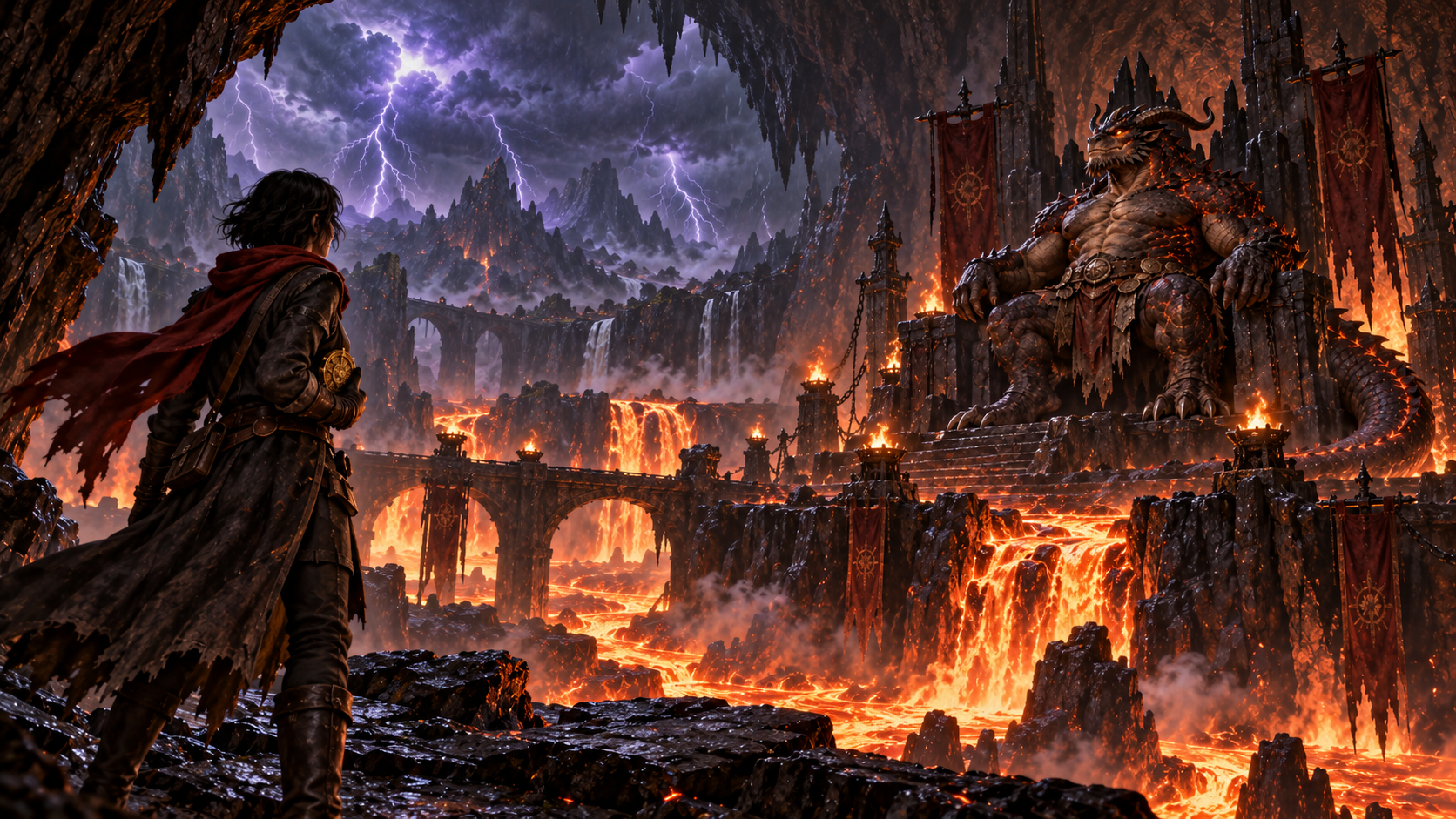
He opened one amber eye.
“Linnet,” he said.
The false name cracked in his mouth.
Mara kept her hands visible. “That is what people call me.”
“No.” His voice moved through the cavern more slowly than thunder. “That is what you call yourself when you plan to leave.”
The soldiers reached the archway above. Their captain shouted Mara’s true name.
The Ogre Dragon smiled. It was not a kind expression, but it was honest.
Mara drew the stolen seal from her coat. Gold flashed in the volcanic light: the royal mark that had condemned three villages to make room for a duke’s new hunting forest.
“I brought you a gift,” she said.
“You brought me a reason for armed men to enter my home.”
“The gift is what happens when they do.”
His second eye opened.
The soldiers poured onto the first bridge. Steel rang. Orders echoed. Their captain lifted a crossbow and called the creature an abomination in the king’s name.
The Ogre Dragon rose. The throne, suddenly relieved of him, looked small.
He did not roar. He inhaled.
Every flame in the cavern bent toward his mouth. The molten rivers climbed their banks in shining ribbons. Heat pressed Mara to her knees. When he exhaled, he released no fire at all—only a breath so dense with power that the bridge bowed like grass beneath a storm.
The soldiers fled before the stone broke. Their captain did not.
He loosed the bolt. The Ogre Dragon caught it between two claws.
“Your king,” he said, examining the iron point, “has mistaken distance for safety.”
He squeezed. Metal ran between his fingers like candle wax. The captain followed his men.
Silence returned in pieces. Mara discovered that she was still kneeling.
“Stand,” the creature said. “I prefer bargains made at eye level.”
She looked up the impossible length of him. “That presents a practical problem.”
For the first time, he laughed. The sound loosened pebbles from the ceiling.
He descended the basalt steps and crouched before her. Even then, his eyes remained above hers. Heat radiated from the seams in his scales, but his breath against her face was unexpectedly cool.
“Your name,” he said.
“Mara.”
The mountain repeated it in a low vibration. This time, the stones accepted the offering.
She held out the royal seal. “The king is digging toward this cavern. He thinks the old maps lead to a vault.”
“They do.”
Mara’s pulse stumbled.
The Ogre Dragon’s gaze dropped to the seal, then returned to her face. “But the treasure is not gold.”
He extended one vast hand. She placed the seal upon his palm. His scales were rough at the edges and warm in the centre. One claw curled carefully around the object without touching her skin.
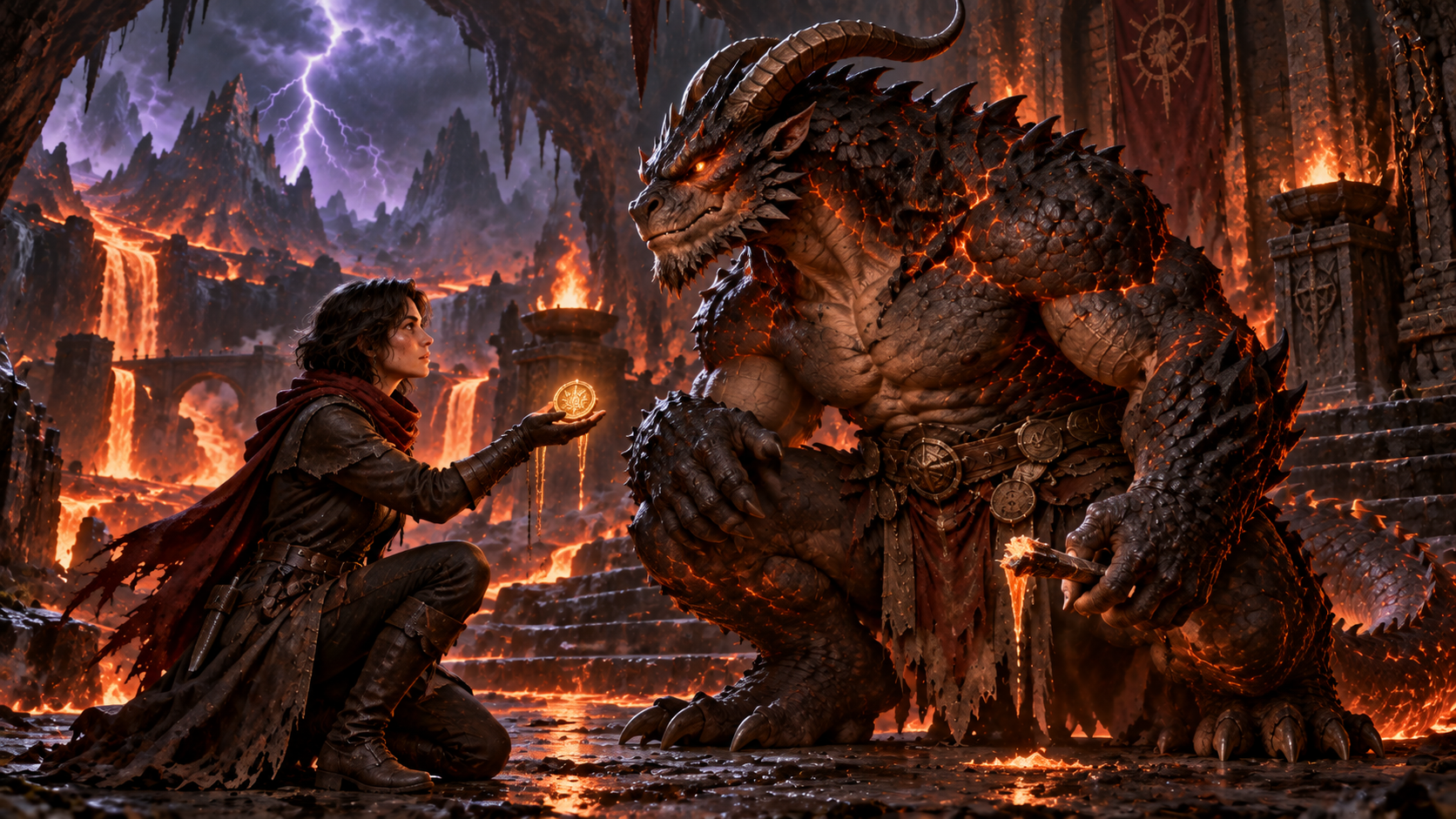
“What is it?” she asked.
“A storm that was buried because the sky could not survive it.”
Lightning flashed somewhere beyond the mountain. The thunder arrived through solid rock.
“And you guard it?”
“I guard everything that would destroy the men who believe they own it.”
Mara thought of the villages marked for erasure. “Then we have similar tastes.”
His nostrils widened. The amber in his eyes brightened.
“Careful,” he murmured. “An ogre’s appetite is not improved by flattery.”
“Was that flattery?”
He leaned closer. Heat moved over her throat. His mouth held fangs capable of dividing armour, yet the danger she felt was not the simple danger of being eaten. It was the danger of being recognised by something that had no patience for disguise.
“No,” he said. “That is why I noticed it.”
The stolen seal began to glow in his hand.
Lines of light spread across the cavern floor, joining symbols carved into the bridges. The mountain groaned. Far below, something vast turned in its sleep.
Mara stared at the seal. “What did I do?”
“You brought a royal command into a place older than kings.”
“Can you stop it?”
The Ogre Dragon stood. “Yes.” He did not move.
Mara glared upward. “Are you going to?”
“That depends.”
“On what?”
His tail uncoiled from the throne and came to rest behind her, blocking the tunnel without touching her.
“Whether you came to save your villages,” he said, “or merely to punish the men who harmed them.”
The distinction cut more cleanly than any knife.
Mara thought of roofs burning in careful rows. She thought of the captain’s face. She thought of how often vengeance had worn justice’s coat and found it a comfortable fit.
“Both,” she admitted.
The Ogre Dragon nodded once. “A true name. A true answer. You learn quickly.”
The light reached the molten rivers. The buried storm awoke.
Wind exploded upward, carrying sparks, ash and the scent of rain. The cavern roof vanished behind rotating cloud. Lightning struck the bridges again and again, each bolt shaped like a luminous root.
The Ogre Dragon stepped into it.
Fire ran from the rivers over his feet. Lightning wrapped his horns. His magma seams blazed white. The two powers met across his body—ancient flame below, impossible storm above—and for one terrible instant Mara saw why the mountain had demanded names. It wanted to know what to call the dead.
She ran toward him.
“Mara!” It was the first time he had shouted.
She climbed the plates of his tail, seized one horn and pressed the royal seal into the burning seam above his heart.
Gold melted. The king’s command became liquid light. The Ogre Dragon closed both hands over hers.
“Choose,” he said through clenched fangs. “Release the storm, and it will erase every road into this mountain.”
“Including the villages?”
“Including everything.”
“Then swallow it.”
His eyes widened.
“You said you guard what would destroy greedy men.” Mara tightened her grip on the horn. “You never said you had to guard it outside yourself.”
The creature’s laugh was agony and admiration together. He opened his mouth.
Mara kissed him first.
It was a reckless, adult decision made beneath enough lightning to illuminate a kingdom. His claws held her with astonishing precision. His mouth tasted of rain on hot stone. When they parted, he inhaled the storm.
Cloud, lightning and wind collapsed into him. The magma seams beneath his scales changed from red to violet.
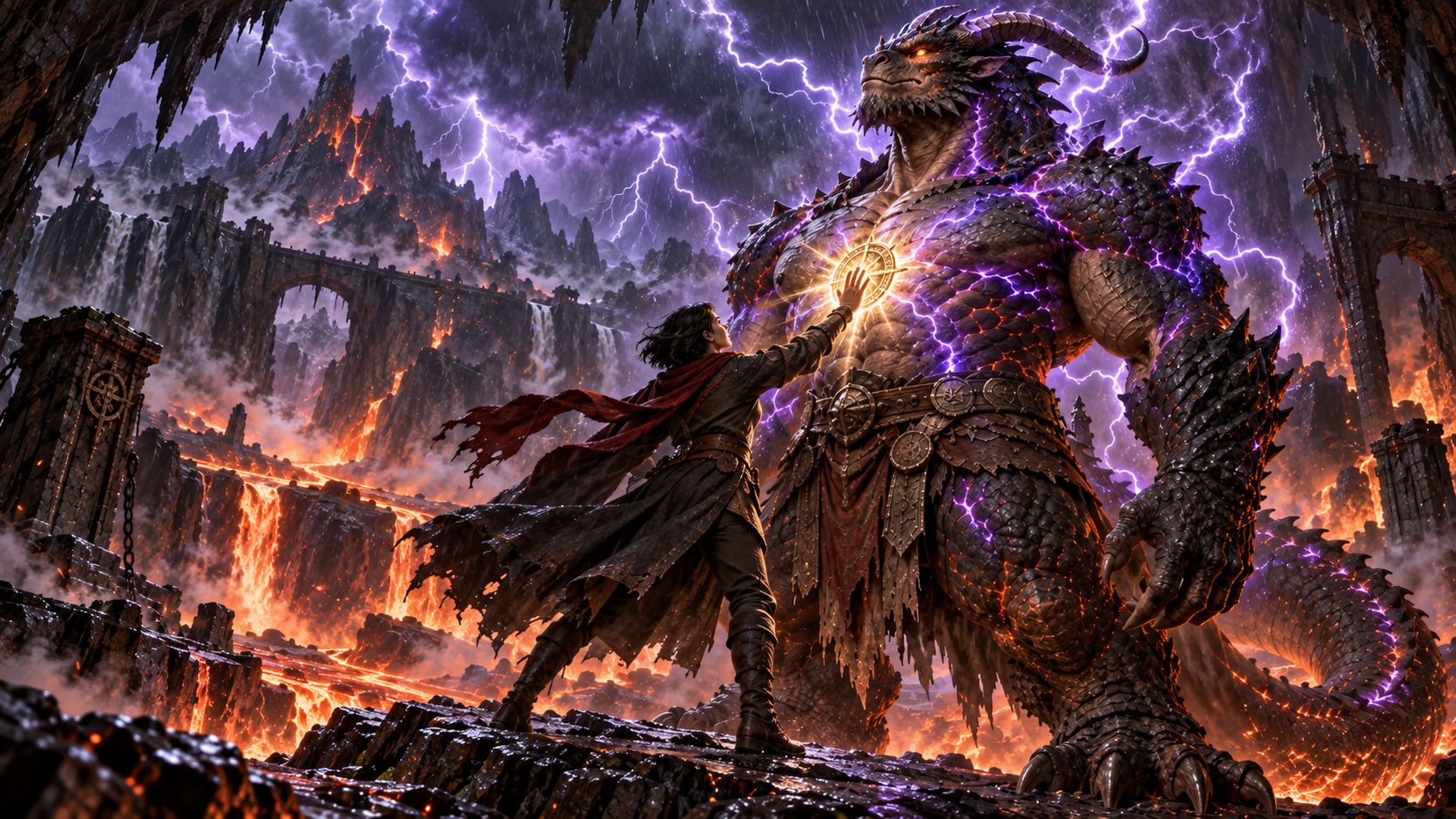
The mountain became still.
At dawn, the soldiers returned with three hundred men and a royal engineer. They found the pass gone.
Where the road had been stood a wall of black glass. Within it, frozen lightning formed the shape of a colossal dragon’s eye.
The condemned villages received a visitor that winter: a broad-shouldered traveller with amber eyes, accompanied by a woman who answered only to her true name. Wherever they passed, boundary stones melted. Deeds vanished from locked chests. Cruel men dreamed of thunder beneath their beds.
Some said the traveller was an ogre dressed as a dragon. Others said he was a dragon burdened with an ogre’s hunger.
Mara never corrected them. She knew the truth was larger, older and considerably harder to fit inside an inn.
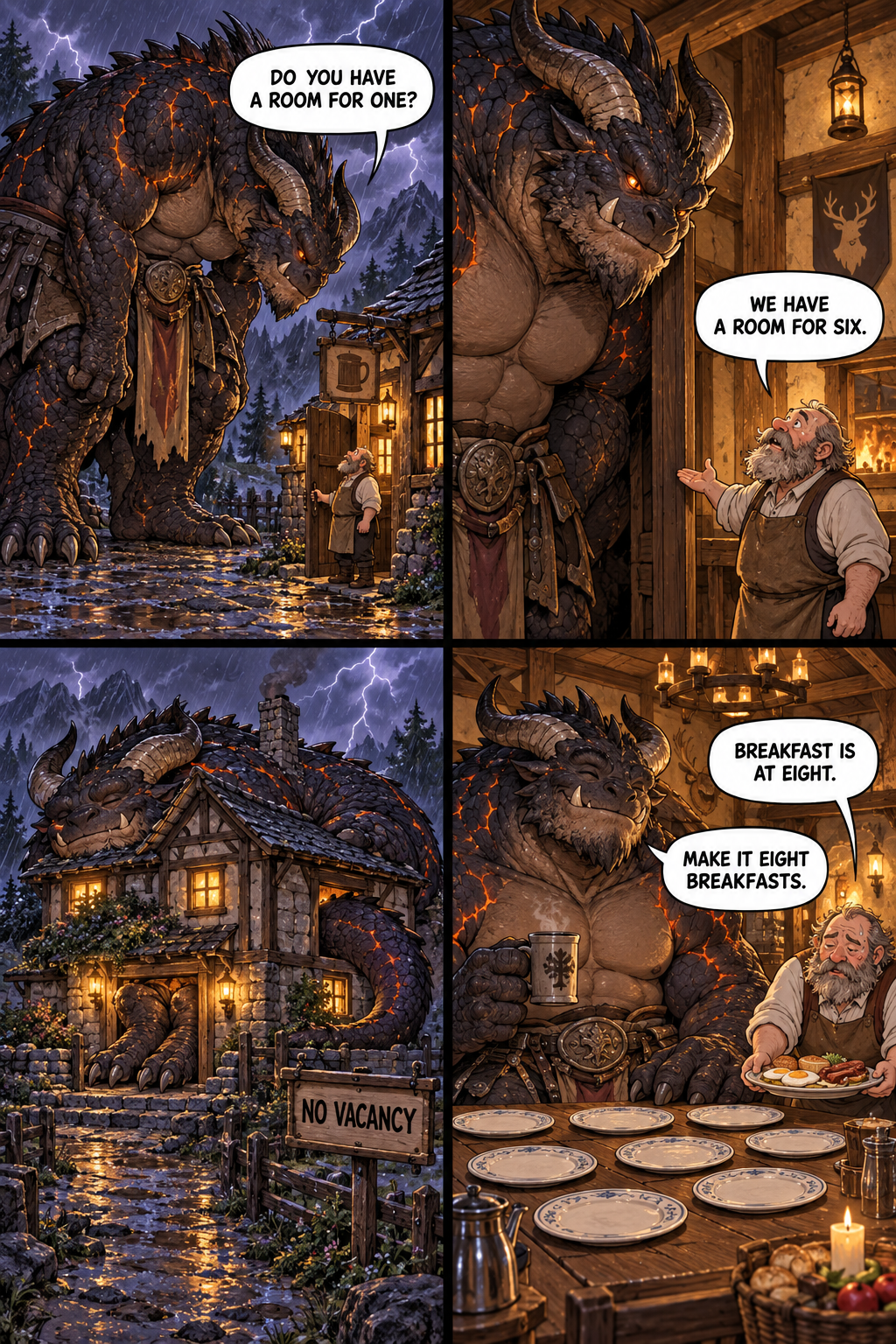
The Small Comic: A Room for One
Watch the Tale
Watch on YouTube
Watch on YouTube
Curator’s Cabinet
This story takes inspiration from the modern creature lore behind Ogre Dragon — the Storm-Blooded Colossus by Love Smiths. The linked 18+ product page contains the creator’s original creature artwork and tale, along with the adult collectible that inspired the concept.
Keep a little dragon magic nearby with L’Atelier Époustouflant’s dragon-frame photo magnets, personalised with your own photo.
Affiliate disclosure: This page contains affiliate links. If you purchase through them, The Velvet Bestiary may earn a commission at no extra cost to you. Recommendations remain separate from the fiction. Read our disclosure.
Sources and further reading
- Charles Perrault, The Fairy Tales of Charles Perrault, including “Little Thumb,” “Puss in Boots” and “The Sleeping Beauty in the Wood.”
- University of Colorado Boulder, digitised edition of Perrault’s “Hop-o’-My-Thumb.”
- Love Smiths, “Ogre Dragon — The Storm-Blooded Colossus,” creature artwork, original tale and product page.
Editorial note: Historical sources establish the literary ogre tradition. Love Smiths’ Ogre Dragon is a modern fantasy character. The Velvet Bestiary story above is original fiction inspired by both and does not claim the Ogre Dragon is a traditional folkloric being.
Leave a Reply