The Nightwarden:
What the Forest Kept
She did not come to meet the monster. She came to forget him.

Tree nymphs, sacred groves and the Nightwarden
Nightwarden is our name for a fictional forest guardian. The older beings through whom to approach this tale are Greek nymphs, especially those whose lives are bound to individual trees. A nymph may sing, dance, rear a child or die. A grove may belong to a deity and contain the haunts of numerous nymphs. Those distinctions affect everything that happens when a person steps into the wood with an axe. [1] [2] [3]
Contents of this guide
Long before luminous alien forests reached cinema, storytellers imagined woodlands whose lives could not be separated from the beings within them.
In the Homeric Hymn to Aphrodite, mountain nymphs live alongside trees that spring up with them. When those trees wither, the nymphs' lives end with theirs. The passage gives an unsettling shape to a familiar idea: the forest is not merely somewhere a spirit lives. It can be part of that spirit's body.
Who brings up a demigod?
The mountain nymphs enter the Homeric Hymn to Aphrodite because a child will need looking after. Aphrodite tells Anchises that nymphs will rear their son Aeneas before she brings him to his father. To explain who these foster mothers are, the hymn pauses the family story. They live a very long time. They eat divine food and dance with the immortals. Yet each has a life that can end, measured by a fir or oak growing on a mountain. These beings can raise a mortal child, keep company with gods and still grow old. Homeric Hymn to Aphrodite, lines 256–279
The trees are sacred while they stand. People leave them alone. When their allotted end comes, the bark withers, the branches fall and the nymph’s life goes with them. Imagine passing the same tree every winter. You might never see the woman who lives on its timescale. You would nevertheless have some idea how old she was getting. That is a rather different encounter from finding a human figure hiding among the branches. The hymn in the University of Chicago’s classical texts collection
Ovid makes the connection bloodier in Book VIII of Metamorphoses. Erysichthon attacks an oak sacred to Ceres. The wounded trunk bleeds; a dryad speaks from within it. He ignores the warning and fells the tree. Ceres answers the destruction with hunger no meal can satisfy.
The oak that already has witnesses
In Ovid, Erysichthon chooses a tree that a whole community can recognise. The oak is vast, hung with garlands and votive offerings. Nymphs have danced round it. When a man tries to stop the cutting, Erysichthon turns his axe on him. Only then does the voice from the wood announce the dryad’s approaching death and the punishment to come. Her companions take their grief to Ceres. The attack on the tree has broken a set of relationships extending well beyond its trunk. The Nightwarden’s forest can remember a visitor. Ovid’s grove needs no such magic to remember who came with an axe. Ovid, Metamorphoses VIII, Erysichthon and the oak
A nymph, a hamadryad and a sacred tree
Nymph is the broadest of these names. In the Homeric Hymn to Pan, nymphs dance in places a herdsman might pass: a mountain slope, a spring, a wooded glade. In the Hymn to Aphrodite, a particular group of mountain nymphs has a more intimate relationship with trees. Firs or tall oaks grow when the nymphs are born. The trees flourish for a long time, then lose their bark and branches as the nymphs’ allotted lives run out. The hymn imagines beings whose lifespan can seem immense to a human parent and yet has an end. [4] [1]
Hamadryad is the useful narrower term for a nymph sharing the life of a tree. Athenaeus preserves verses attributed to Pherenicus in the course of a discussion about food and fruit. A list of daughters supplies names associated with such plants as the oak, the vine and the fig. A writer interested in the name of a fig has preserved a piece of mythical genealogy. Readers comparing tree spirits need to attend to this kind of accident of transmission: a detail may survive in a work about dining although the story in which it began is largely lost. [5]
Music and company in the wild
Pan’s hymn gives a woodland encounter an audible setting. The god ranges over rough ground by day and plays his pipe towards evening. Nymphs sing and dance, and Echo answers across the mountain. For a listener out of sight of the dancers, the difference between a human voice, an echo and an unseen company is precarious. The poem also brings the nymphs into relation with the god through shared pleasure. Their activities continue perfectly well before a human visitor arrives. [4]
This helps explain why a modern forest guardian and a nymph can feel related even when their functions differ. A guardian on patrol has a duty, an intruder to detect and a boundary to enforce. The nymphs in the hymn have music and one another. A person crossing their ground may have interrupted something rather than triggered a trap. Ancient representations of animate woodland can imagine a place as inhabited without supplying a single sovereign intelligence who speaks for the entire forest. [4] [1]
Two poets tell the tree-feller’s story
Callimachus’s Greek Hymn to Demeter sets Erysichthon among the trees of a grove sacred to the goddess. He wants timber for a hall where he can feast. A poplar cries out when struck. Demeter takes the appearance of her priestess Nicippe to warn him, and he meets the warning with a threat. His punishment is a hunger so consuming that his household struggles to contain the expense and the embarrassment. His original ambition to furnish a dining room makes the choice of punishment particularly exact. [2]
Ovid’s Latin version makes the wounded oak and its resident nymph central. The tree bears signs of reverence from other people, bleeds when struck, and a voice announces the nymph’s death. Her companions appeal to Ceres, the Roman goddess corresponding to Demeter. Reading the versions separately preserves two powerful details that tend to disappear in a blended retelling: the Greek poet gives a disguised goddess an opportunity to warn the man, and the Roman poet gives the victim a chance to speak from the tree. [3] [2]
Who owns a grove?
In these poems several claims can coexist in the same patch of ground. A deity receives honour there. A nymph can depend on a living trunk. Human neighbours remember the place, hang offerings on the branches and recognise an outrage when it happens. The man who sees only the amount of timber available has overlooked every relationship that would have warned him. That is a historically more precise way into these texts than treating them all as accounts of a single ancient office of forest protector. The Nightwarden inherits the question of whose life a forest contains. His body, world and particular duty are inventions for this tale. [1] [2] [3]
These are distinct ancient literary traditions, not accounts of blue-winged alien guardians. The story below borrows their connection between living woods, injury and consequence. Its characters, setting and memory ritual are original fiction.
Sources and further reading
What the Forest Kept
The machines would start at dawn.
Nadia Rook had written the hour herself, beneath a map of the eastern grove. Now, walking beneath its branches, she could hear engines being unloaded beyond the ridge.
The forest remembered her before its guardian looked up.
Flowers opened along the path she had once walked barefoot. Their light followed her into the cavern, brightening the empty stone seat beside him.
She remained standing.
"Make me forget you."
The Nightwarden folded his wings. Their translucent veins caught the flowers' light: blue, then violet, then a darkness she could not remember seeing there before. He wore the mantle she had repaired last winter. Her uneven stitches were still visible beneath his throat.
"All of me?"
"Enough to sleep."
Behind him, luminous sap marked a ring upon the roots. Its lights dimmed one by one as the night passed. When the last went out, morning would reach the eastern grove. They had once used that quiet clock to measure how much longer she could stay.
There were very few lights left.
The Root
She set a specimen tube on the stone between them. A pale root floated inside it. She had labelled it with a number, not a name.
"You cut that this morning," he said.
"A sample."
He drew back his sleeve. A fresh, narrow wound crossed his forearm. Blue blood had dried at its edges.
Nadia looked from the wound to the tube.
"You said it was a root."
"It is."
"I thought it was only a plant."
"I said it was a root, Nadia. You supplied the 'only.'"
Above them, something immense shifted beneath the stone.
She knew that the grove and its guardian exchanged signals. He had shown her the responses to touch. She had watched light travel from a branch into the markings at his wrist. She had still told herself that a severed root was a local injury, that he could retreat into another cavern while the forest grew back.
None of her diagrams had included a sleeve being pulled back.
"Will you do it?" she asked.
He rose and walked toward the far wall. The stems parted around him, revealing an opening narrow enough for one person at a time.
"You can leave a memory here. You will lose it. The forest will not."
"Would you forget?"
"No."
She had expected anger. His willingness was worse.

The Night She Chose
Pale leaves hung without branches beyond the opening. The grove kept what it had felt: rain, footsteps, the pressure of hands, voices carried through its wood. Nadia had seen fragments before. Tonight she could hear whole conversations passing softly above her.
The Nightwarden held out his hand. A leaf lowered itself into it.
Nadia heard rain.
She was standing beneath his outspread wing, inside a night she had avoided remembering for six months.
He had asked whether she wanted him closer. She had taken his hand and placed it against her cheek.
She remembered the rain striking the wing above them, his hesitation before the kiss, the warmth of his hand. When she kissed him again, his careful composure had broken into a small, astonished laugh. She had drawn him back by the clasp of his mantle before he could apologise for it.
The memory ended.
Nadia was still holding her own face.
"This one."
Beneath the leaf, a white ember rested in a stone dish.
"The night is where your bond began," he said. "If you sever it, you lose what grew from it too. Our time together. What you learned of me. What it meant to you."
"And the leaf?"
"Stays here. Burning its stem breaks your connection to the memories. It does not destroy our record. Nothing outside you is undone."
She took it from him. A fine thread of light ran from the stem to her palm.

The Other Leaf
A second leaf descended beside the first.
Its image was not a kiss.
It was her field office, built among the eastern roots. The extraction map spread across her desk. Her own voice saying that the proposed clearance corridor contained no evidence of individual sentience.
Someone had asked whether she was certain.
She had signed instead of answering.
The forest had been beneath her feet then, too.
Nadia stepped back. The leaf followed.
"I didn't ask for that."
"No. But it was true."
There it was again: her signature. The sample number. The corridor she had marked for clearance that morning. Her contract depended on the survey being accepted. The unedited recordings she had withheld would have made acceptance impossible.
She had not believed the grove incapable of feeling. She had needed its feelings to be inconvenient, inconclusive, someone else's problem.
Now its blood stood in a numbered tube.
"If I forget you," she said, "I won't remember whom this hurts."
The Nightwarden looked at the two leaves. He did not answer for her.
She had called it heartbreak because that sounded less deliberate. But she had come to remove the memories that made her signature unbearable. The report would remain. The machines would come. She wanted to be able to sleep afterward.
Beyond the ridge, an engine turned over.
A root snapped. The stone shelf shuddered, and the Nightwarden caught it with one hand. Another light went out upon the wall.
Nadia reached toward him.
"Don't."
She stopped.
This time, she did not tell him that she had meant well.

What She Sent
She moved the kiss leaf away from the ember. The thread at her palm remained unbroken.
Then she held out the memory of her signing the report.
"Keep this one where it can be witnessed. If anyone comes to ask what I knew, show them."
He returned it to the hanging archive. Giving it a place there had erased nothing from her. She could still hear the question she had refused to answer.
She took out her field transmitter.
The report was still there. So were the recordings she had excluded: responses to touch, patterns that changed with his speech, the links between the grove and its guardian.
She attached the new sample reading, the original survey, her signed retraction and a confession that the omissions had been deliberate. She addressed the packet to the independent review office and every laboratory that had trusted her work.
The screen warned her that transmission could not be recalled.
She sent it.
Outside, the engines continued. There would be calls, an investigation, arguments over stopping the work. A message was not a miraculous cure. But nobody could now use her permission without seeing what she had hidden.
"Will that save you?"
"I don't know."
"Will you forgive me?"
He looked at her then.
"Not tonight."
She nodded.
At the mouth of the cavern, the kiss leaf settled into her hand. Its light sank gently into her skin, and the thread faded. Not broken. Returned.
She remembered the rain, the second kiss, his laugh. She remembered the desk and the pen as well.
Nadia walked out alone. Behind her, the flowers closed slowly, conserving their light until dawn.
The forest let her go.
It did not forget her.

A Private Moment
Before the night of the archive, Nadia and the Nightwarden had a simpler problem: finding somewhere the forest could mind its own business.
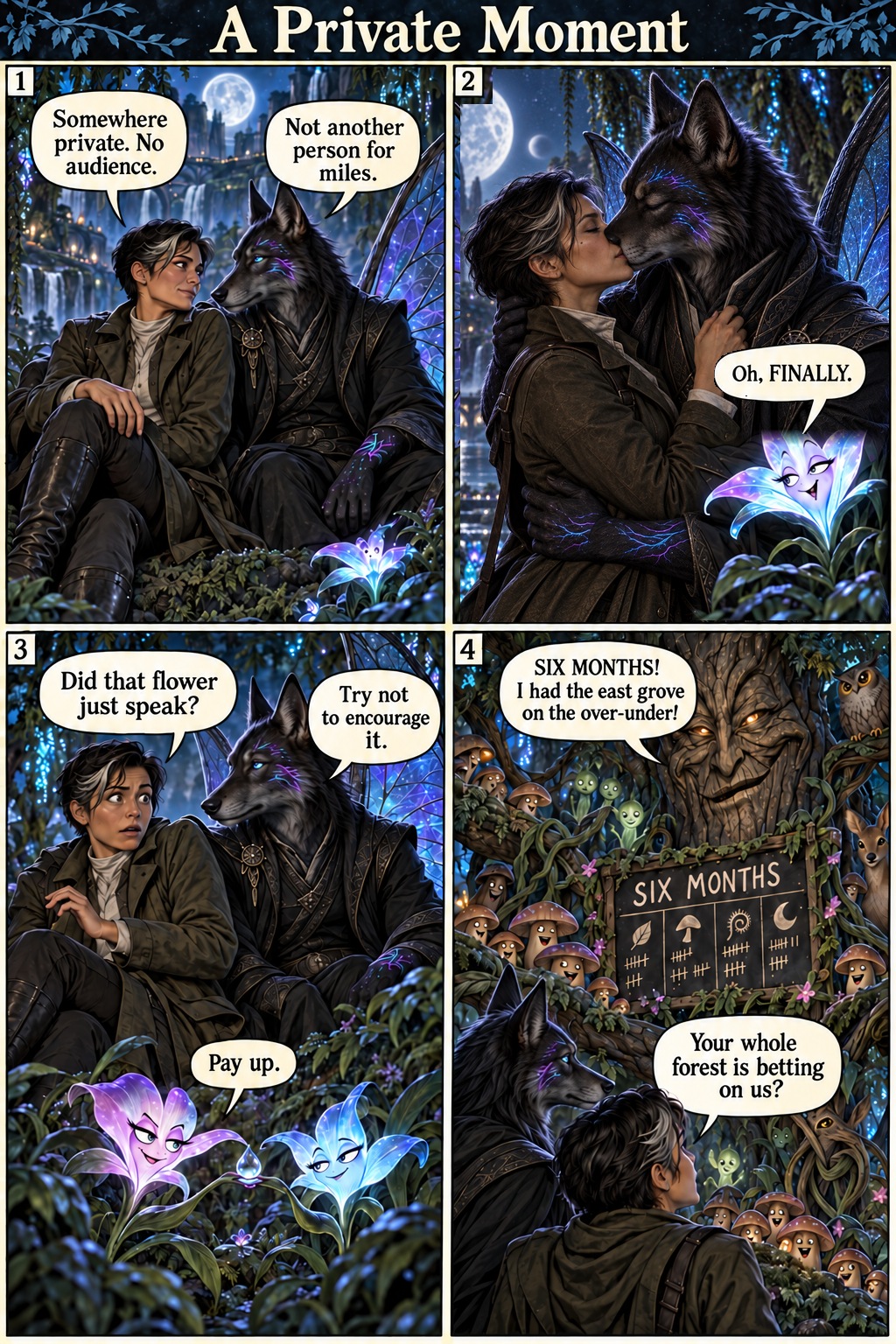
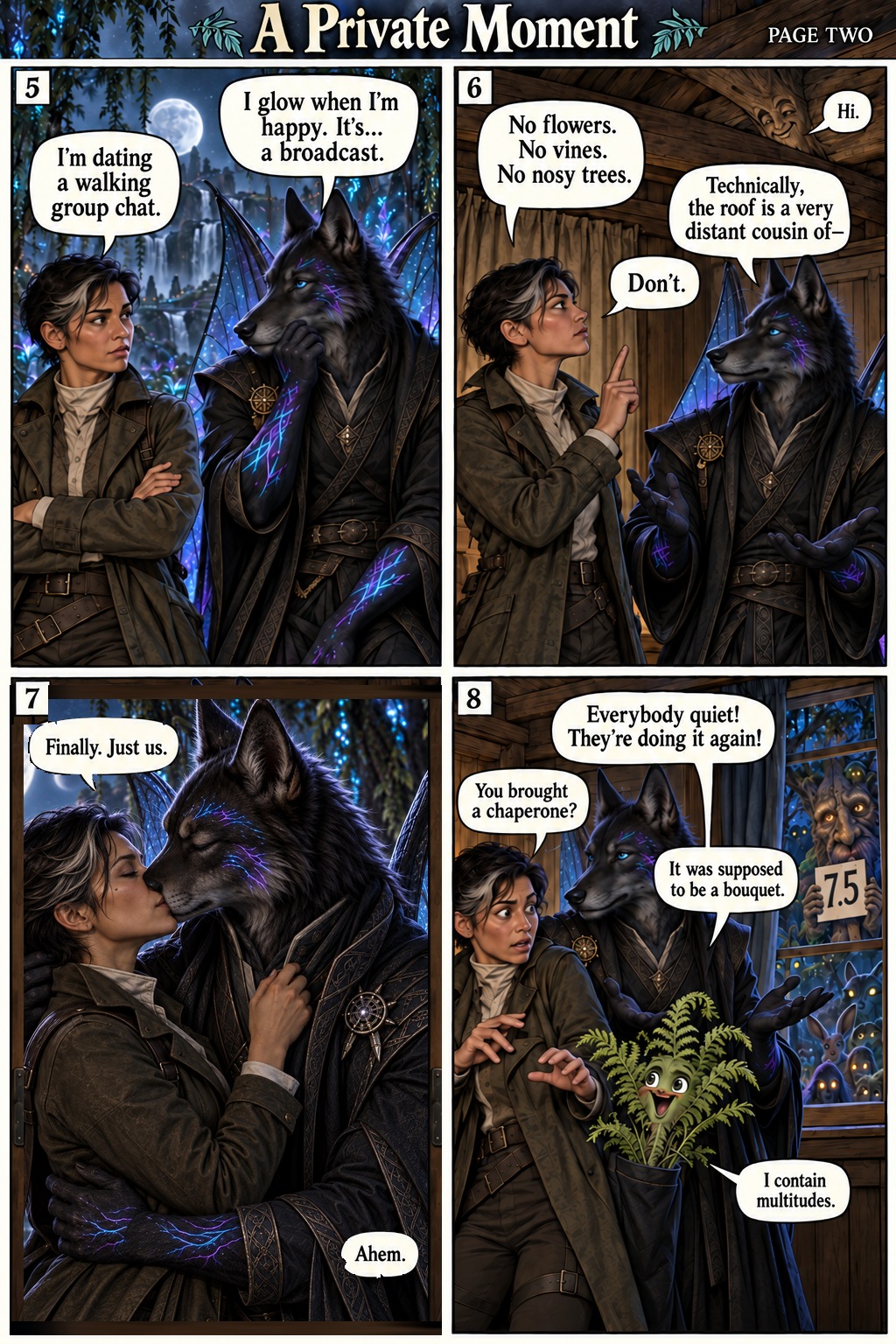
Read the comic transcript
Panel 1. Nadia: Somewhere private. No audience. / Nightwarden: Not another person for miles.
Panel 2. Flower: Oh, FINALLY.
Panel 3. Flower: Pay up. / Nadia: Did that flower just speak? / Nightwarden: Try not to encourage it.
Panel 4. Old tree: SIX MONTHS! I had the east grove on the over-under! / Nadia: Your whole forest is betting on us?
Panel 5. Nightwarden: I glow when I'm happy. It's… a broadcast. / Nadia: I'm dating a walking group chat.
Panel 6. Nadia: No flowers. No vines. No nosy trees. / Nightwarden: Technically, the roof is a very distant cousin of— / Nadia: Don't. / Rafter: Hi.
Panel 7. Nadia: Finally. Just us. / Fern: Ahem.
Panel 8. Fern: Everybody quiet! They're doing it again! / Nadia: You brought a chaperone? / Nightwarden: It was supposed to be a bouquet. / Fern: I contain multitudes.
Watch the Moving Tales
Watch on YouTube
Watch on YouTube
Curator’s Cabinet
For readers drawn to luminous guardians and unfamiliar worlds, this creature-inspired adult design carries a little of that otherworldly atmosphere beyond the page. It is separate from the story and its fictional memory ritual.
For your reading table, personalised coasters from L’Atelier Époustouflant can carry an illustration of your own.
Affiliate disclosure: This page contains affiliate links. If you purchase through them, we may earn a commission at no extra cost to you. Recommendations remain separate from the fiction. Read our disclosure.
Roots of the Tale
- Homeric Hymn to Aphrodite, lines 256–272 — the linked lives of mountain nymphs and their trees.
- Ovid, Metamorphoses, Book VIII — Erysichthon’s attack on the sacred oak and the dryad within it.
The Nightwarden, Nadia and the memory archive are original Velvet Bestiary fiction, not an ancient legend or an official screen-universe story. Illustrations are AI-assisted.
Another threshold awaits: The Dungeon Without Locks · The Drider’s Eighth Thread.
Leave a Reply