The Griffin and the Homing Coin
The mint pays its gold guard in coins that fly home when the pay bell rings. Before the council arrives, she has to find out who taught them the way.

Griffins in ancient art, travellers' tales and medieval poetry
A griffin, also written griffon or gryphon, combines a lion’s body with the head of a bird of prey. Many examples have wings. An ivory carver could show it leaning over a plant, a Greek writer could place it beside northern gold, and a medieval poet could harness it to a chariot. The eagle-and-lion outline travelled much further than any one story about the creature. Its history begins as much in workshops as in books. [1] [2] [3]
Contents of this guide
Herodotus puts the world’s greatest store of gold in the far north of Europe and reports that the Arimaspians, a one-eyed people, were said to carry it off from griffins. He does not vouch for any of it: he says he doesn’t believe in one-eyed men. In another passage he traces the chain of tellers. The Issedonians told the Scythians, and the Scythians told the Greeks. The griffin’s link to gold therefore reaches us at third hand, along a trade route.
A traveller at the edge of the map
Herodotus gives the reader more than one storyteller to listen to. In Book IV he names the poet Aristeas of Proconnesus, who says he reached the Issedonians while under the influence of Apollo. Beyond them in the poem are the one-eyed Arimaspians, beyond those the gold-guarding griffins, and still farther on the Hyperboreans, whose country reaches the sea. The order is worth noticing. Each group lies on the far side of another, and the poet’s personal journey takes him only to the first. A reader can follow this extraordinary itinerary and still point to the place where an eyewitness would have had to hand the telling on. Herodotus, Histories 4.13
The griffin’s gold is part of a question about wealth at the edges of the known world. Herodotus wants to know where all that gold comes from. He gives the reported answer and then pauses to register his difficulty with the idea of an entire people born with one eye. It is a surprisingly conversational moment. Two readers in the same room can be fascinated by the beast and disagree about the traveller who claims to know its neighbours. The historian has left room for both of them. Herodotus, Histories 3.116
The creature survives as an object, too. The Metropolitan Museum holds a small East Greek terracotta griffin head from the 4th century BCE, about eight centimetres tall, which may once have decorated a drinking vessel. The museum describes the heraldic griffin as having a lion’s body and an eagle’s head and wings.
The griffin at the rim of a cauldron
For something a person could actually stand beside, look at a Greek bronze protome, a projecting head made for the shoulder of a large cauldron. The Met dates this one between the middle of the seventh and the beginning of the sixth century BCE. Several such heads could surround a single vessel. Elaborate cauldrons were dedicated at sanctuaries including Olympia, Delphi and Samos. Picture walking around the offering. Long before you could see the griffins on the far side, the near ones would already seem to be looking your way. The bronze puts a remarkable body to work in a human place of dedication. Its maker had no need to settle what really lived beyond the Issedonians. The Met, bronze Griffin Protome
Before the Greek account of the gold
A small carved ivory in the Metropolitan Museum shows a griffin resting its front legs on a plant form and raising its head. The surviving piece may once have had an adjoining panel that completed the plant. Ivories of this kind were set into furniture in the early first millennium BCE. A reader who looks only for a griffin crouching over coins might walk straight past it. The plant, the original support and the direction the animal is reaching all matter to what the scene might once have shown. [1]
Another plaque, excavated in a storeroom at Fort Shalmaneser in Nimrud, shows a griffin rearing against a papyrus flower. The fort stored objects acquired in the course of Assyrian expansion, among them booty and tribute. Findspot, style of workmanship and original intended setting can therefore be different pieces of information. A museum label saying an ivory was found in an Assyrian building does not tell us that one Assyrian author invented its animal. It gives us a much firmer and more interesting starting point: an actual object and evidence for the routes by which such images moved. [4]
A beak, a wing and a name
On early Greek cauldrons the part projecting from the vessel can be a head and neck alone. Specialists call this a protome. Pointed ears, an open beak and the long neck can be enough for a viewer to recognise a griffin, even with no wings or lion paws visible. On an ivory there is room for the relationship between bird forepart and feline body. On a vase or a bronze vessel a maker has different surfaces to fill and different loads to support. Surviving griffins should not be graded against the anatomy of a modern full-body illustration. [5] [1]
A hippogriff is an especially instructive near neighbour. In canto 4 of Ariosto’s Renaissance Italian Orlando Furioso, the poet supplies its parentage: a griffin sired it on a mare. Its forward features and wings express one side of that parentage, and the remainder resembles its mother. The poem needs a remarkable mount and makes its shape intelligible through a family relationship. The names griffin and hippogriff therefore give genuinely different leads to a reader trying to identify a winged animal with a rider. [6]
From an Arabic inscription to a Christian procession
The large bronze known as the Pisa Griffin probably originated in the medieval Islamic Mediterranean. It bears an Arabic inscription wishing good things to its owner. In Pisa the bronze spent centuries on the cathedral. The research project that studied it compared its construction with other cast animals. A metal object can outlast the building or patron it was made for, travel between languages and acquire a radically different audience. Its inscription remains evidence of an earlier setting even when a new viewer has learned to recognise it as part of a Christian city. [7]
Dante’s griffin draws a chariot in the procession near the end of Purgatorio. In canto 31 Dante looks at its reflection in Beatrice’s eyes. The reflection appears now in one nature and now in the other while the creature itself stands still. The University of Texas commentary relates the paired natures to Christ. This interpretation depends on what the animal does in a particular procession and on the language of the poem. It would tell us little about the function of the furniture plaque from Nimrud. The same composite body gives the poet and the ivory carver different possibilities. [3]
Did dinosaur bones inspire the griffin?
A much-repeated modern hypothesis links the gold-guarding griffin to Central Asian finds of Protoceratops, a beaked, four-footed dinosaur. In 2024 palaeontologists Mark Witton and Richard Hing examined the proposal in detail. They test it against the distribution of the fossils, the locations associated with ancient gold, the practicalities of recognising a skeleton in the ground and the long history of bird-and-lion images. They find no persuasive chain connecting the fossils to the tradition. The question is a specific historical claim that can be investigated, rather than a contest between people who enjoy fossils and people who enjoy myths. [8]
Two questions are often compressed into that attractive origin story. Could someone, at some time, have interpreted a large fossil through knowledge of fabulous animals? Did a particular encounter produce the griffin tradition or demonstrably influence the ancient account of the gold? The first possibility supplies no date, traveller or route for the second. Herodotus tells readers that he is passing on reports, and carvers in the Near East had already been making hybrid animals. Both kinds of evidence stand independently of a proposed dinosaur connection. [8] [2] [1]
Rusk, the mountain mint and the enchanted coin are original fantasy.
Sources and further reading
- The Met, Plaque with griffin, carved ivory from Nimrud
- Herodotus, Histories 3.116, gold and the northern lands
- University of Texas, Danteworlds, the griffin in Purgatorio 29 and 31
- The Met, Champlevé plaque with a griffin and floral frieze
- The Met, bronze griffin protome for a cauldron
- Ludovico Ariosto, Orlando Furioso, canto 4, stanza 18
- Italian National Research Council, The Pisa Griffin Project
- Mark P. Witton and Richard A. Hing, Did the horned dinosaur Protoceratops inspire the griffin?, 2024
Herodotus, Histories 3.116 (Macaulay translation)
The Metropolitan Museum of Art, Terracotta head of a griffin
The Griffin and the Homing Coin
The mint paid Rusk one gold coin at the wicket, and for about as long as it takes to say so, she owned it.
Then the pay bell rang. The coin split along its rim, unfolded two wings no bigger than fingernails, and flew up the counting-room chimney. She lunged. Her beak closed on soot. The coin went between two courses of brick with a sound like a wasp in a jar.
At the wicket, twelve quarry porters were turning out their pockets. Hale, the treasurer, stood behind them with his keys swinging from one finger. They had been paid a quarter of an hour ago, and every one of them was a coin short.
“Who weighed the money?” Rusk asked.
“Devren did,” said Hale. “He’s chained in the bell loft until the council gets here.”
Rusk flicked an ear. Devren had weighed the mint’s gold beside her for seven years. He counted aloud, even the numbers nobody disputed, and once he had kept a guildmaster waiting while he fished a lamb’s tooth out of the scale pan. A man like that did not miscount twelve coins.
She turned to the nearest porter. “When did you last have your money?”
“Before the bell.”
She asked the next, and the next. They all gave the same answer: after the weighing, after the count, and before the bell. Whatever had taken the gold had waited for the bell.
The bell loft had a window too small for a griffin to climb through and just big enough for one to hang her head in. Rusk landed on the sill. The timber complained. Inside, Devren sat on the floor with one ankle chained to the bell frame.
“Have you got a pencil?” she asked.
He held one up. “Normally people ask how I am.”
“You’ve still got the pencil. Draw me the other end of the chimney.”
He drew it on the back of a payroll envelope: three flues from the counting house, gathering into a tall service tower above the ravine. The narrowest let out beside the parapet, at the height of a man’s waist. Nobody had swept it in years. The pigeons had made it theirs.
Rusk tucked the sketch under a strap. Devren frowned at the floor. “Hale changed the drawstring on his pay purse this morning. He had a strip of red copper worked through it. I thought he was showing off.”
“Did he pay you?”
Devren dug a coin out of the lining of his cuff. “After the bell. I was going to check its weight. Then he had me arrested.”
The coin had never heard the bell. Rusk held it to the lamp. Two fine lines ran round its edge, and when she slid a claw under one, it lifted like the wing case of a beetle.
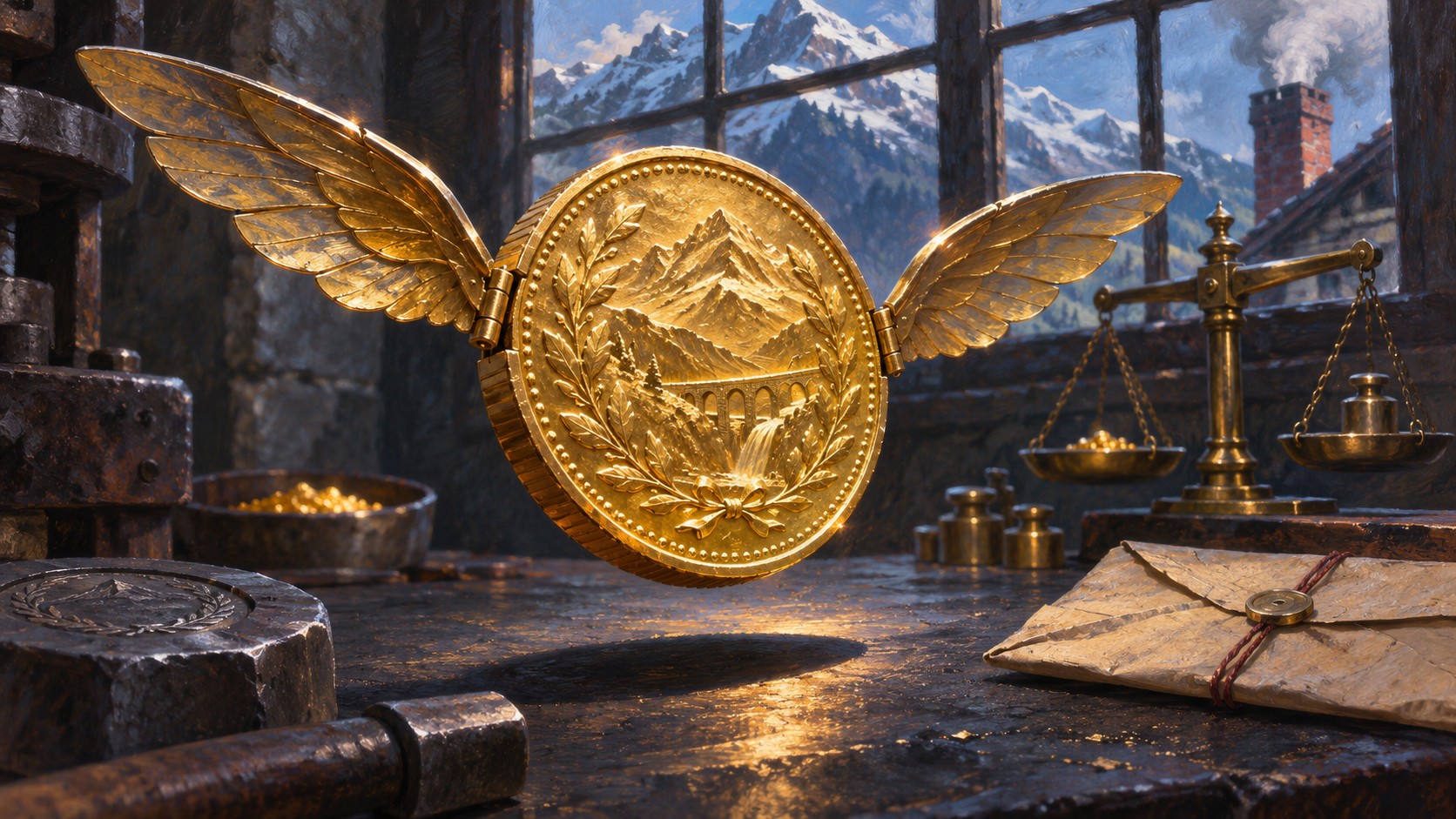
“Keep it,” she said. “When I reach the tower, ring the bell.”
She had to dive through smoke to get there. The flue was exactly where Devren had drawn it, and a red-copper purse hung beneath its mouth, lashed to the parapet and heavy with more than one man’s wages. Hale had come by the stairs. He stood in the shadow of the wall with a knife, sawing the purse free of its lashings, while on the far side of the parapet a little ropeway bucket waited to carry it over the ravine.
Rusk dropped onto the roof so hard that the gutter tore loose under her front claws. Hale flinched back, slipped on the wet lead and slid toward the gap. The knife flew out of his hand and into the dark. He grabbed a fistful of her wing feathers.
She could have shaken him off. She had room to do it, and nobody would have asked her why. Instead she caught the back of his coat in her beak and hauled until both his boots met stone.
He shoved her away, flung the purse into the bucket and kicked it off the parapet. It ran out along the wire over the ravine.
“Follow it, then,” he said. “I’ll tell the council the griffin took the gold.”
Rusk spread her wings across the top of the stair. “You can tell them from here. I’d wait for the bell.”
Devren rang the bell.
His coin shot out of the loft window and across the courtyard. It overtook the bucket on the wire and struck the purse hard enough to set the whole thing swinging. It struck again. Rusk snatched the return rope in her claws and pulled.
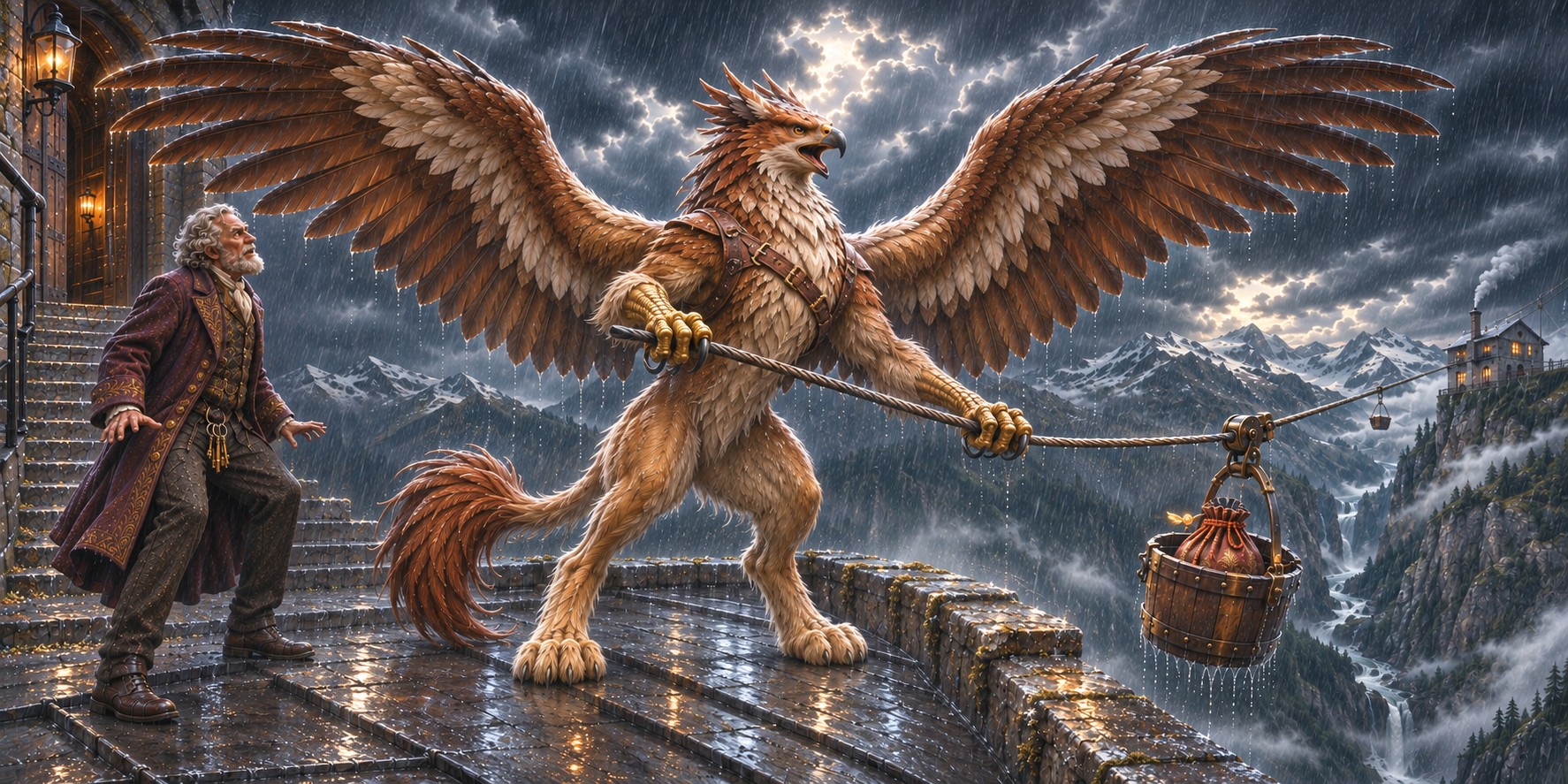
The bucket came back inch by inch. The council had been climbing toward the loft to deal with Devren, but they followed the bell instead, and then a small gold wasp up the roof stair. They reached the roof door in time to see the coin prise open a seam in the red-copper purse, squeeze inside and fall still among the others.
Hale shut his mouth.
Rusk set the purse down in the middle of the roof. “Get Devren. Count it where everyone can see.”
They carried Devren up still wearing the chain. He counted the whole purse aloud, coin by coin, and for once nobody told him to hurry. Rusk’s own coin was in the second handful.
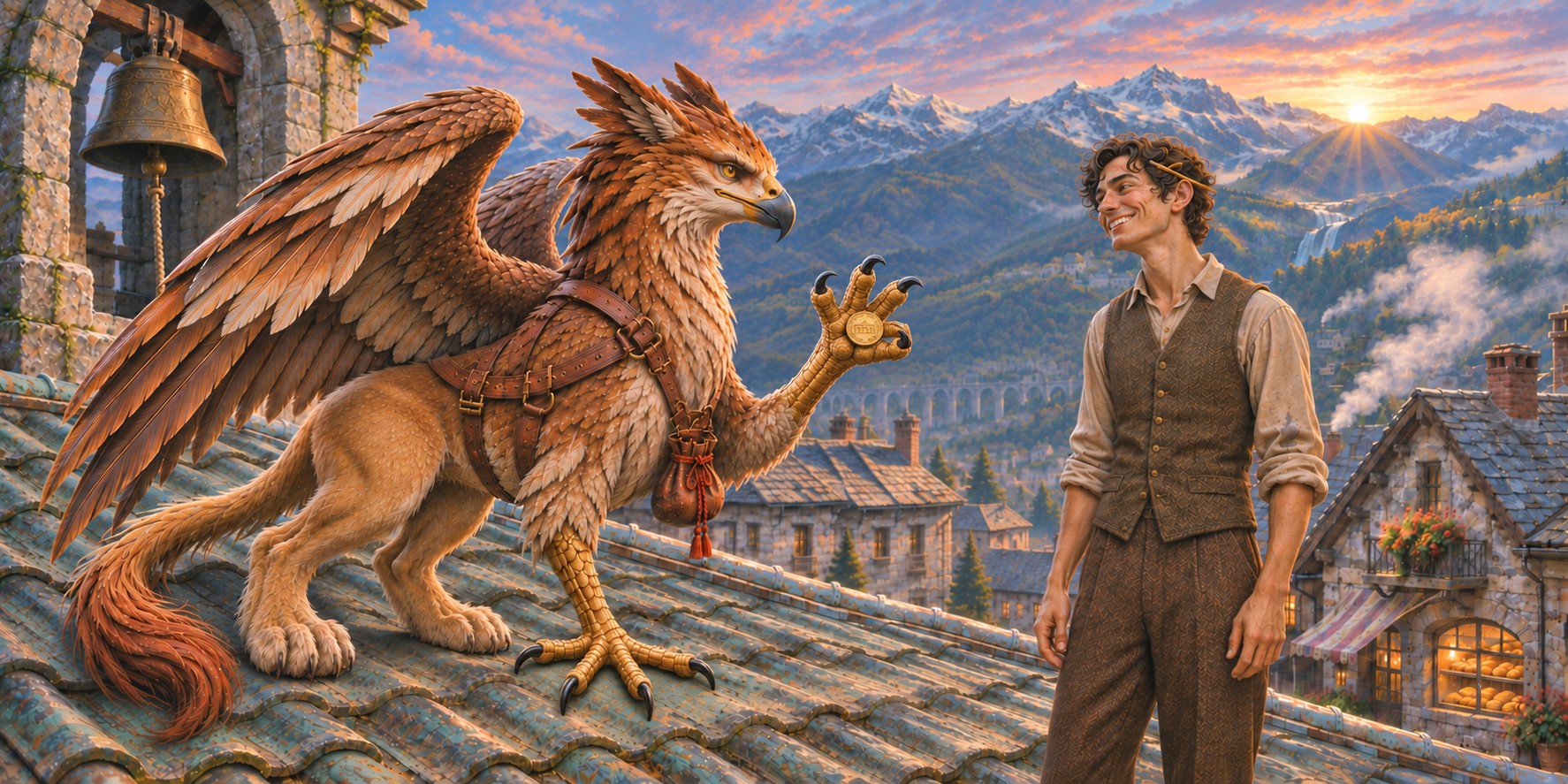
At dawn the porters were paid in silver from the reserve. Devren brought a new gold coin for Rusk and waited while she turned it over in her claws.
“You don’t trust it,” he said.
She pointed at the bell.
He climbed to the loft and rang it. When he came back down, she was still standing on the roof with the coin in her claws.
“Get your coat,” she said. “The bakery’s open. You can count the change.”
The Duke’s Tip
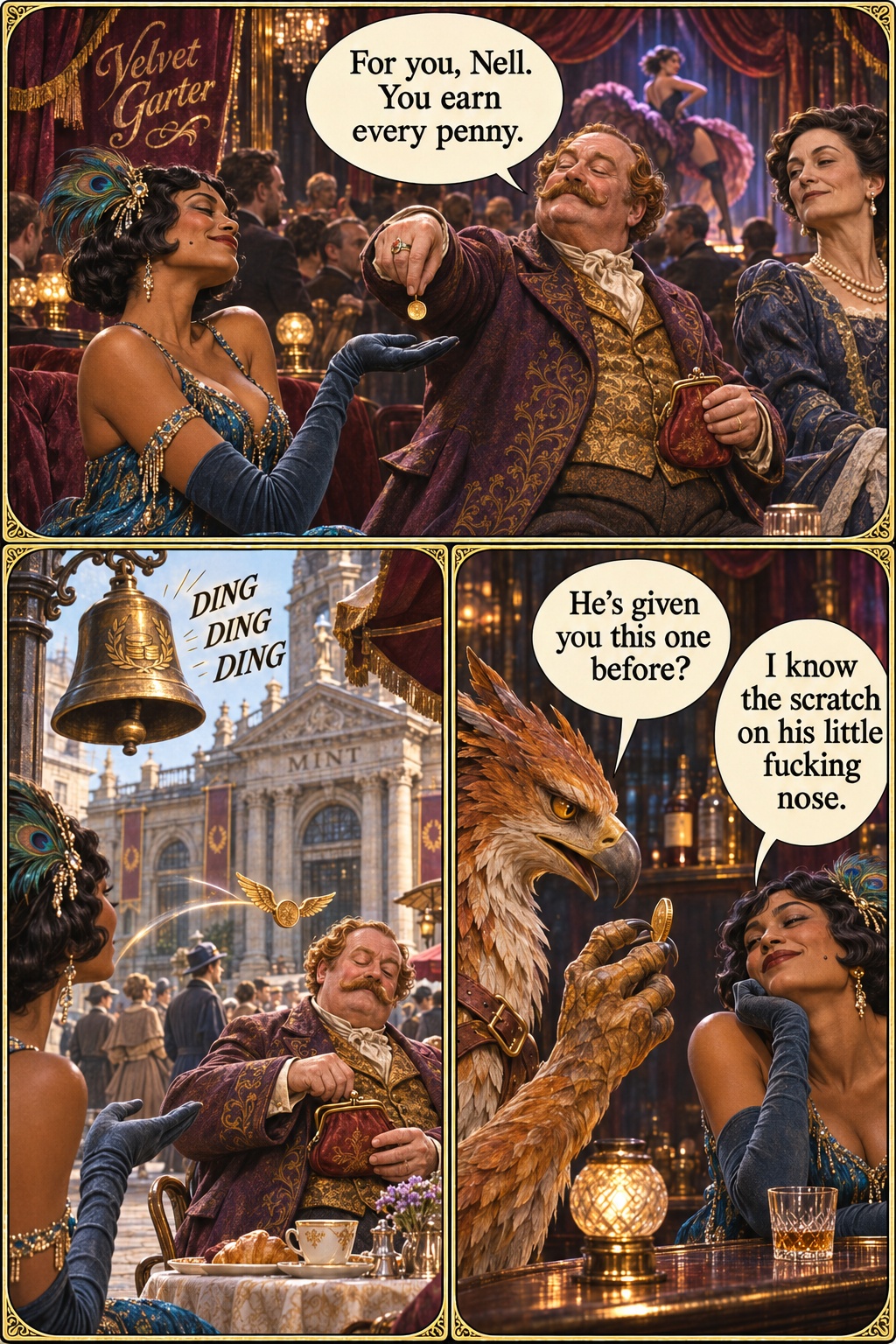
The duke has been tipping the same dancer with the same coin for a month.
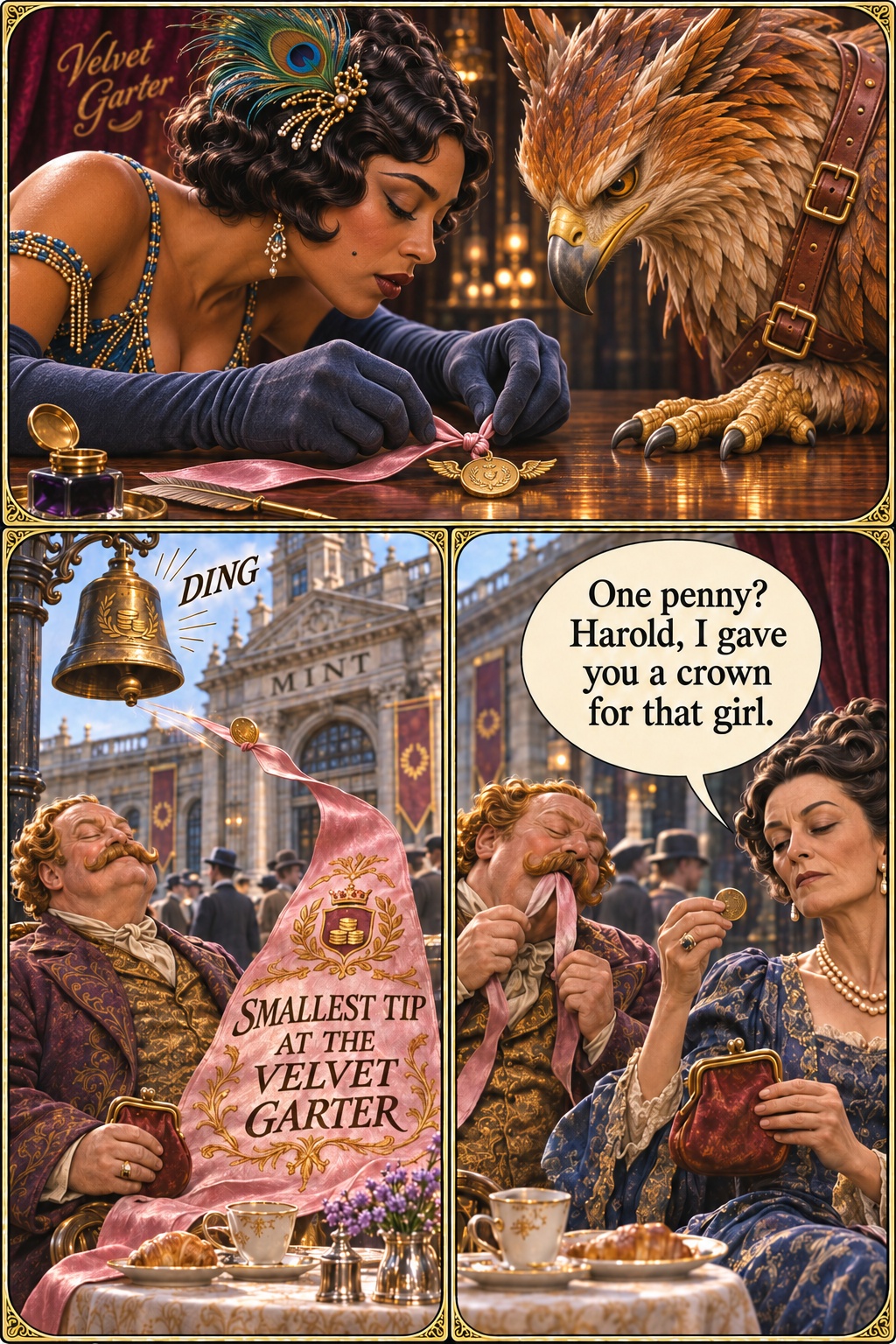
Read the comic transcript
Panel 1. The duke holds a gold penny over Nell’s glove where everyone at the Velvet Garter can see his tip.
Duke: For you, Nell. You earn every penny.
Panel 2. The mint bell rings next morning. The little penny sprouts wings and flies from Nell toward the duke’s open red purse.
Panel 3. That night, Rusk shows Nell the familiar penny at the bar.
Rusk: He’s given you this one before?
Nell: I know the scratch on his little fucking nose.
Panel 4. Nell ties the end of a pink ribbon directly to the small winged coin on the counter. Rusk watches the knot.
Panel 5. The bell rings. Flying home to the duke at breakfast, the coin unfurls a pink banner reading SMALLEST TIP AT THE VELVET GARTER.
Panel 6. The duchess inspects the penny. The duke has the end of the silk in his mouth.
Duchess: One penny? Harold, I gave you a crown for that girl.
The Night Deposit
After three false alarms, Rusk has traced the trouble to the bedroom above the mint vault.
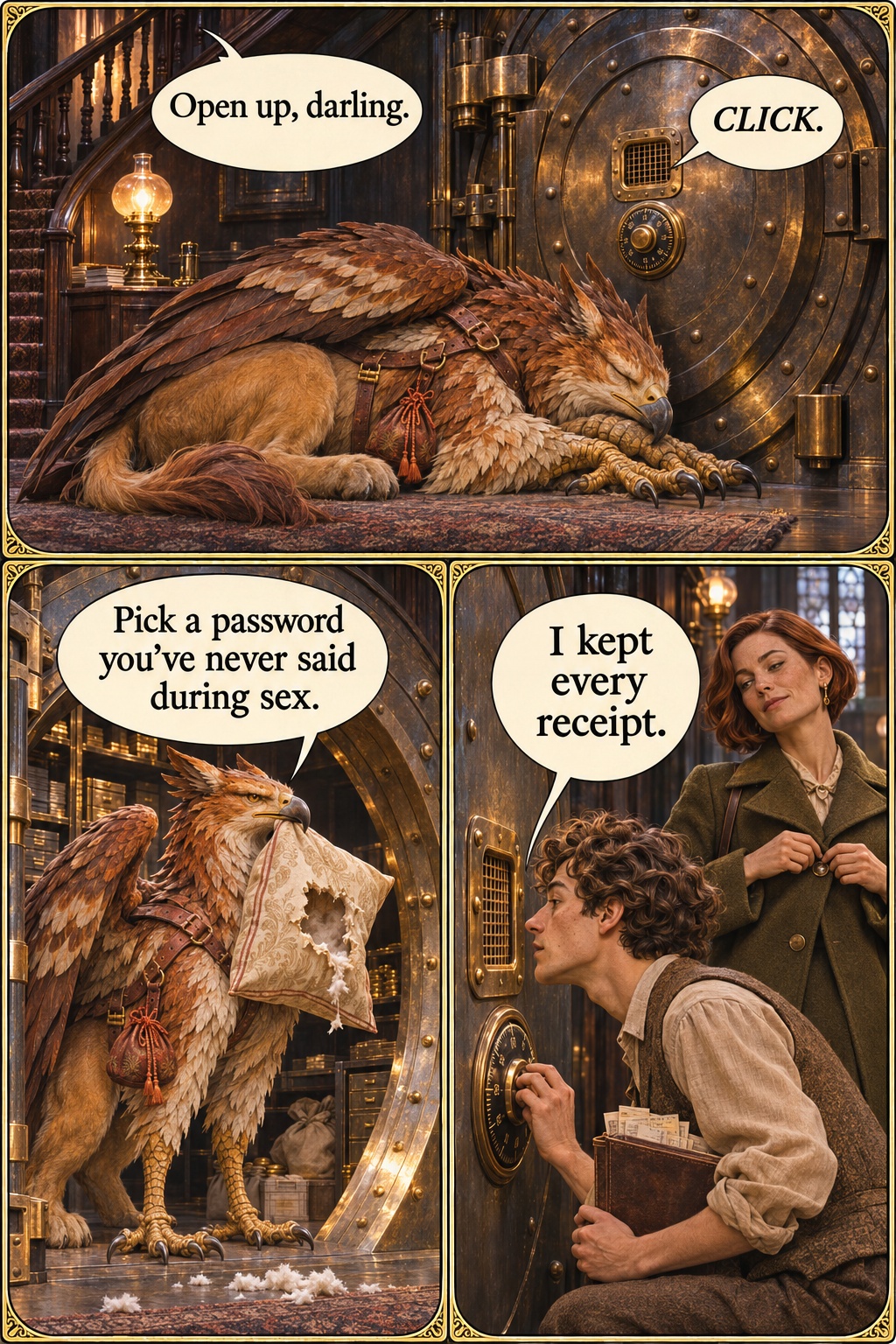
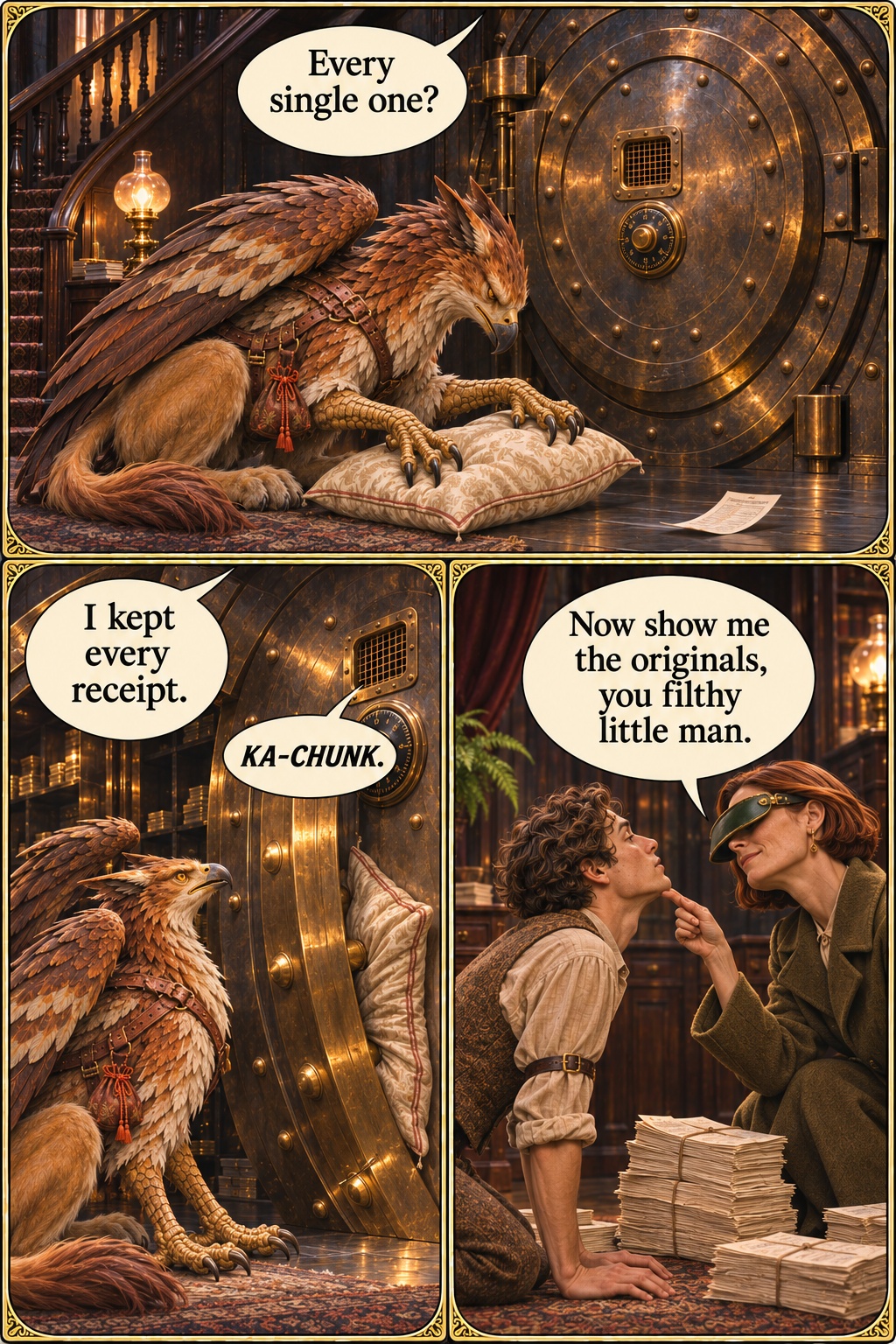
Read the comic transcript
Panel 1. Rusk sleeps in front of the vault. Devren’s voice carries down the stairs and the lock clicks.
Devren, upstairs: Open up, darling.
Vault: CLICK.
Panel 2. Rusk stands at the open vault with a hole bitten clean through her pillow.
Rusk: Pick a password you’ve never said during sex.
Panel 3. Devren leans into the speaking grille. His date pauses with one button of her coat undone.
Devren: I kept every receipt.
Panel 4. Rusk kneads a fresh pillow. A piece of paper slips along the floor and a voice carries downstairs.
Date, upstairs: Every single one?
Panel 5. The lock recognises Devren’s voice again. The vault door opens and crushes the pillow.
Devren, upstairs: I kept every receipt.
Vault: KA-CHUNK.
Panel 6. Devren kneels by stacks of tied receipts. His date, wearing a green accountant’s eyeshade, lifts his chin with one finger.
Date: Now show me the originals, you filthy little man.
Original Velvet Bestiary fiction and AI-assisted illustrations.