The Baku and the Blue Woodblock
Somebody has printed a dead woman’s kitchen on two hundred sheets of paper. By the third night, so many strangers are dreaming their way in for supper that her wife can’t get through the door.

The baku in Japanese dream lore
The baku (獏, also written 貘) is a protective beast in Japanese tradition, best known for eating bad dreams. Its trunk, tusks, shaggy body and predatory paws belong to a long history of assembling one animal out of several. The earliest Chinese animal to bear the related name, the composite beast in medieval pictures and the living tapir in a modern zoo each have a different part in that history. Donald Harper, The Cultural History of the Giant Panda in Early China
Contents of this guide
A beast small enough to sit beside the pillow
Folklore
Wake from an ugly dream and the baku is the beast you would want beside the bed. In Japanese tradition its appetite could work in the sleeper’s favour. It ate what had frightened you. The Los Angeles County Museum of Art traces the creature to Chinese lore and places it in Japan by the fifteenth century. By the early seventeenth century readers could find it in the illustrated Sankai ibutsu, a book of strange things from mountains and seas. Later printmakers gave people more than one way to picture their bedside guardian. LACMA, Monster that Eats Nightmares
Start with its nose. On a seated baku carved in Japan in the eighteenth century, the trunk belongs to an elephant. Follow the same animal back and you find tiger paws and an ox’s tail. Some accounts give it the eyes of a rhinoceros. Carvers could pick out different features, so a reader looking for one fixed arrangement of stripes, fur and scales will soon meet an exception. The seated carving at the Met is only seven centimetres high. In the close-up you can see the little rounded bumps the artist cut into its hide. The Met, Seated Baku
There survives a particularly intimate use for those odd proportions. A wooden headrest traditionally associated with Toyotomi Hideyoshi takes the shape of a baku. Its upper surface is softened with leather and cotton. The owner could settle his head on the very animal he hoped would guard it. The Kyoto account also gives the baku a taste for iron and bronze. In wartime those metals went into weapons, leaving the beast hungry. A baku carved over a gate could carry a wish for peace. The idea that Hideyoshi’s pillow may also have been a charm against assassination is the collection’s interpretation. Japan Tourism Agency, Hideyoshi’s Pillow
How a bear-like animal acquired an elephant’s trunk
One difficulty in tracing a monster is that the name sometimes travels more readily than the animal. In early Chinese writing, mo (貘) could designate a living creature. The dictionary maker Xu Shen, active around the turn of the second century CE, described it through a comparison with a bear. Donald Harper has argued from the written and zoological evidence that these early references point to the giant panda. Search those early descriptions for a trunk or for a job at someone’s bedside and you will be looking for features supplied by later witnesses. Harper, early descriptions of the mo
In the ninth century the poet Bai Juyi, also written Bo Juyi, described the mo with parts borrowed from four creatures. The elephant contributed its trunk, the rhinoceros its eyes, the ox its tail and the tiger its paws. A reader can assemble that beast feature by feature without ever having seen a living animal that looks like the result. This helps explain why a convincing picture could later become misleading evidence about zoology. In 1824 the French scholar Jean-Pierre Abel-Rémusat used woodblock pictures of this composite to identify the ancient animal as a tapir. Harper traces the subsequent currency of that identification, including the modern use of the name for real tapirs. Harper, the ninth-century description and the 1824 identification
What could a sleeper actually put beside the bed?
The Tokyo National Museum lists a Chinese Cizhou-ware pillow decorated with the beast, dated to the thirteenth or fourteenth century. It also lists Japanese pillows with baku and nandina from the eighteenth century. They let us ask a more precise question than whether people believed in dream-eaters. What could someone make, give or use in the hope of a good night? One maker could put the image on a pillow, another could carve the entire headrest in the animal’s shape, and another could choose a mirror. Those objects are evidence of protective imagery entering a household. They cannot tell us what any one owner subsequently dreamed. Tokyo National Museum, All About the Mythical Beast Baku
A New Year print offered another way to put an image to work overnight. In the custom associated with the takarabune, or treasure ship, a print of the vessel placed beneath the pillow was meant to encourage an auspicious dream. The Seven Lucky Gods are its traditional passengers. A dream-eating beast and a ship laden with good fortune answer different wishes, even when the chosen spot for a picture is the same. In one case a sleeper hopes to lose something frightening. In the other the sleeper hopes to receive a dream worth remembering. Smithsonian National Museum of Asian Art, Treasure Ship and the New Year custom
A guardian you could wear or set on a shelf
Some surviving baku are netsuke, small toggles worn with suspended belongings. Consider the problem for the carver. A tiger’s silhouette is usually easiest to recognise from its whole body in motion. A tiny object has to work when the owner turns it in the hand. A compact seated body keeps the outline readable. The long nose, paws and tail give the fingers and eyes separate points of discovery. The Metropolitan Museum’s catalogue also notes the raised bumps on its carving, a surface treatment shared with other eighteenth-century representations of supernatural animals. Those bumps help place this particular object within an artistic practice. They need not appear on every baku. The Metropolitan Museum of Art, Seated Baku
There is also a bronze incense burner in the form of a baku in the Science Museum Group collection. Put it beside the carved toggle in imagination. Both makers had to render the distinctive head, but one was shaping a vessel that would sit in a room and the other a small, portable carving. In an illustrated book the maker had paper and ink to work with instead. The Tokyo museum includes a nineteenth-century volume of Hokusai’s Manga among the materials for studying the beast. The persistence of the trunk across these settings is striking. The size, substance and work of the animal could change each time. Science Museum Group, bronze baku incense burner · Tokyo National Museum, exhibition objects
Why would a nightmare-eater guard a gate?
At a gate the baku’s appetite for metal becomes easier to understand. The Japanese collection account of Hideyoshi’s headrest associates metal-eating with the absence of weapons. There is a domestic scale to the story, a sleeper who would like danger to stay away until morning. There is also a public one, a person approaching a gate who encounters an image associated with a peaceful interior. Read the location as carefully as the face. A trunk high above an entrance can do a different job from the same trunk tucked beneath a tired head. Japan Tourism Agency, the baku headrest and gate carvings
What Velvet Bestiary invented
Our Tama inherits the bedside job and the peculiar paws. Her appetite for fried tofu is ours. So is the trouble Sumi brings her. What happens when the dream you need the baku to eat is also the last place you can still have supper with your wife?
Sources and further reading
- Donald Harper, The Cultural History of the Giant Panda in Early China
- LACMA, Monster that Eats Nightmares
- The Met, Seated Baku
- Japan Tourism Agency, Hideyoshi’s Pillow
- Tokyo National Museum, All About the Mythical Beast Baku
- Smithsonian National Museum of Asian Art, Treasure Ship and the New Year custom
- Science Museum Group, bronze baku incense burner
The Baku and the Blue Woodblock
On Tuesday night somebody in the dead woman’s kitchen asked for an egg on top. That was when Sumi lost her temper. She had been married to the cook for twenty-six years. She had been queuing for three nights.
“Eat the lot,” she told the baku. “Start with him.”
Tama put down the fried tofu Sumi had brought as a deposit. “When you say the lot, does that include the cook?”
Sumi sat on the step. She smoothed the oil paper over the remaining piece of tofu, folded in both ends and put it away. “I was hoping you’d know how to do this.”
It began with a print. After Nao died, Sumi had cut a picture of their kitchen into a cherrywood block. She got the battered kettle right on the first try. The little finger on Nao’s left hand took a whole afternoon. It bent sideways where she’d shut it in a drawer the winter they met.
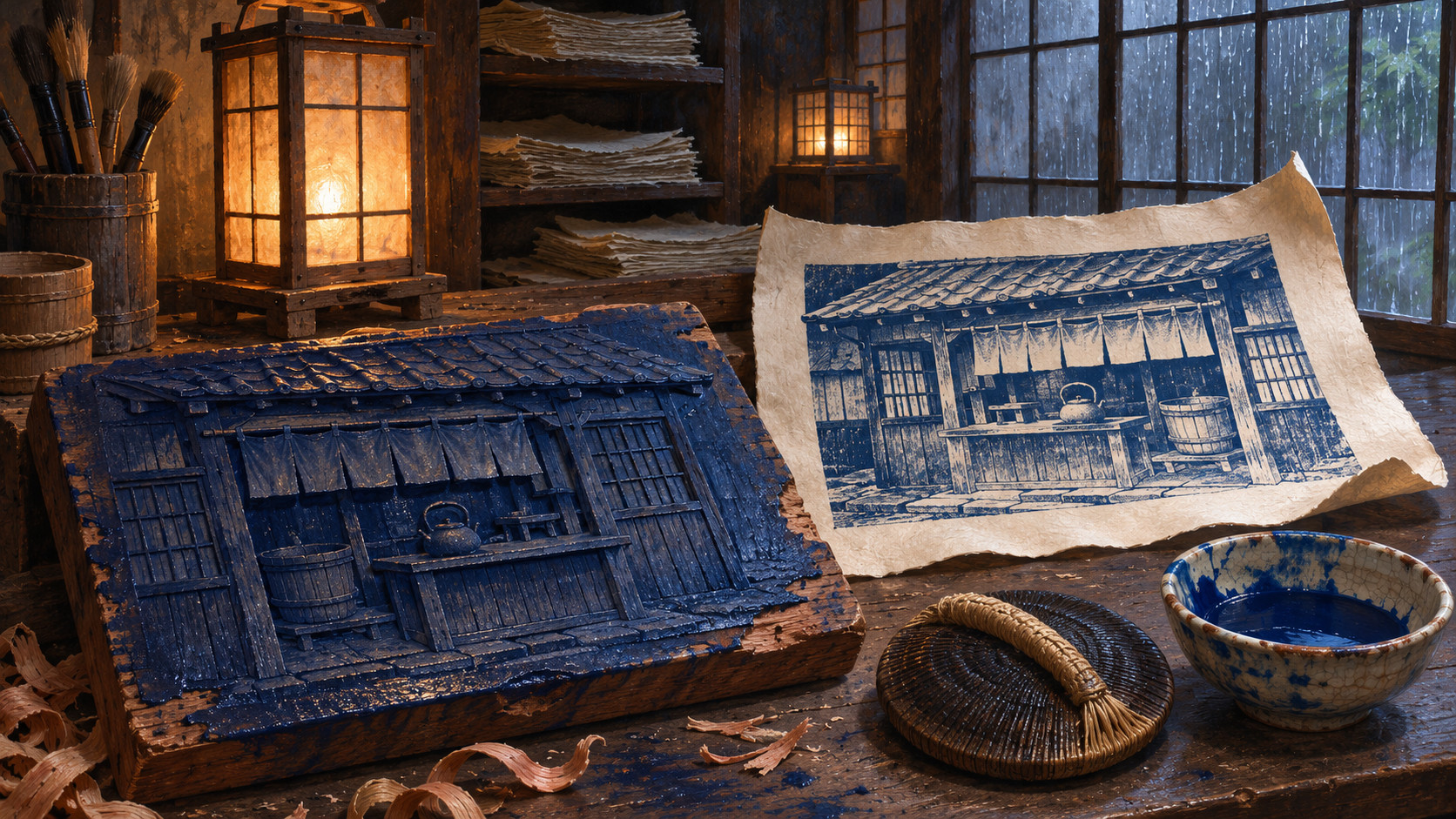
Sumi pulled a proof in blue and slept with it beside her. That night Nao served her a bowl of noodles. They discussed whether the spring onions had gone tough. In the morning Sumi took the block to her printing shop and pulled another two hundred copies. Paper and ink cost money. By then so had the funeral.
Any sleeper beside a blue print could enter that kitchen. There was just the one room to go round. On the second night a stranger found the door. By Tuesday there was a queue clear down the lane and somebody had written a review of the broth.
“I’ve bought back thirty-one,” Sumi said. “Half the town wants twice what they paid. One man wants an egg.”
At the shop Tama laid her cheek on the blue block. The timber was warm from the stove on the other side. “The room belongs to the block. I can eat a bad dream when it comes loose. This one’s still attached.”
“Suppose we burnt it?”
“Your shop. Your wife. You tell me.”
Sumi turned the block face down. Tama saw something cut into the back, under a smear of old paste. A little pair of sandals. A striped curtain. Sumi caught her looking.
“I save wood. That was our first shop sign. Nao cut that side herself.”
They put their heads down on opposite sides of the proof.
In the dream, the customer at the counter was turning his bowl this way and that to find the best angle to sketch it. Behind him Nao worked in steam up to her eyebrows. There were two hundred people between Sumi and the woman she had come to see. A baku the size of a small cupboard has certain advantages in a queue. Tama got them as far as the serving hatch.
“That’s enough orders,” Sumi called.
Nao looked up. Egg slid off the spoon in her hand. For one splendid second she looked every inch the woman who had once marched into a bathhouse stark naked to demand her stolen sandals back.
“Where the hell have you been?” she said. “I’ve needed a piss since Monday.”
The first customer complained. Tama ate his complaint. It tasted exactly like the man’s breath. He woke up and took his bowl with him. The people behind him stepped forward.
“I can spend all night doing this,” Tama said. “They’ll be back tomorrow.”
Sumi ducked under the counter. She took the ladle. Nao pressed both hands into the small of her back and for a moment simply stood there, letting somebody else be on shift.
At the rear of the kitchen was a blank blue wall. In its place in the real kitchen there had been a little door onto the lane. Tama sniffed the grain. Beneath the smell of noodles was old paste, and beneath that, the dust off a pair of sandals. Between Sumi’s kitchen and Nao’s old shop sign, the wood was scarcely thicker than paper.
“I can get you out the back,” Tama said. “I’ll have to go through the block. It’ll spoil every print.”
Sumi looked at the customers with their elbows on her counter. Then she looked at Nao, who had taken her shoes off and was rubbing one stockinged foot against the other.
She set the ladle down. “You heard her. Find the bloody door.”
Tama sank her tusks into the blank wall. Out in the printing shop the block split with a noise that woke the cat. In the kitchen the blue plaster fell away and a striped curtain lifted on the smell of rain. One by one the customers vanished from their stools. The man who wanted an egg left with his mouth open.
Nao stepped into the lane. Sumi followed her as far as the curtain. “Will I see you if I come back tomorrow?”

Nao hooked her crooked finger through Sumi’s. Her fingers were greasy. Sumi had forgotten that part.
“Love,” Nao said, “if you ever make me open another restaurant, I’ll haunt you proper.”
In the morning two hundred sheets of paper showed an empty kitchen with its back door open. A few people asked for refunds. Sumi paid them. One woman said she rather liked it this way and bought a second copy for her sister.
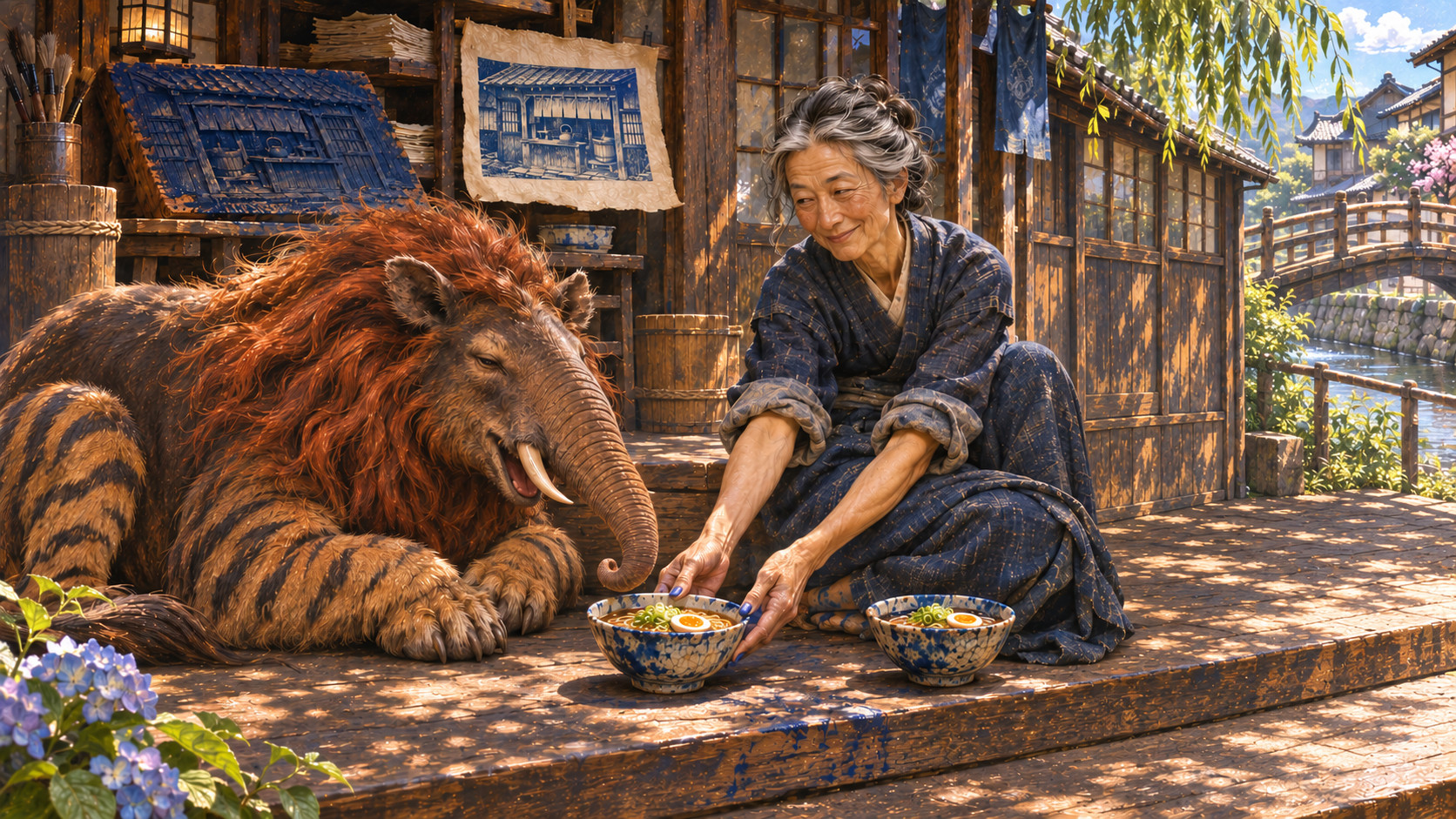
At noon Tama found Sumi behind the shop, eating noodles on the step. Beside her sat an empty bowl.
“For her?” Tama asked.
“For you, you great hairy ass. I know she’s dead.”
Tama sat down. Sumi put an egg on top.
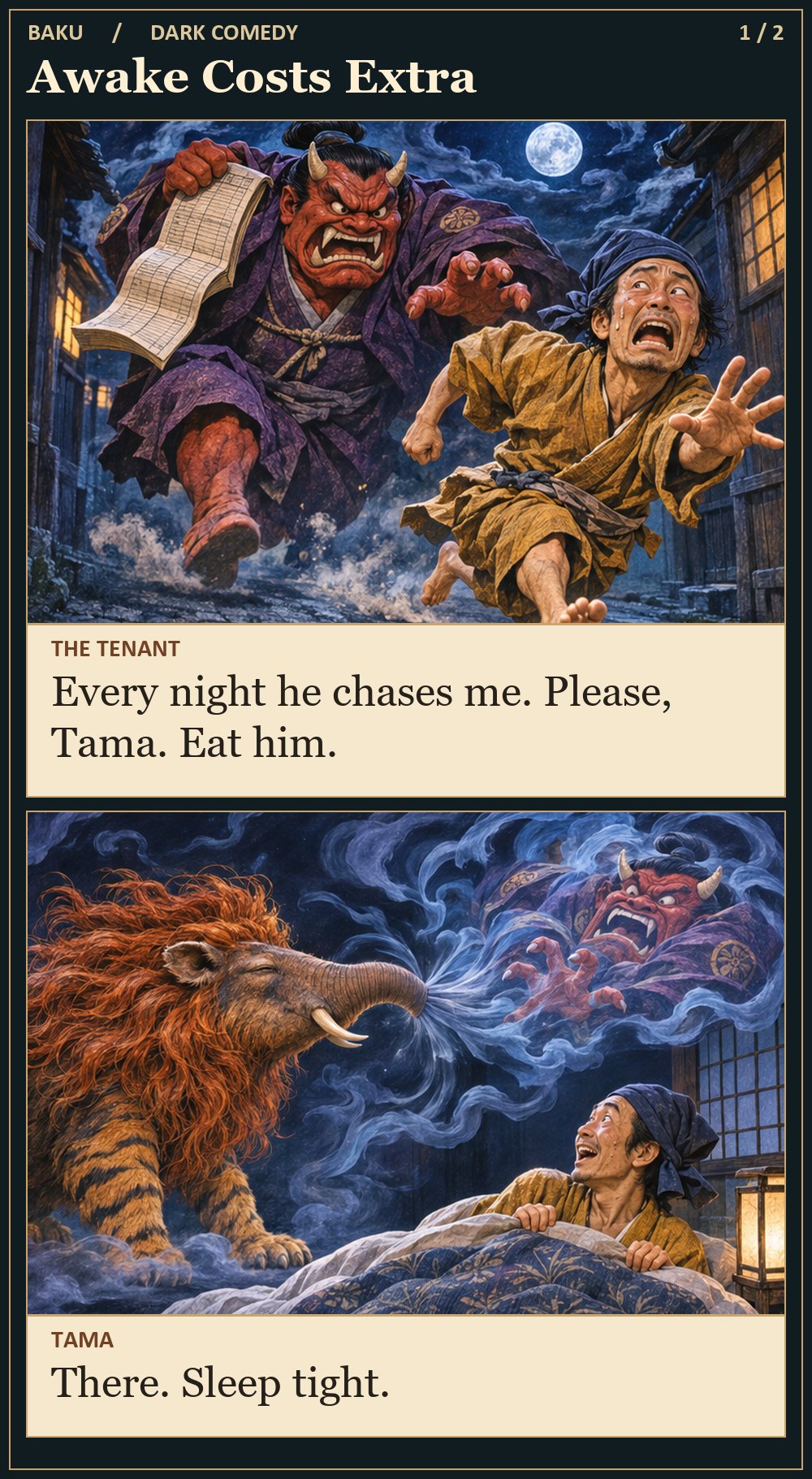
Awake Costs Extra

Read the comic transcript
Panel 1. In a dream, a barefoot tenant flees a red ogre through a narrow lane.
The tenant. “Every night he chases me. Please, Tama. Eat him.”
Panel 2. Tama draws the pursuing ogre into her trunk. He dissolves into blue smoke.
Tama. “There. Sleep tight.”
Panel 3. At dawn the same red ogre stands on the real doorstep with his ledger open.
The landlord. “Morning. Three months’ rent, if you please.”
Panel 4. The tenant leans in close. Tama brings out her abacus.
The tenant. “Can you eat him awake?”
Tama. “That’s murder. Different rate.”
Paying His Respects


Read the comic transcript
Panel 1. A translucent gambler sits on the hangman’s pillow with an open palm. Tama listens.
The hangman. “Every night it’s the last man I hanged. Tell him I’m sorry.”
Panel 2. The ghost counts his debt on his fingers. The hangman avoids his eye.
The ghost. “I forgave the hanging. I want the fifteen mon he borrowed.”
Panel 3. The hangman leaves the coins on the grave. The ghost grins.
The hangman. “Fifteen. There. Now can a man get some sleep?”
Panel 4. That night the gambler brings a queue of dead creditors all the way to the hangman’s pillow.
The ghost. “Lads, this is him. The one who’s paying people back.”
The Silent Bell


Read the comic transcript
Panel 1. At dusk Sumi shakes a little brass handbell in her print shop and hears it ring.
Tama. “Give it a shake. Hear it? In a dream that bell makes no sound.”
RING
Panel 2. In bed she shakes the silent bell. A faceless black shape with two pale eyes bends over her.
Sumi. “I’m still asleep.”
Panel 3. The baku tears the nightmare into inky strips. Sunrise comes through the screens.
Tama. “I’ve got it. Open your eyes.”
Panel 4. In the morning light Sumi shakes the bell over her tea. Silence. In the dark reflection the two pale eyes are still there.
Not a sound.
Original Velvet Bestiary fiction and AI-assisted illustrations.