The Caladrius and the Red Kite
The palace clipped its healing bird’s wings so he would stay close to the king. Now a sailmaker is burning up in a harbour under fog, and the last patch of sunlight is a hundred feet above the quay.
The caladrius, the bird at the sickbed
The caladrius is the bird brought to a sickbed in medieval European bestiaries to reveal whether the patient will live. A witness must watch the bird’s face. Looking away foretells death. Looking straight at the patient begins a cure that the bird must finish in flight. Readers will encounter the spellings caladrius and charadrius, and other forms in French and Italian writing. A classical story about jaundice, a Christian account of salvation and a French lover’s complaint each put a different question to the bird. Aberdeen Bestiary, folio 57r · G. C. Druce, The Caladrius and Its Legend
Contents of this guide
The white bird at the sickbed
Folklore
Imagine standing behind the family while a bird is brought to a sickbed. Everyone wants a look at its face. In the Aberdeen Bestiary, the caladrius lives in royal residences. The writer, who names the earlier Physiologus as a source, gives it white plumage from end to end. That is about all a stranger needs to recognise it in this book. At the bedside its most important characteristic is which way it turns its head. University of Aberdeen, folio 56v
The Aberdeen artists give their reader both outcomes on adjoining manuscript pages. In the first, the bird turns away. The people gathered round the patient now know he will die. In the second, a caladrius looks straight at a sick king. That is the image his household would have wanted. The university’s facsimile lets you turn the leaf between the two pictures. Try covering the accompanying text and watching the bird. A movement so small you might miss it in an aviary tells a family everything it came to learn. The first sickbed and the king’s sickbed
When the patient can recover, the bird has work to do. It draws the illness into its own body through its gaze. It must then fly up towards the sun, whose heat disperses what it carries. The family can stay beside the bed. The bird is the one that has to leave with the sickness. That second half of the legend is worth keeping in mind whenever you see a painting of a caladrius sitting quietly on a coverlet. Its hardest journey still lies ahead. University of Aberdeen, folio 57r
A medieval reader was also invited to see Christ in the creature. The writer connects its spotless white plumage with freedom from sin, and its willingness to bear someone else’s burden with salvation. The entry even raises an objection. How could a bird classed as unclean represent Christ? Lions and eagles can stand for royalty, the writer answers, whatever their dietary classification. The little bird gave its audience quite a lot to argue about after the sickroom emptied. University of Aberdeen, translation and commentary
Before the bestiaries, a bird that had to look back
The Roman-era Greek writer Aelian reports a belief about a bird his English translator calls a stone-curlew. In On the Nature of Animals 17.13, a sufferer from jaundice looks at the bird and the bird holds the person’s gaze. Aelian attributes recovery to this exchange. The passage is strikingly narrow. It describes one complaint and a particular meeting of eyes. There is no king in bed, no death sentence for the patient the bird refuses, and no account of flying up to the sun. Those familiar details belong to other texts. Aelian, On the Nature of Animals, book 17, chapter 13
It matters whose eyes are doing the work. A person can stare at a captive bird for as long as they like. The story still depends on the bird returning the look. In Aelian’s telling that stare sounds almost hostile. In later bestiaries an illustrator could turn the same small movement into an act of mercy. The resemblance makes the classical passage worth reading beside the medieval one. It does not establish an unbroken chain of copyists between the two, or identify a modern species that could perform the cure. Aelian, the reciprocal gaze · University of Aberdeen, Latin text and translation
Two pictures, and the story between them
In the Aberdeen manuscript the reader has a privilege the family at the bedside lacks. The family witnesses a single outcome. The reader can turn the leaf and see the other. Turn from folio 56v to 57r and the body on the bed remains a familiar shape while the bird changes its orientation. A tiny head has to do the work that another painter might assign to a speech or an inscription. The figure facing the bird in the second scene wears a crown. Authority over a household, even a royal household, gives its patient little say about which way a visitor will look. Aberdeen Bestiary, folio 56v · Folio 57r, including the facing king
The bird’s white plumage plays two parts on those pages. It gives the artist an immediate way to distinguish the visitor from the people around the bed, and it gives the commentator a visible attribute to interpret. Other artists could give a similar creature very different colouring. G. C. Druce describes an example in a fourteenth-century Italian manuscript, Harley 3448, with a green body and blue and yellow wings. The man bringing it to the sickbed and the direction of its head do more to identify the scene than its plumage. Matching the colour alone would miss a surviving version of the story. Druce, Harley 3448 and the Italian treatment, pp. 394–395
A bird above a church door
At the church of St Mary at Alne in Yorkshire, a medieval carver found a way to tell the story to a visitor walking through a doorway. On a stone of the twelfth-century arch a sick man lies under a coverlet. The bird above him is huge beside its patient, its beak turned to his face. From the ground this is a sensible liberty to take with scale. A life-sized bird carved in proportion to the bed might disappear into the stonework. The visitor who knows the story can read the verdict without turning a page. As G. C. Druce observed in his study of the carving, the direction of the beak also gives a viewer a way to recognise the encounter in other media, including the cathedral glass at Lyon. Druce, photographs and description of the Alne sculpture and Lyon window
Why is an unclean bird allowed to represent Christ?
The Aberdeen writer anticipates a reader who knows the scriptural distinction between clean and unclean animals. If a bird is classed among the unclean, how can an author use it to represent the Saviour? The answer draws on other animals whose qualities carry a particular meaning in a particular passage. The eagle and lion can suggest royal power. The serpent lifted up by Moses supplies another scriptural comparison. A reader trained in this way of reading could consider a creature’s legal classification in one context and its chosen emblematic meaning in another. Aberdeen Bestiary, folio 57r, the author’s objection and reply
There is an uncomfortable historical detail here too. The text maps the bird looking away onto Christ turning away from Jews and towards Gentiles. That is the medieval Christian author’s anti-Jewish interpretation. At another point the same author applies the encounter to individual Christians undergoing confession and repentance. A short retelling about a kind white bird can easily drop both passages. Reading them restores the particular religious argument the author attached to the animal and makes clear why a general description of medieval belief cannot stand in for the words on this leaf. University of Aberdeen, full passage in English and Latin
The lady who declined to be a cure
In the French Bestiary of Love associated with Richard de Fournival, a suitor borrows the caladrius to make a case for himself. He calls his distress a sickness and says the woman has turned her face away. In his chosen comparison her refusal becomes a verdict on whether he can survive. One can see why he chose this creature. A glance is such a slight thing for him to request, yet his version of events makes withholding it seem a dreadful act. A British Library manuscript preserves the lover’s address among its illustrated pages. British Library, Harley MS 273, Bestiaire d’amour · Druce, the caladrius in the lover’s address
The separately transmitted lady’s reply turns his reasoning back on him. She sees danger in what might follow if she grants what he wants, and finds in the bird a reason for caution. The person cast as somebody else’s remedy has her own future to consider. That exchange preserves something a list of magical powers cannot convey. Once two people can argue with the same legend, even agreement about what the bird does leaves plenty of room for disagreement about what a human being owes another. Bibliothèque nationale de France, Le bestiaire d’amour, followed by the lady’s reply
What Velvet Bestiary invented
In our harbour the white feathers, the gaze and the flight towards the sun all come from the bestiary. Brindle’s clipped wing feathers, his deadline at sunset and Kit Marr’s very large red fish are inventions for the tale.
Sources and further reading
The Caladrius and the Red Kite
Brindle came out of the fish cart with a sprig of parsley behind one ear and an invoice tied to his leg. One white bird, live, on loan from His Majesty until supper. The girl who untied it read the last line aloud.
“Damage to be charged to the borrower.”
“Put me back,” Brindle said. “They’ve sent you a damaged one.”
The girl lifted his wing. Somebody at court had cut the long flight feathers square across, as neatly as a row of teeth. She folded the wing gently into place and tucked the parsley into her own buttonhole. “We’ll argue about the bill when my mother’s up.”
Through the open doors of the sail loft he could see a woman lying on the cutting table. She had a sail needle tucked into the grey bun at the back of her head. The people who loved her had remembered the pillow and forgotten the needle.
Brindle climbed the table leg by beak and claw. He had hoped the woman would be somebody else. Eighteen years put flesh on a face in different places, but he would have known that thumb anywhere. Half a blue anchor tattooed on it. The other half lived on the index finger. When those two fingers closed on a pair of shears the anchor came together.
“Kit Marr,” he said.
Her eyes opened. “You still walk like a bishop with wet drawers.”
“And you still sleep on your tools.”
Her daughter removed the needle. Down on the quay someone called that the top of the signal mast had gone gold. The fog lay only over the harbour. Above it the sun was dropping clear toward the sea.
Brindle kept his eyes on Kit’s hands. Once he met her gaze the fever would pass into him. He would have to carry it up into daylight. At court the south gallery stood high above the mist. On a bad day they wheeled the king’s bed to the window and lifted Brindle onto the sill. If he stayed below until nightfall, it would settle in his breast and there it would stay. He had buried two birds that way.
Kit followed his eye to her tattoo. “Oh,” she said. “You remember.”
He remembered his first week at court. Kit had been the young woman paid to stitch his travelling hood. When the keeper discovered she knew how to handle a bird, he had paid her to hold the shears as well.
“What did you do with the money?” Brindle asked.
“Drank it. I’d like to tell you I bought medicine for my old mother. I bought gin. On the way home I was sick on a perfectly good pair of shoes.”
He looked her in the face. She looked straight back. As the fever went out of her, Brindle found himself so cold he had to bite his tongue to stop his beak clattering.
Kit sat up. “Where’s my red fish?”
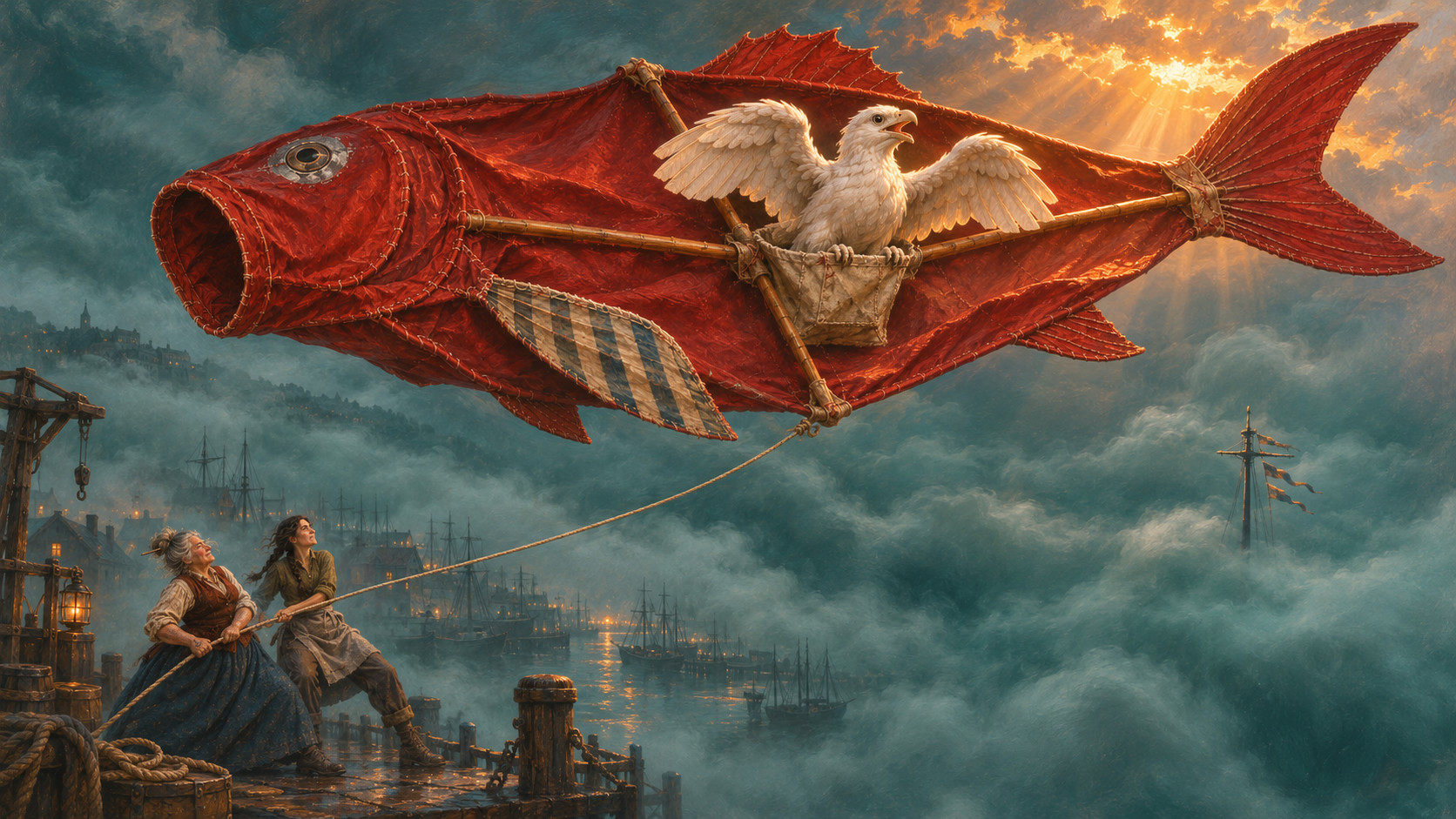
Her daughter went to a cupboard and pulled down a kite. It unfolded across the floor, an enormous red mullet with a sailcloth belly and a staring silver eye. Kit had made it to hang over the fishmongers’ guild at fair time. Somebody had mended one fin with a piece of striped petticoat.

“An awful lot of trouble,” Brindle managed, “to make me smell of fish twice in one day.”
Outside, men were taking the lamps round. Kit’s daughter ran the kite off the end of the quay. For a moment the red mullet lay on the water. Its painted eye blinked under a wave. Then a gust came through the gap between the warehouses and the fish stood on its tail and went up streaming.
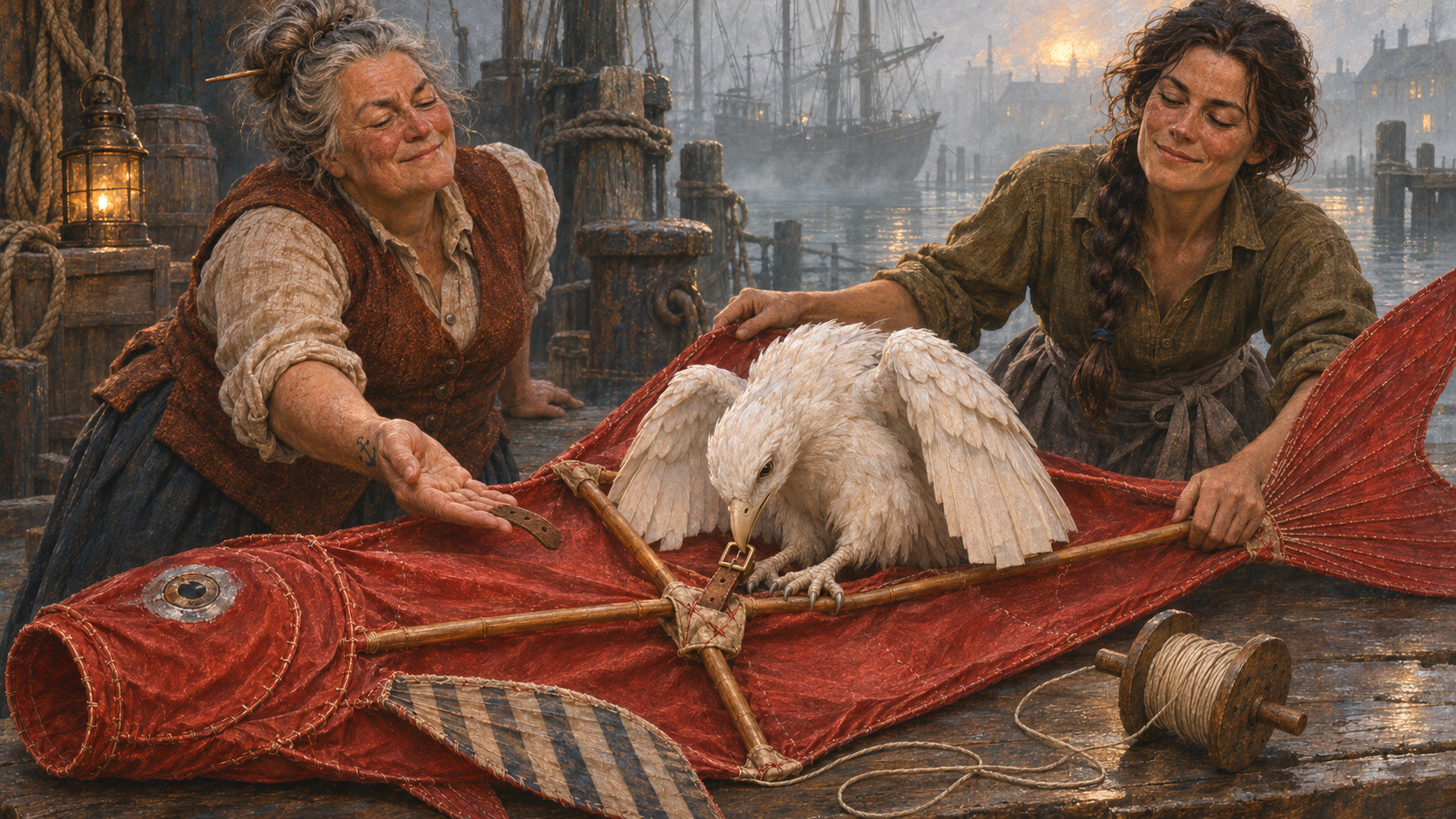
Kit brought it down just far enough for Brindle to climb into the shallow pocket where the two wing spars crossed. There was a strap inside. He saw Kit’s thumb and forefinger reaching for the buckle and struck her hard enough to draw blood.
Her daughter pulled a breath between her teeth. Kit just held the strap out on her palm.
“You do it, then.”
Brindle closed the buckle himself. It made a very small click.
They let out the line. At first all he could see was the chimney pots going by sideways. Then the painted fish took a dive. His stomach stayed aloft without him. On the quay somebody began to wind him in.
“Give it here,” he heard Kit say. “He can tell us what he needs.”
Brindle knew these winds. As a young bird he had stolen so many oysters from this harbour that the shuckers knew him by name. At the mouth of the gap the air always rose off the slates of the customs house. He could feel the warm current through his shortened flight feathers.
“Walk west,” he shouted. “Keep walking till you smell vinegar!”
Kit’s boots thumped along the quay. Below him the pickle stall went by. The red fish jumped so hard the last of his breakfast, one small silver fish scale, blew off his beak.
Then his head came out of the fog. He could see the sun and the roofs on the hill and one surprised gull holding half a sausage. Kit’s fever went through him in a single long shiver. He spread what was left of his wings. For the first time in eighteen years the white feathers under his arms felt hot.
At supper a palace boy came for the bird. Kit was downstairs sewing a patch onto the kite, with a sticking plaster round her thumb. She offered him the invoice. On the back, in the space reserved for damage, Brindle had made two accurate little drawings of his wings and dated them on arrival.
The boy considered his position. “Did the patient live?”
“She did,” said Kit.
The boy ticked the little box marked escaped. “Then I’ll take the parsley. They count that too.”
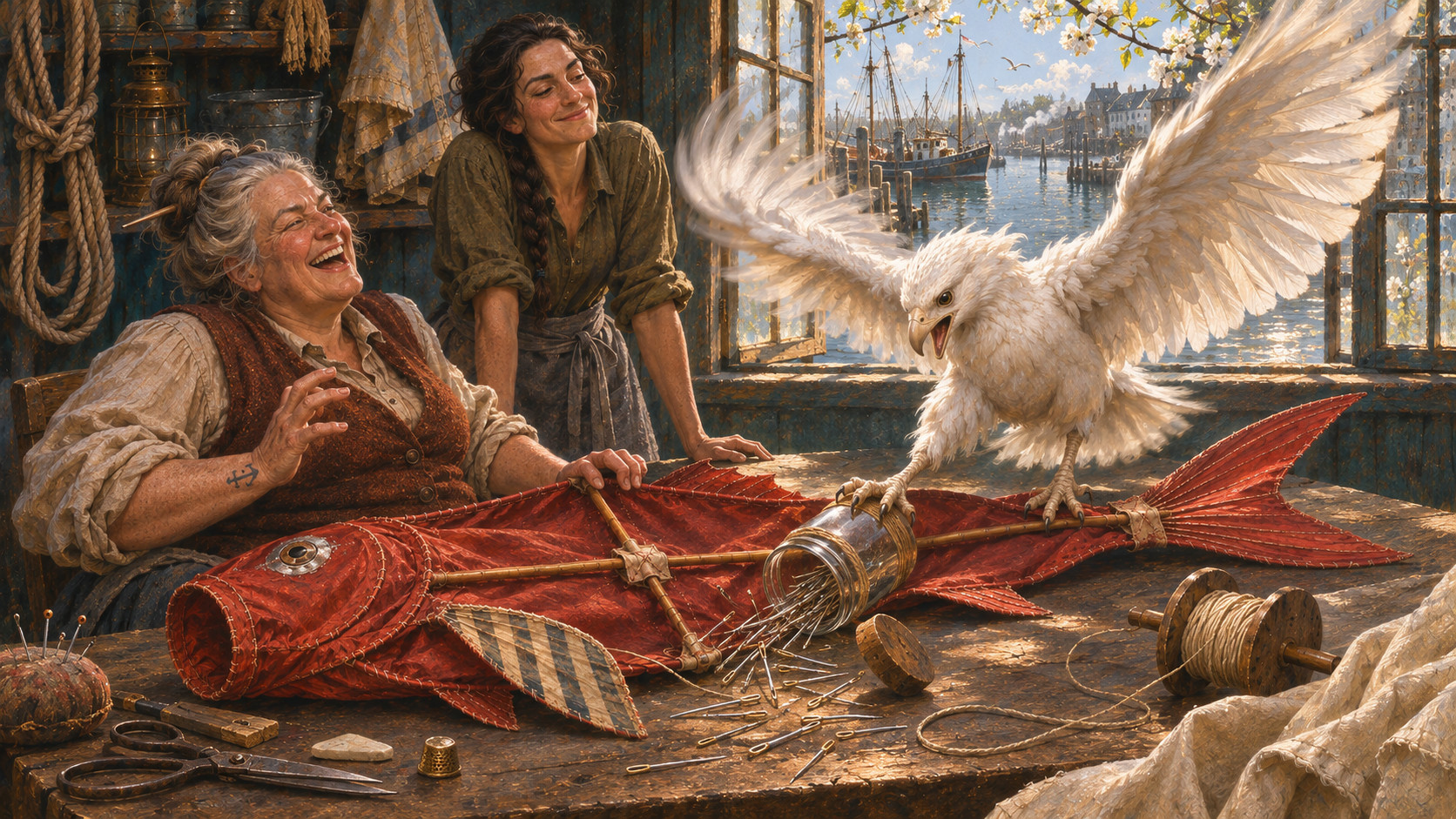
Next spring a white bird flew into the sail loft under his own power. He landed badly, upsetting an entire jar of needles. Kit glanced up at the open window.
“You know we’ve got a door.”
“I’ve had doors,” Brindle said. “I like this better.”
The Breath Test
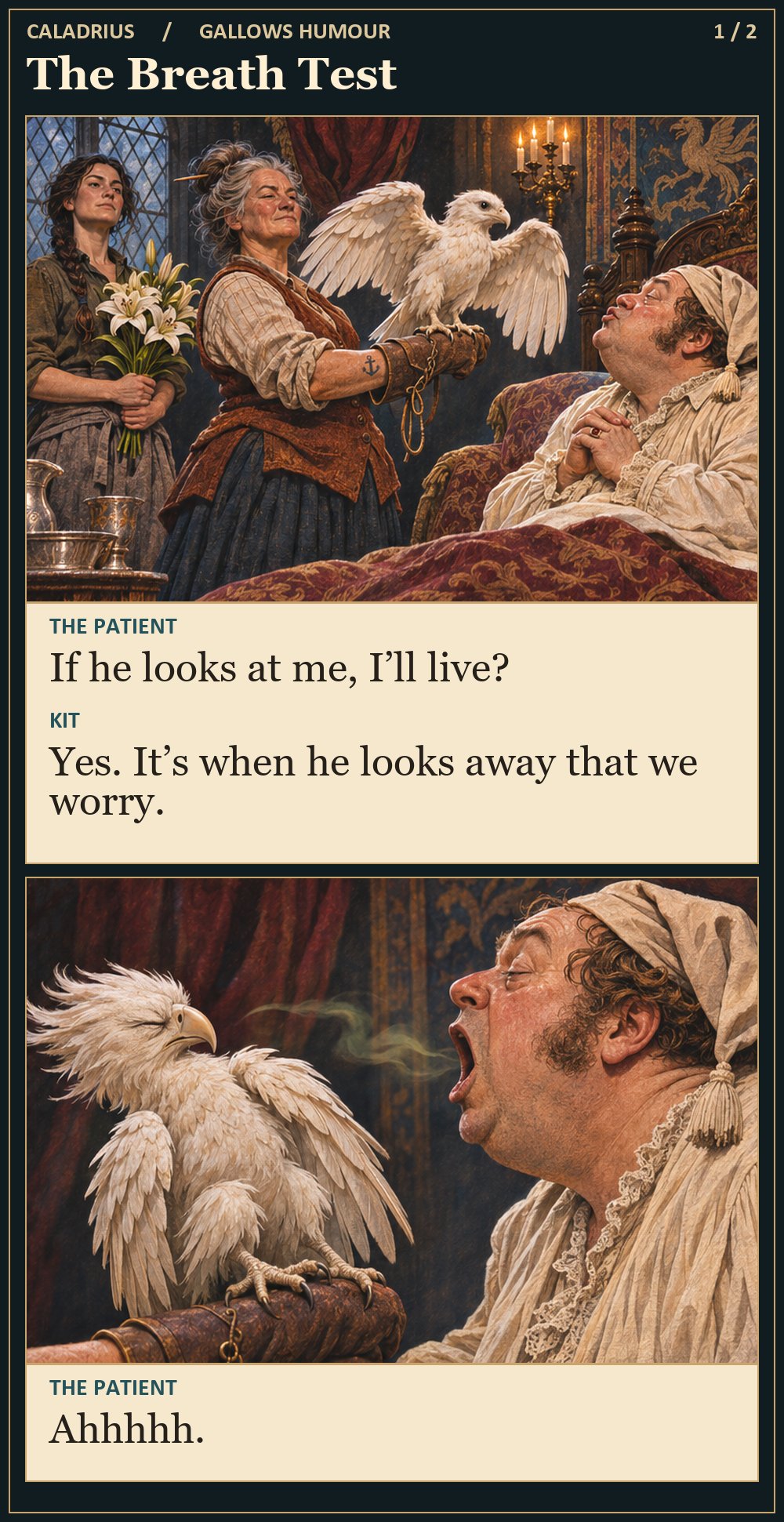
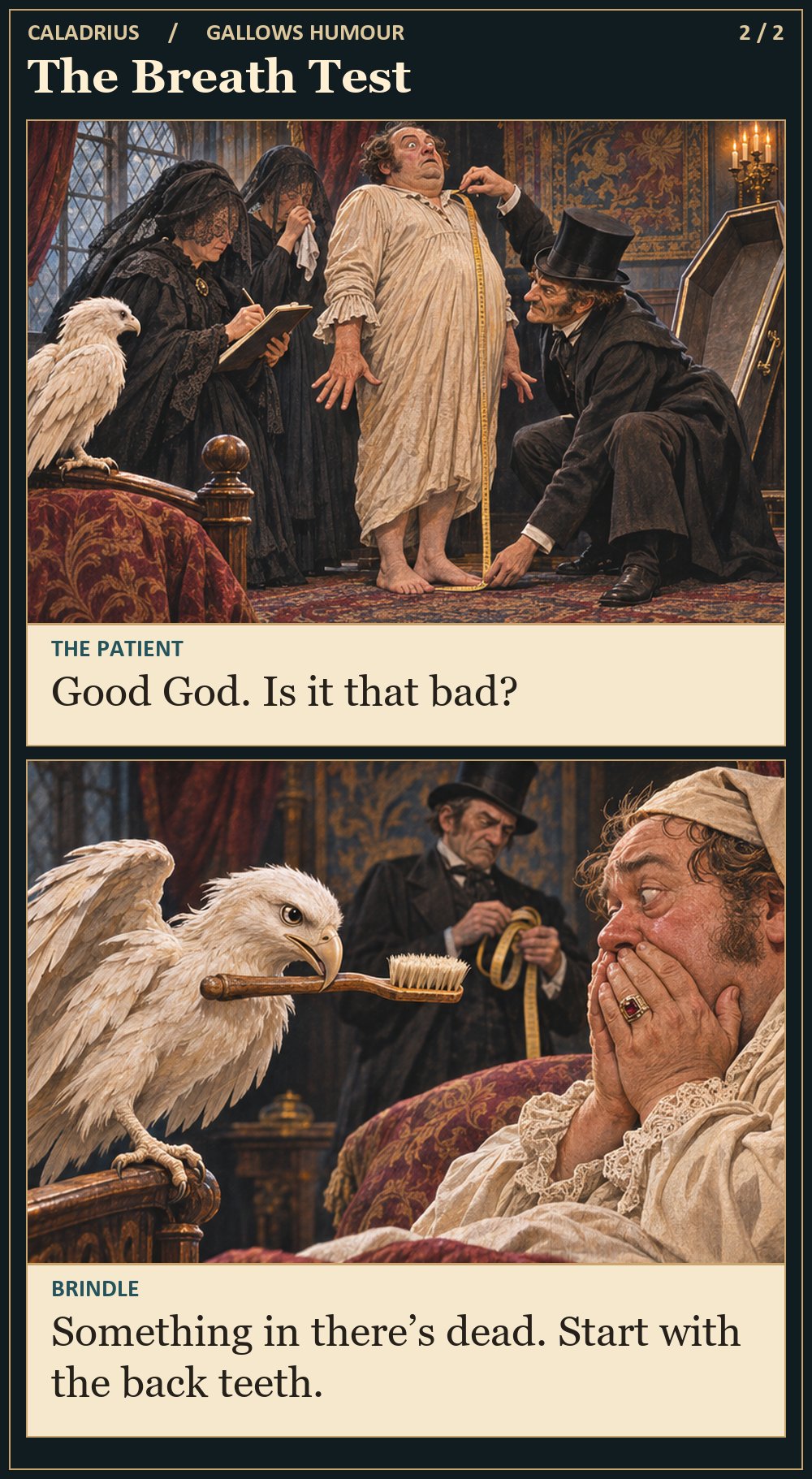
Read the comic transcript
Panel 1. Kit brings a white caladrius to a sick man’s bedside.
The patient. “If he looks at me, I’ll live?”
Kit. “Yes. It’s when he looks away that we worry.”
Panel 2. The patient opens his mouth. His breath hits Brindle. The bird turns away.
The patient. “Ahhhhh.”
Panel 3. The patient stands barefoot on his mattress while an undertaker measures him beside an open coffin.
The patient. “Good God. Is it that bad?”
Panel 4. Brindle hands him a toothbrush. The undertaker winds his tape back in.
Brindle. “Something in there’s dead. Start with the back teeth.”
The Harbour Cure
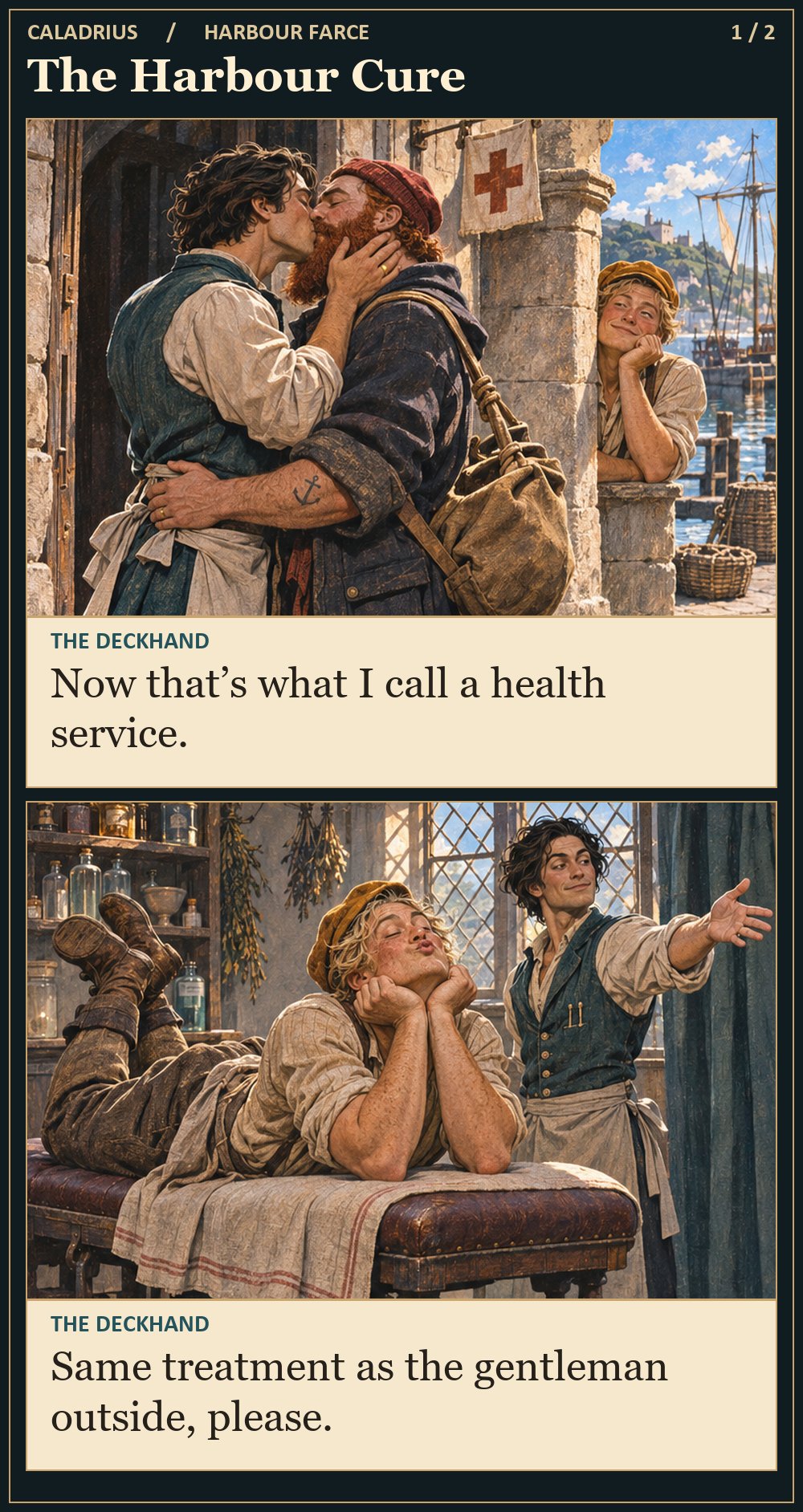
Read the comic transcript
Panel 1. A blond deckhand watches the handsome nurse kiss a red-bearded sailor in the clinic doorway.
The deckhand. “Now that’s what I call a health service.”
Panel 2. The deckhand flings himself onto the couch, closes his eyes and purses his lips.
The deckhand. “Same treatment as the gentleman outside, please.”
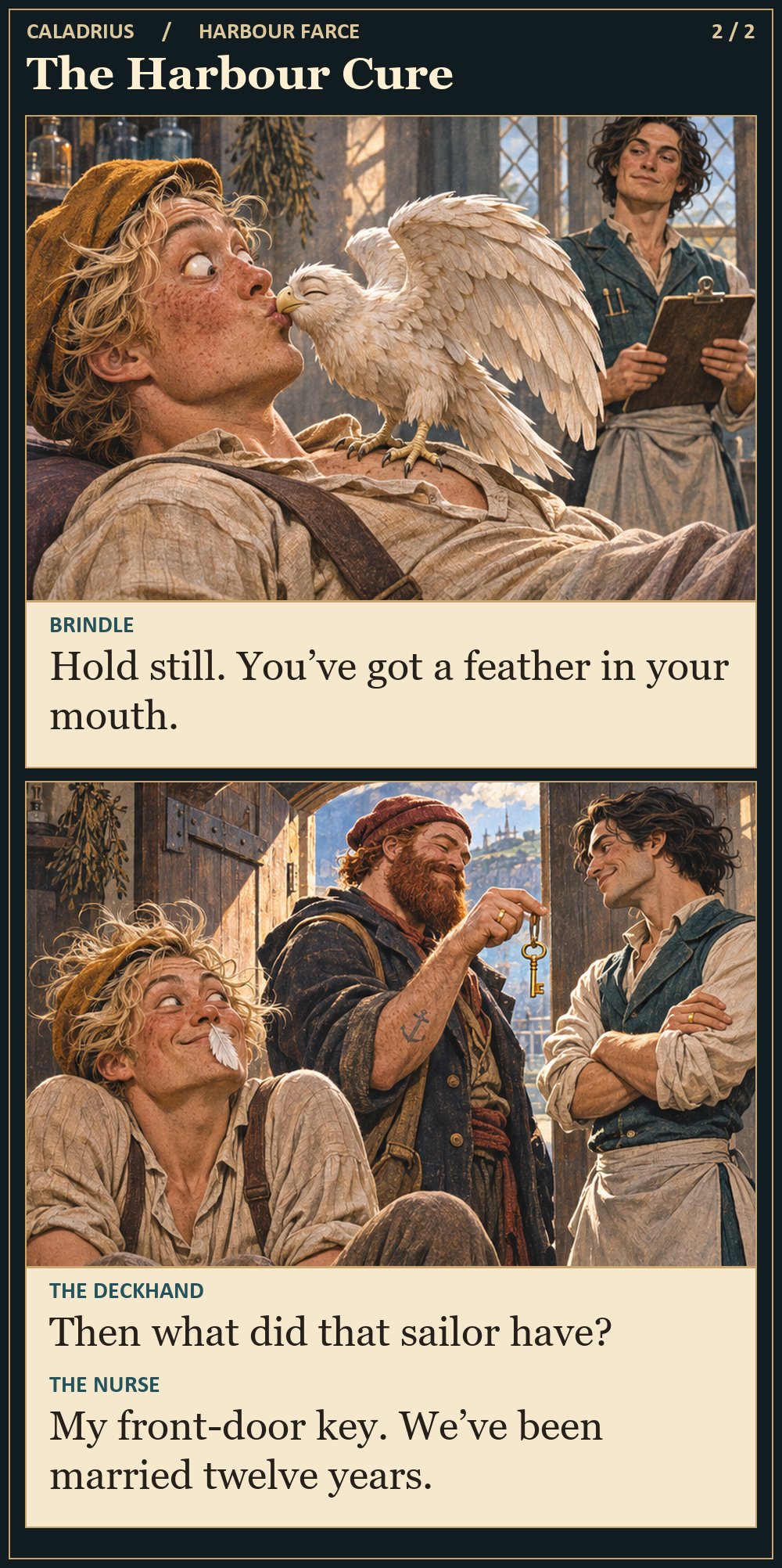
Panel 3. A white caladrius lands on his chest. The deckhand opens his eyes nose to beak with Brindle.
Brindle. “Hold still. You’ve got a feather in your mouth.”
Panel 4. The red-bearded sailor holds up a house key. The deckhand still has a feather on his lip.
The deckhand. “Then what did that sailor have?”
The nurse. “My front-door key. We’ve been married twelve years.”
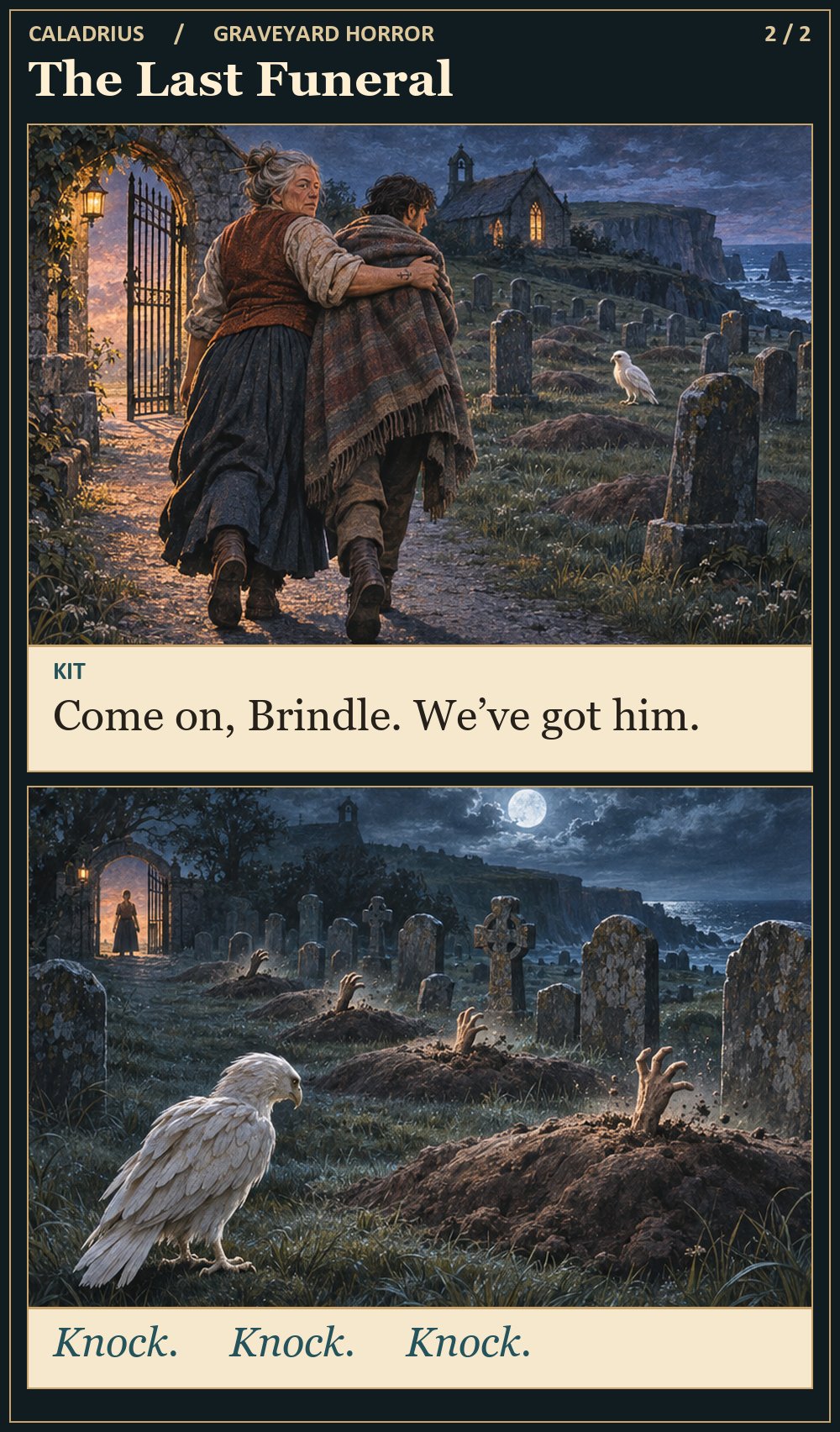
The Last Funeral
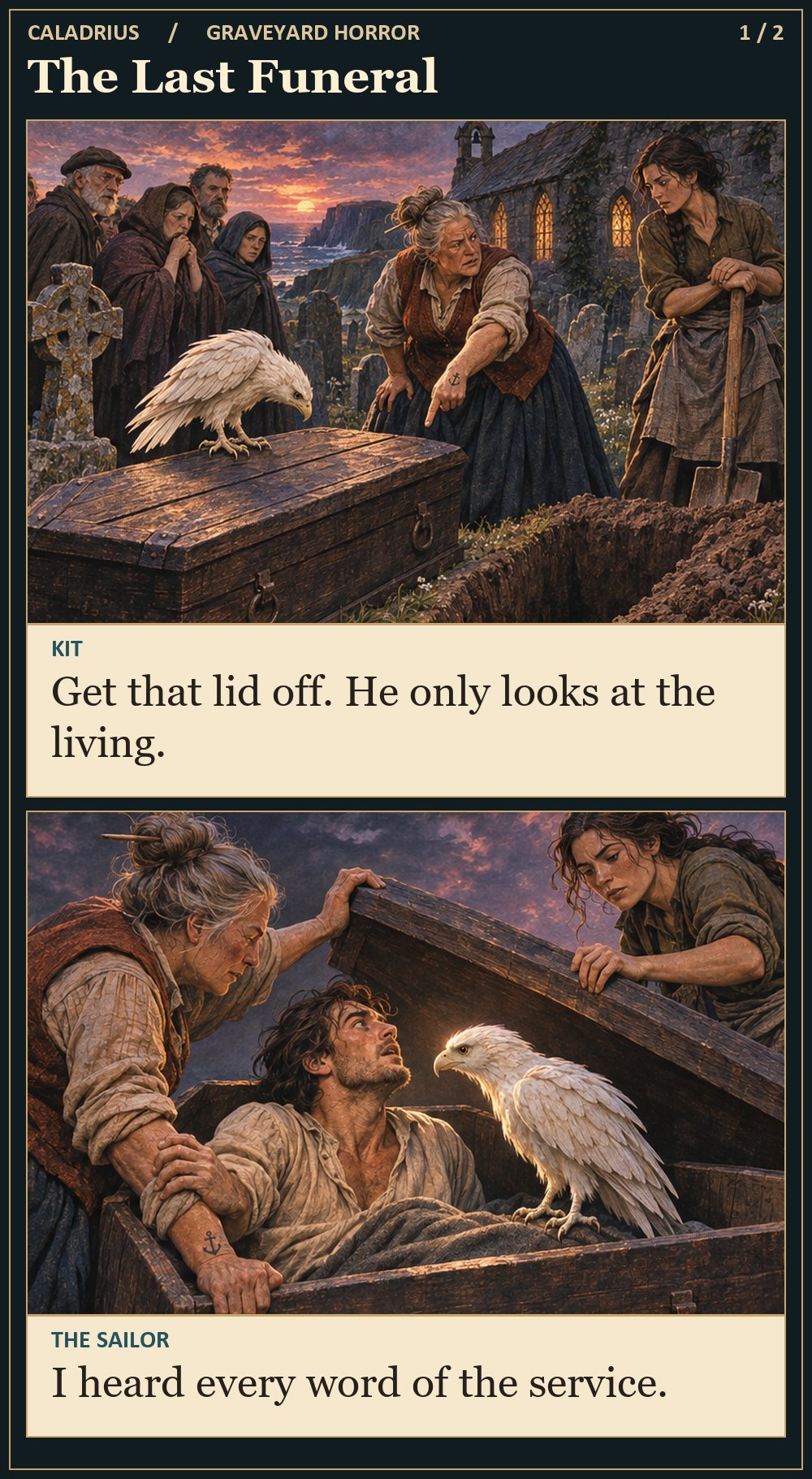
Read the comic transcript
Panel 1. A small white caladrius stares down at a closed coffin beside an open grave.
Kit. “Get that lid off. He only looks at the living.”
Panel 2. Kit and the gravedigger lift the lid. A living sailor sits up, gasping.
The sailor. “I heard every word of the service.”
Panel 3. Kit wraps the sailor in a blanket and leads him toward the gate. The bird stays behind.
Kit. “Come on, Brindle. We’ve got him.”
Panel 4. The bird peers into the dark rows of graves. Earth stirs at mound after mound. Hands are coming up.
Knock. Knock. Knock.
Original Velvet Bestiary fiction and AI-assisted illustrations.