The Vegetable Lamb and the Bride’s Wheelbarrow
A collector means to pickle his prize exhibit as soon as his daughter’s wedding guests have seen it alive. The exhibit has other plans. They require a wheelbarrow, an ugly fern and somebody willing to get married on time.
The vegetable lamb of Tartary
The vegetable lamb is an animal that grows from a plant in European accounts of the marvels of Asia. In one version a fruit opens to reveal a little creature with flesh and bones. In another a living lamb grazes with its belly fastened to a stem. Names include barometz, borametz, Scythian lamb and vegetable lamb of Tartary. Tartary here is a geographical term used by historical European writers. The names document how Europeans imagined a distant marvel. They do not establish a single Central Asian community as the source of the story. Garden Museum, vegetable lamb in print · Henry Lee, The Vegetable Lamb of Tartary, 1887
Contents of this guide
How much grass can a lamb reach?
Folklore
Take a piece of string into a meadow. Pin one end to the soil and walk a circle holding the other. In one European account of the vegetable lamb, you have just traced the whole world the animal will ever know. Its belly grows from a stalk. It can turn, stretch its neck and eat the grass it can reach. When it has grazed the circle bare, it dies with a field full of food in sight. Collectors called this creature the Barometz or the Scythian Lamb. Older books also call it the Vegetable Lamb of Tartary. Garden Museum, Barometz or Vegetable Lamb
One of the pleasures of following this story through the books is that the lamb changes shape. In the accounts brought together by the naturalist Henry Lee in 1887, one plant grows from a seed like a melon’s. Its ripe fruit splits, and there is a fully formed little lamb inside. Another account gives the creature four legs and a stalk attached at the navel. That lamb can lower itself to graze, but its own stem holds it fast. The first is a wonder of birth. The second gives you a living creature whose dinner is forever just out of reach. Henry Lee, The Vegetable Lamb of Tartary, chapter I
Eventually you could see one for yourself in a collection. The Garden Museum in London holds an eighteenth-century specimen whose maker arranged fern roots into the shape of a lamb. Imagine being invited to identify it by lamplight, with the collector standing at your elbow. The museum also holds an illustration after a 1605 image by Claude Duret, reproduced in Lee’s book. The picture can show you how a lamb might grow. The object can show you what a resourceful person managed to make. Garden Museum, the illustration and the specimen
Lee himself argued that reports of cotton helped give rise to the story. Cotton really does produce a soft, spinnable fibre on a plant, an arresting thing to describe to anyone accustomed to getting wool from a sheep. That was Lee’s explanation for how the rumour travelled. The little fern animals in collections have their own, demonstrably human makers. Henry Lee, preface and study
When wool could grow on a tree
In the fifth century BCE, Herodotus described a striking Indian material for readers accustomed to sheep. Wild trees there produced something that compared favourably with sheep’s wool, he said, and people made their clothing from it. His short account in Histories 3.106 describes what a plant yields and what people do with the fibre. There is no bleating, grazing or creature emerging from a pod. The distinction matters because cotton figures prominently in later arguments about where the vegetable-lamb story came from. A writer saying that clothing material grows on trees is describing something a traveller could actually encounter. Herodotus, Histories 3.106, Macaulay translation
The point at which a comparison becomes an animal is much harder to document. At a market a tuft of fibre can pass from hand to hand. It shows what the material feels like but says very little about the shape of the plant before harvest. The same word, wool, can name a familiar product for the speaker and suggest a startling producer to a listener. Henry Lee proposed cotton as an explanation for the legend. The gap between Herodotus and the medieval travellers leaves room for that proposal, but a suggestive resemblance cannot trace every step by which a tale travelled. Herodotus, Indian clothing · Lee, preface and history of cotton
A medieval traveller invites the reader to dinner
In the fourteenth-century Travels attributed to Sir John Mandeville, the extraordinary thing is concealed inside a fruit. The narrator describes a creature with flesh, blood and bones, resembling a small lamb without its wool. He adds that people eat both the fruit and what is inside it, and claims to have eaten of the fruit himself. What makes the episode memorable is an ordinary action, opening food to see what it contains. The narrator’s claim of personal experience belongs to the way this travel book tells a story. It supplies no independently recorded specimen or place where the fruit can be examined. The Travels of Sir John Mandeville, the Cotton manuscript in modern spelling
The narrator then turns the tables on a reader inclined to laugh. In his own part of the world people tell of trees bearing barnacle geese. Someone hearing that report far away could find it every bit as difficult to credit. Mandeville pairs the two wonders so that familiarity, geography and trust suddenly become part of the question. This also helps distinguish his lamb from the one in later pictures. There is no meadow whose circumference has to be calculated in order to understand a marvellous dinner. Mandeville, the lamb and the barnacle geese
How to examine a lamb in a cabinet
In 1698 Hans Sloane presented to the Royal Society an object sent to him as a Tartarian lamb. He described its length, the colour of its down and the stalks projecting from its body. His particularly revealing observation concerned the supposed legs. Their structure, inside as well as out, resembled the stalks of fern fronds. The animal outline was visible at first glance, but an attentive observer could ask quite a different question. What part of an actual plant was playing the role of each part of the supposed animal? Sloane concluded that a maker appeared to have shaped the object. His description and its illustration were reproduced by Lee. Sloane’s account and figure 4, reproduced in Lee, chapter I
The fern usually associated with these objects bears the scientific name Cibotium barometz. The Hong Kong Herbarium describes a stout rhizome covered in long golden-brown hairs. A rhizome is a plant stem. Living fronds rise from it and can reach a considerable size. The same hairs that have a botanical description under magnification can suggest a fleece to someone looking across a collector’s table. The Garden Museum’s preserved object shows what skill could do with such materials. It proves that a lamb-shaped exhibit could be made. A wild population of grazing sheep-plants is a very different claim. Hong Kong Herbarium, Cibotium barometz · Garden Museum, eighteenth-century fern specimen
How the legend survived its explanation
The plant lived comfortably in poetry after naturalists had begun taking specimens apart. In The Loves of the Plants, Erasmus Darwin addresses the golden-haired barometz directly. In his accompanying note he discusses fern anatomy and Sloane’s suspicion of human workmanship. A reader gets two encounters on the same page. First the lamb is present enough for the poet to speak to it. Then the reader can look underneath it, as it were, to see what supports the illusion. Knowing how the exhibit could be made did little to diminish its appeal as a subject for verse. Erasmus Darwin, The Loves of the Plants, canto I, lines 281 onward and note
There is a similar pleasure in looking at Claude Duret’s 1605 image as reproduced in Lee’s book. An illustrator can show the stalk holding the lamb, even if no one has ever brought such a lamb home alive. Compare the drawing with the fern object and try asking two separate questions. How did the artist think the creature moved? How did the maker persuade a visitor that the object had legs? The first question takes us back to the tethered animal’s shrinking circle of grass. The second takes us into a workshop. Both belong to the creature’s history. Garden Museum, illustration after Duret · Garden Museum, the fern object
What Velvet Bestiary invented
Vetch belongs to the stalk-bound version. We have given him a voice and the collector a daughter who loves him. The green wheelbarrow is Ada’s answer to a question the old descriptions leave hanging. What if somebody simply moved the soil?
Sources and further reading
- Garden Museum, vegetable lamb in print
- Henry Lee, The Vegetable Lamb of Tartary, 1887
- Garden Museum, Barometz or Vegetable Lamb
- Herodotus, Histories 3.106, Macaulay translation
- The Travels of Sir John Mandeville, the Cotton manuscript in modern spelling
- Hong Kong Herbarium, Cibotium barometz
- Erasmus Darwin, The Loves of the Plants, canto I, lines 281 onward and note
The Vegetable Lamb and the Bride’s Wheelbarrow
Vetch discovered what Mr Pell had planned for him when two footmen set a glass jar in his flower bed and began arguing about whether he’d fit through the neck.
“Ears first,” one said.
“After you,” said Vetch.
They left the jar. Vetch pushed it over. It rolled three feet and came to rest in excellent clover, one foot beyond the reach of his mouth. He had eaten the grass round his stalk down to brown whiskers. All his life there had been somebody willing to bring him another patch of turf, and for the last two days that somebody had been busy getting married.
Pell’s daughter Ruth arrived in one shoe, a veil full of hairpins and the other shoe in her hand. She found him licking a snail off the glass.
“The invitation says noon,” he said. “What kept you?”
“Thirty-seven buttons. I nearly went up the aisle in my drawers.”
She tipped a hatful of grass in front of him. Vetch swallowed the first mouthful too quickly. “Your father’s had a jar blown.”
“I know. I found the label. It gives today as the date you died.”
Ruth had brought Vetch up from a bud the size of her thumbnail. She was the first person he had bitten and the only one who had ever bitten him back. When she went to live with her wife on the far side of the hill, she had promised to take him with her. They had argued about beds, soil and whether he would behave indoors. They had scarcely discussed how to get him out.
Now Ruth wheeled over her wedding present from her wife, Ada, who built carts. A green barrow, beautifully balanced, with RUTH down one handle and ADA down the other. From the front someone had hung two extremely optimistic little baby socks.
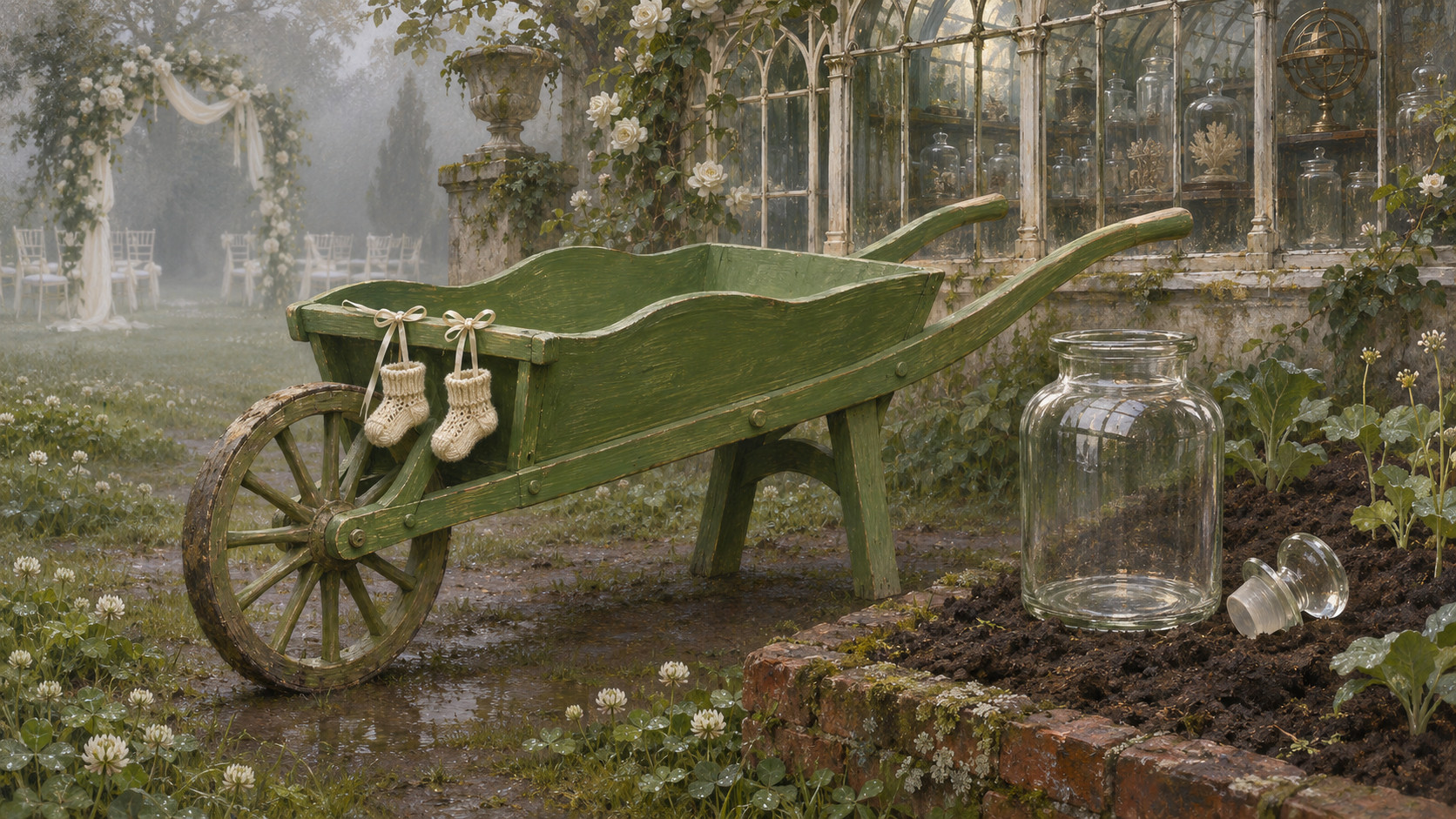
“That,” said Vetch, “is the first part of this wedding I’ve liked.”
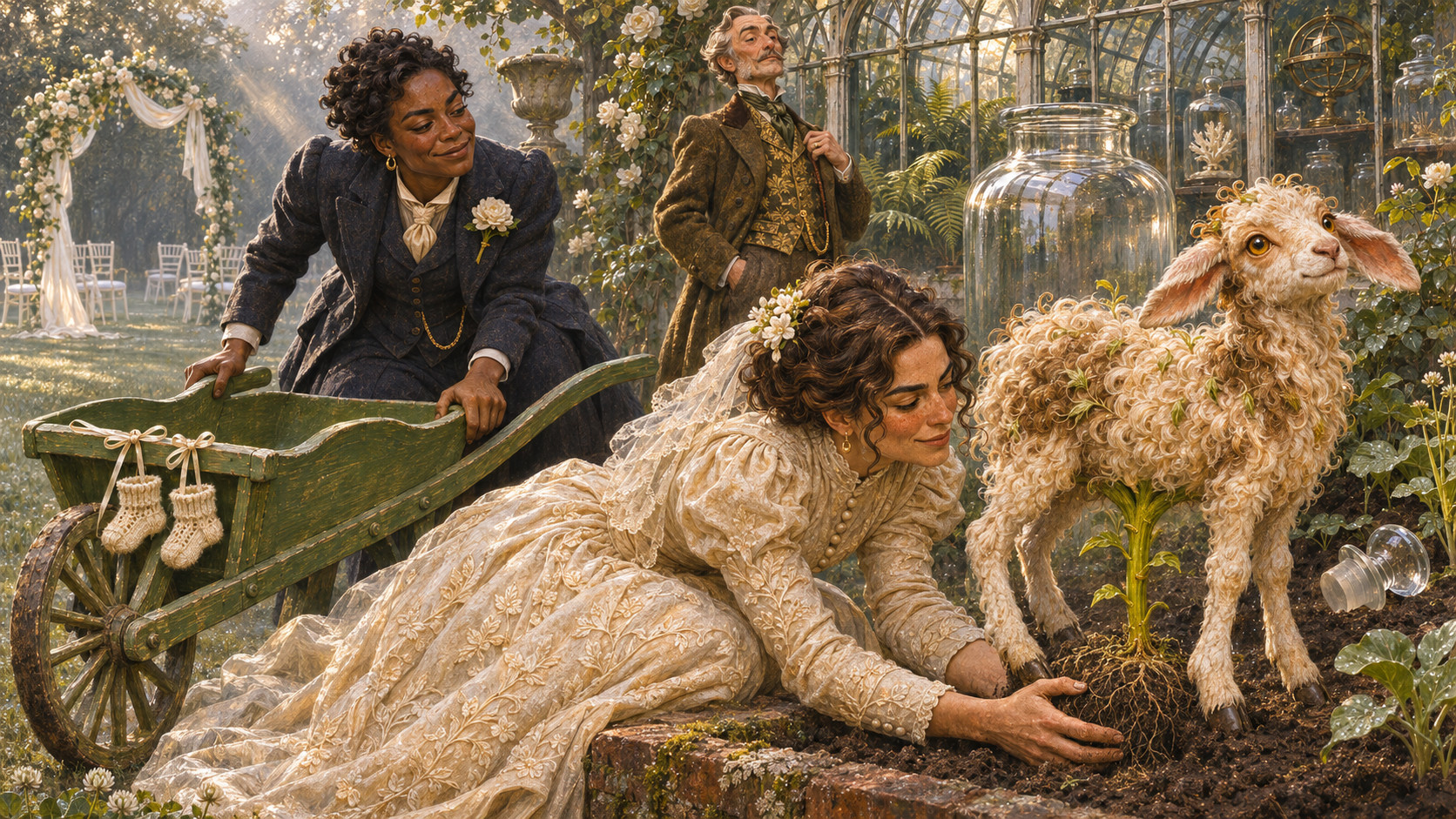
Ruth dug. The earth held together round his roots in a heavy ball. When she lifted it he felt a quite dreadful tug at his belly.
“Stop.”
One fine white root ran under the stone lip of the bed. Ruth put a thumb against it and he could feel the whorls of her skin. Her fingers were shaking. From beyond the hedge came the sound of fifty chairs scraping back for a bride who wasn’t there.
“Go and get married,” he said. “I need the woman who made this barrow.”
Ada came in her good blue suit with a white carnation through the buttonhole. She got down on her back in the dirt to have a look under the lip. “It’s grown into the drain. My jack will lift the edging, if we can get it here without your father seeing. Then somebody has to hold the tile.”
Vetch nodded toward the glasshouse. Behind its steamed panes stood a four-legged shape about his size. Mr Pell used to put it in Vetch’s bed on frosty days. A brown fern root, two glass eyes and little stick legs, expertly arranged. None of the paying visitors had ever asked it a question.
“I’ve had a better idea,” he said. “Bring me my understudy.”
Ada set the barrow against the edge of the bed and eased the root ball into it. The white root still trailed into the drain. When she covered the barrow with her sailcloth, she left him a gap big enough for his nose.
By the time the wedding party came through the gate there was a brown woolly lamb in the jar, its glass eyes made enormous by the curve of the glass. Mr Pell found his daughter and her bride standing ankle deep in his flower bed beside a green wheelbarrow. It had a muddy sailcloth over it.
“You were meant to see him alive,” Pell told the guests. Then, since there were guests, “An exceedingly delicate specimen. I have kept him in perfect condition for eleven years.”
Someone tapped the jar. The root fell over.
A little gasp went round the party. From under the sailcloth Vetch could see forty pairs of polished shoes and ten more that had seen honest work. He knew what Pell would do next. He’d send for the live animal and swear the bride had played a joke.
Vetch put his mouth right up to the drain. It ran under the jar and out through an iron grille in the pedestal on which Pell stood.
“Eleven years,” he bleated, “and you’ve put my arse on backwards.”
Pell jumped off the pedestal. The voice died away up the drain. One of the honest pairs of shoes belonged to the old gardener who had made the fern lamb in the first place. He took one look at the jar and made such a noise into his hat that Ruth had to bite the inside of her cheek.
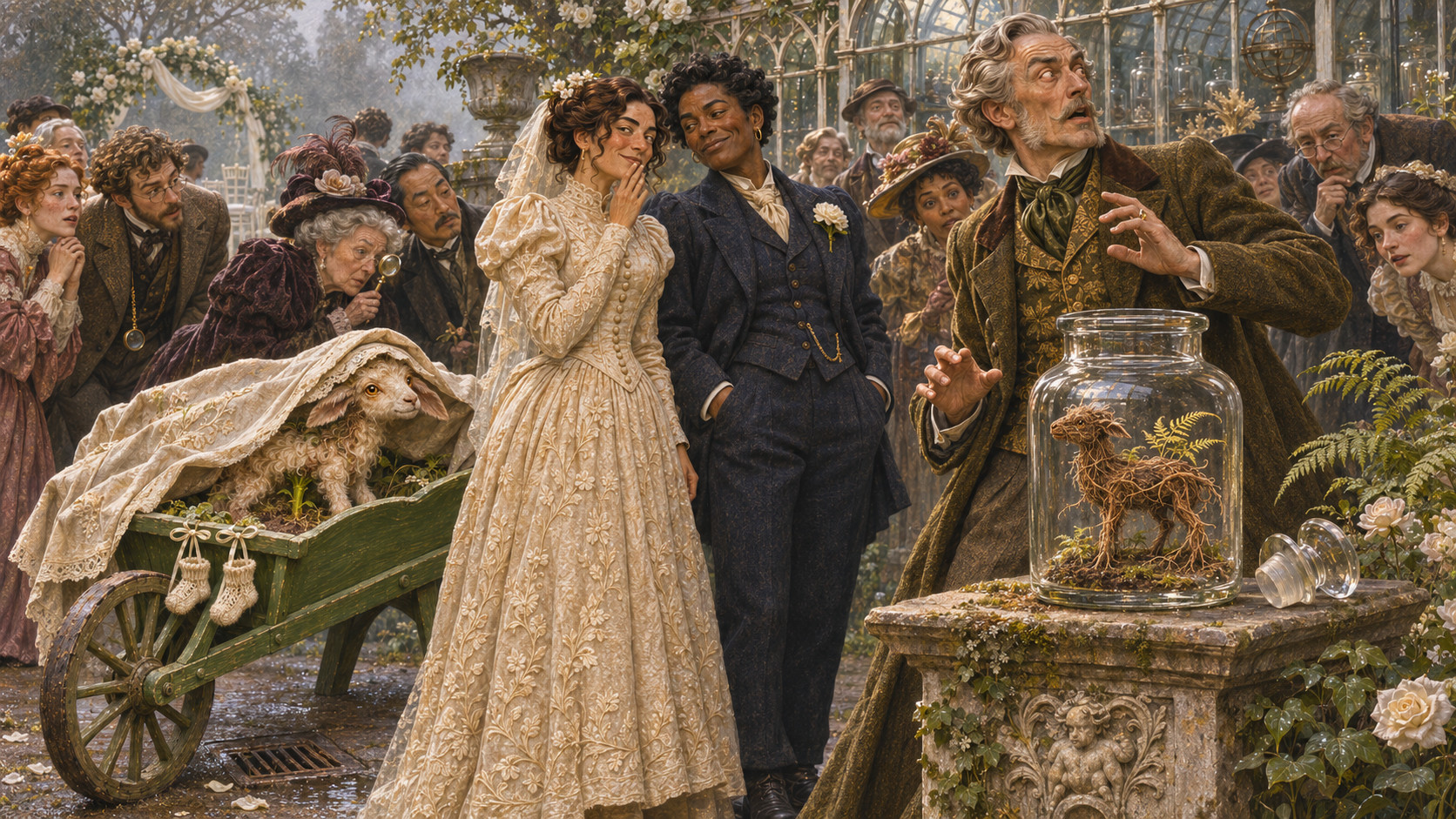
Pell could have lifted the sailcloth. All he had to do was admit, in front of the people who had paid him for eleven years, that he himself could scarcely tell his famous lamb from a lump of fern.
He straightened his collar. “I leave you to examine the specimen at your leisure.”
Ten pairs of working shoes went after him. Vetch was touched to see three pairs come straight back with spades. Two gardeners levered up the stone, Ada lifted the drain tile, and Ruth eased out the white root with two muddy fingers. It tickled so much he sneezed on her veil.
They were married at a quarter past noon. Under the table at the wedding breakfast Vetch experimentally put one hoof on the wheel. The barrow moved six inches and stopped against a chair. He tried it going backwards. Ada quietly moved the chair.
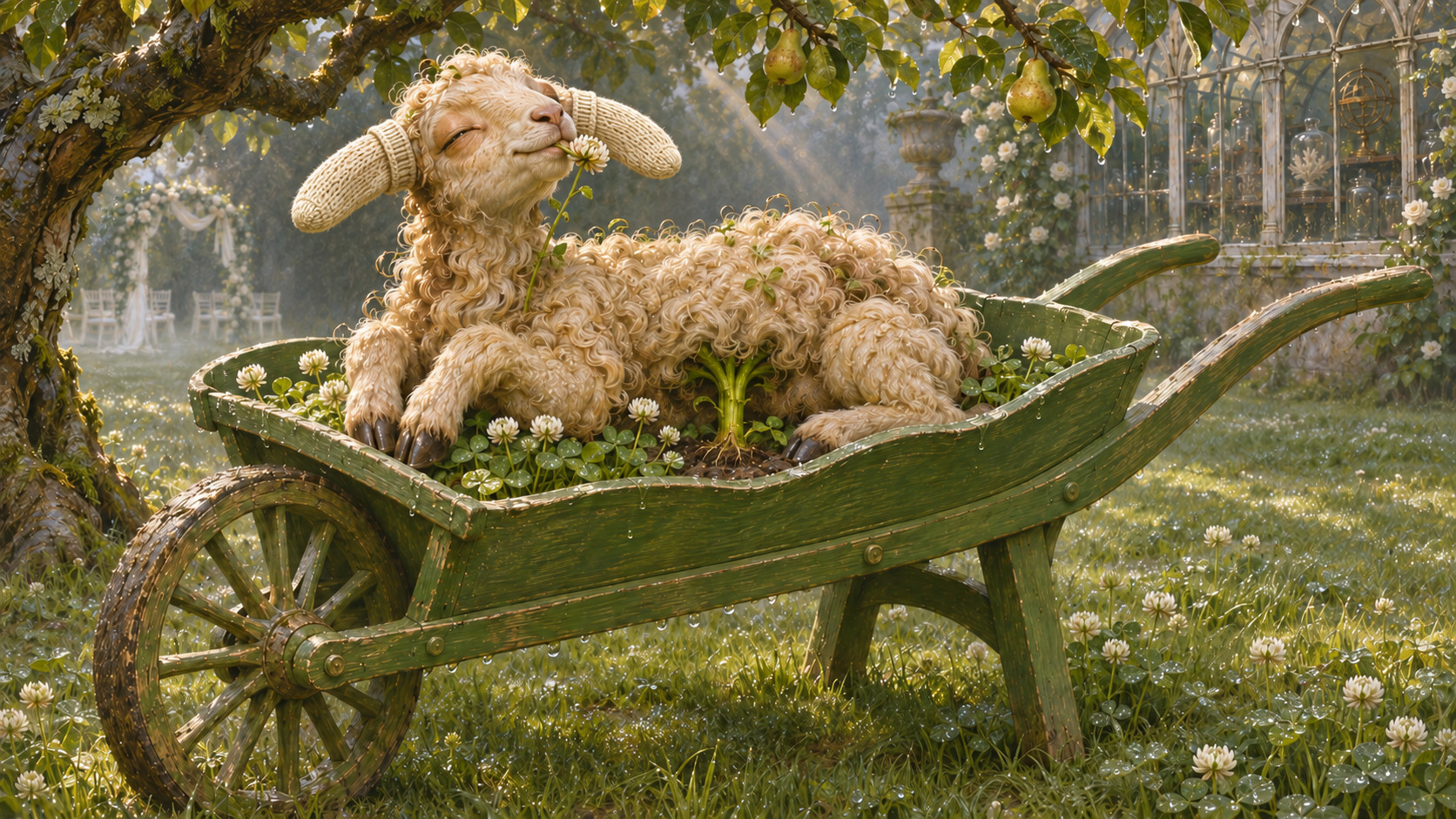
By supper he could get from the scullery to the garden on his own. In the morning Ruth found him under the pear tree with a bellyful of clover. He had pulled the baby socks off the front of the barrow and put them on his ears against the dew.
Some years later he received a catalogue. Mr Pell’s vegetable lamb was still in its jar, listed under Specimens, imperfect. Somebody had added, in the old gardener’s handwriting, For the rear view, consult the former tenant.
Vetch put the thing beneath his barrow wheel to keep it from rolling downhill. It was a handsome catalogue, and very well bound for the purpose.
A Younger Man
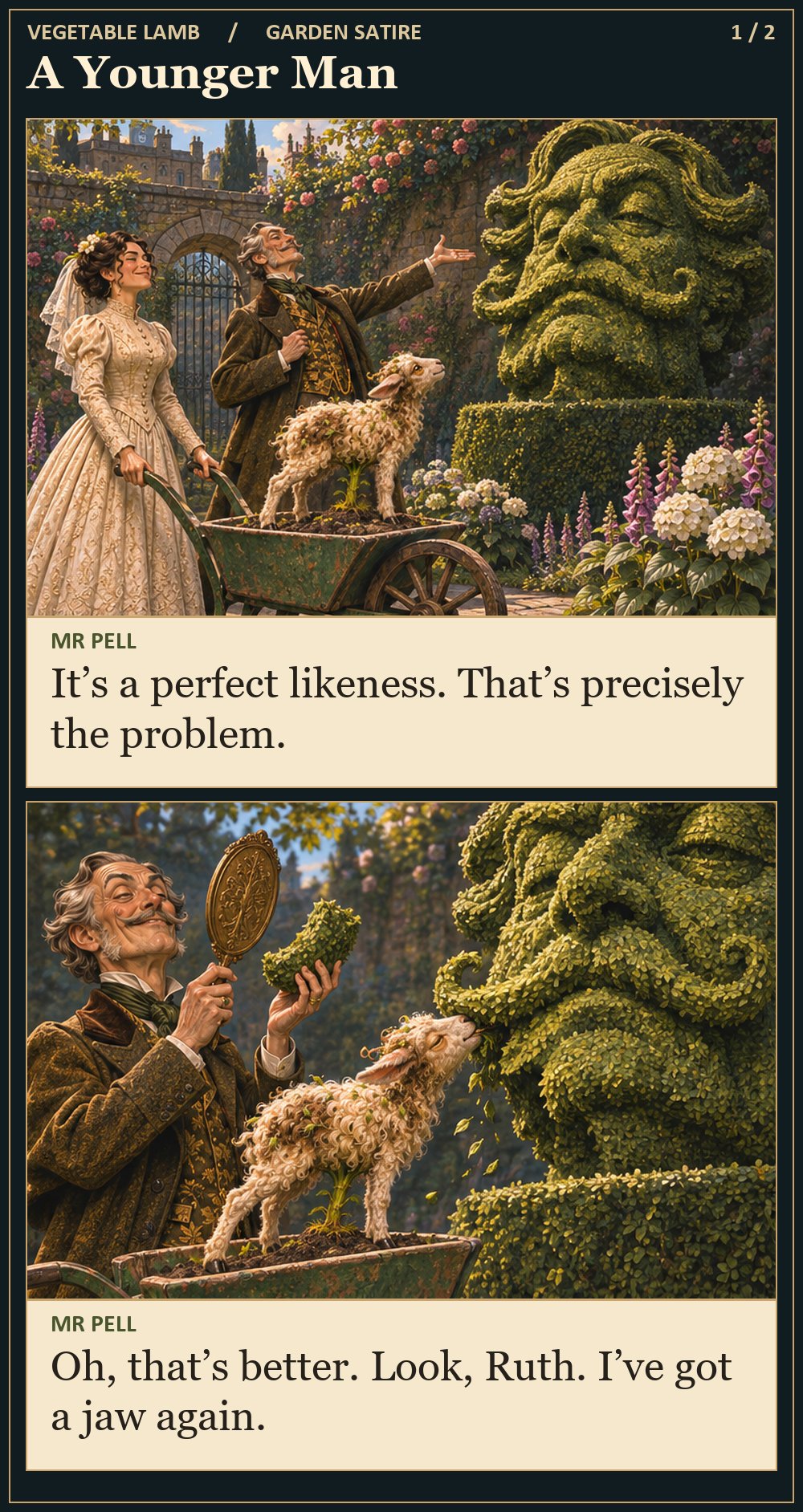
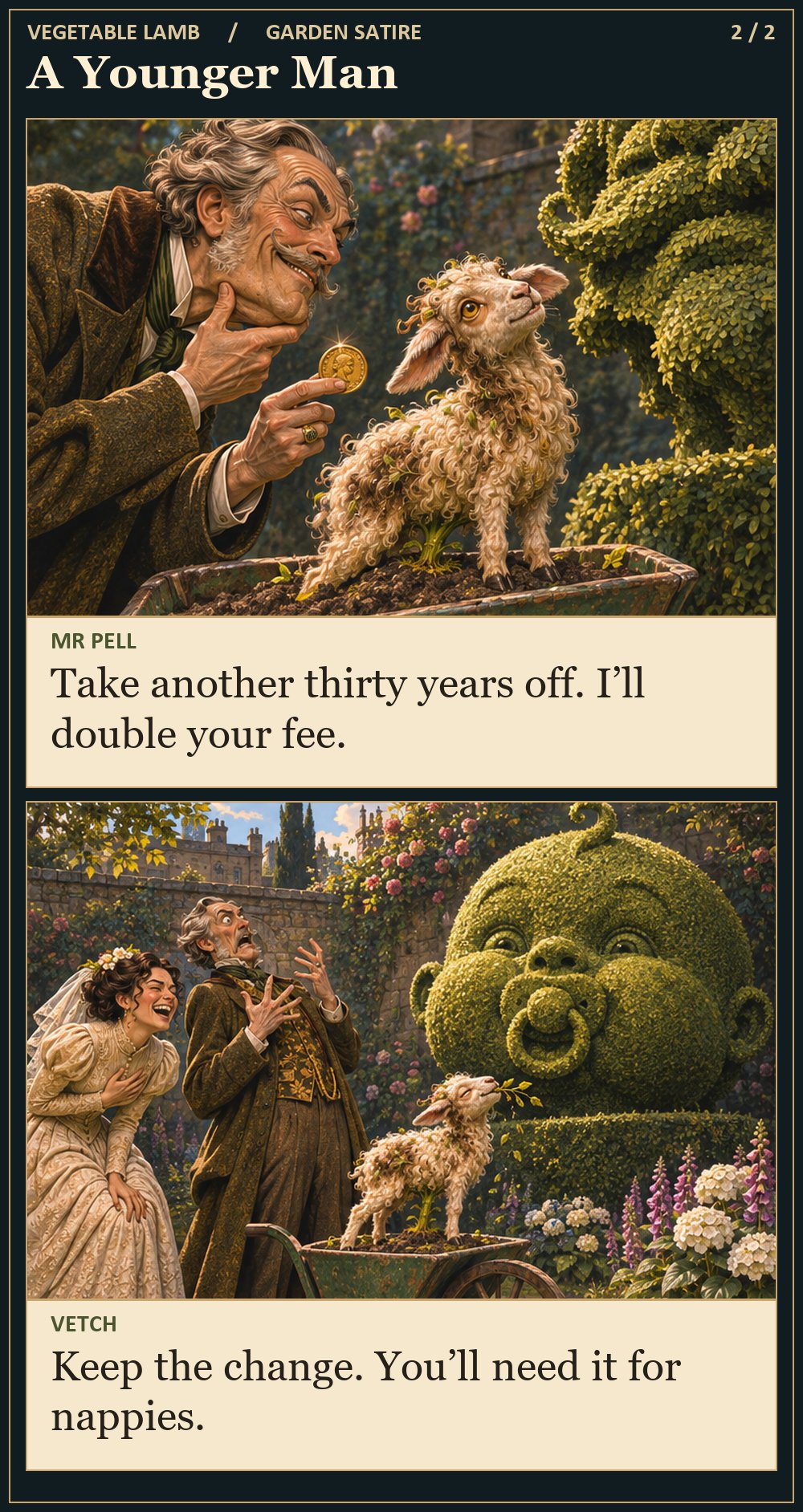
Read the comic transcript
Panel 1. Mr Pell regards a large topiary portrait that reproduces every line of his face.
Mr Pell. “It’s a perfect likeness. That’s precisely the problem.”
Panel 2. Vetch nibbles the hedge from his wheelbarrow. Mr Pell consults his hand mirror.
Mr Pell. “Oh, that’s better. Look, Ruth. I’ve got a jaw again.”
Panel 3. Pell offers Vetch a coin. The lamb looks at the bush and opens his mouth.
Mr Pell. “Take another thirty years off. I’ll double your fee.”
Panel 4. The hedge is now a round-faced baby with one curl and a dummy. Ruth doubles over laughing.
Vetch. “Keep the change. You’ll need it for nappies.”
Down on One Knee
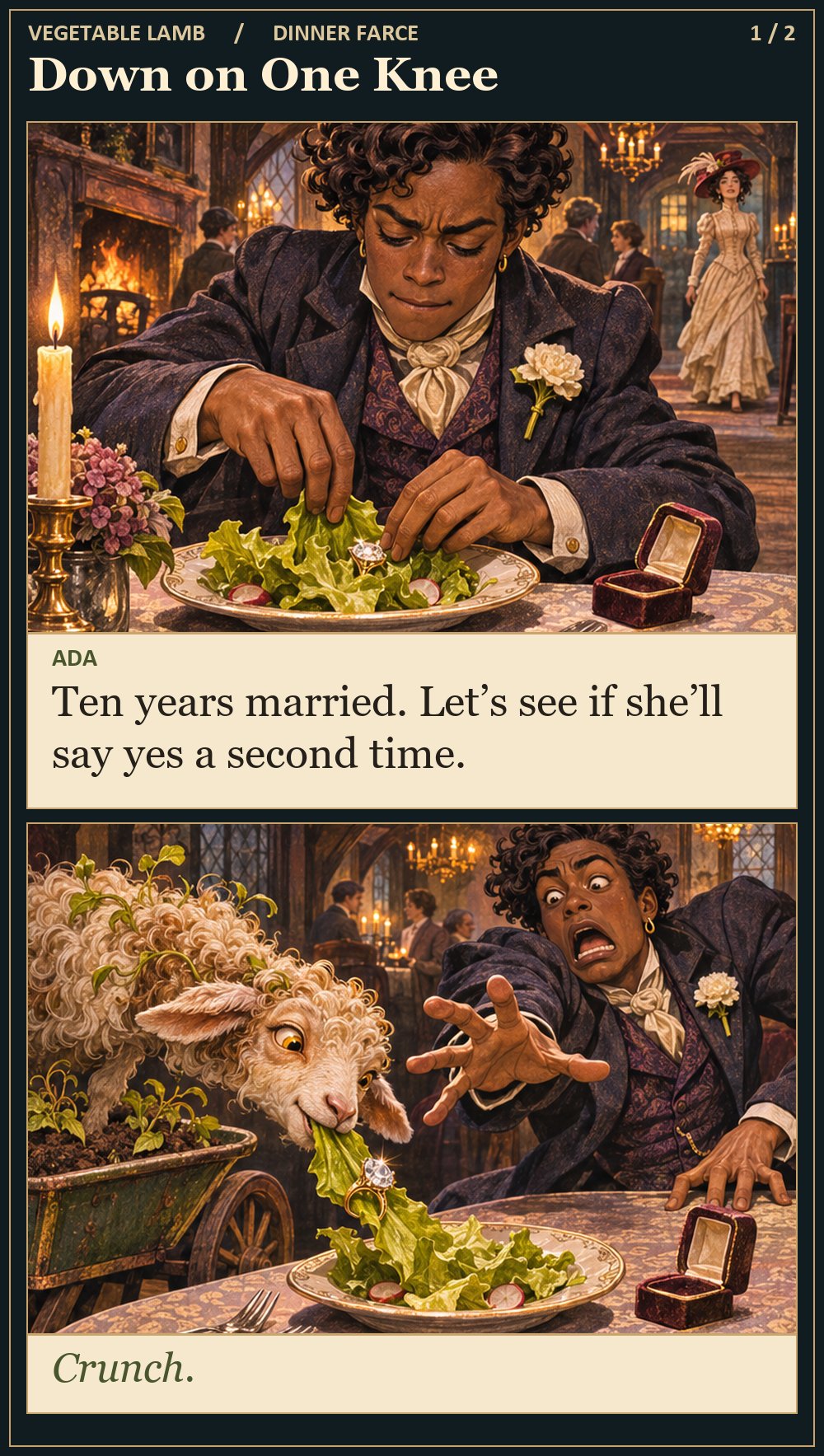
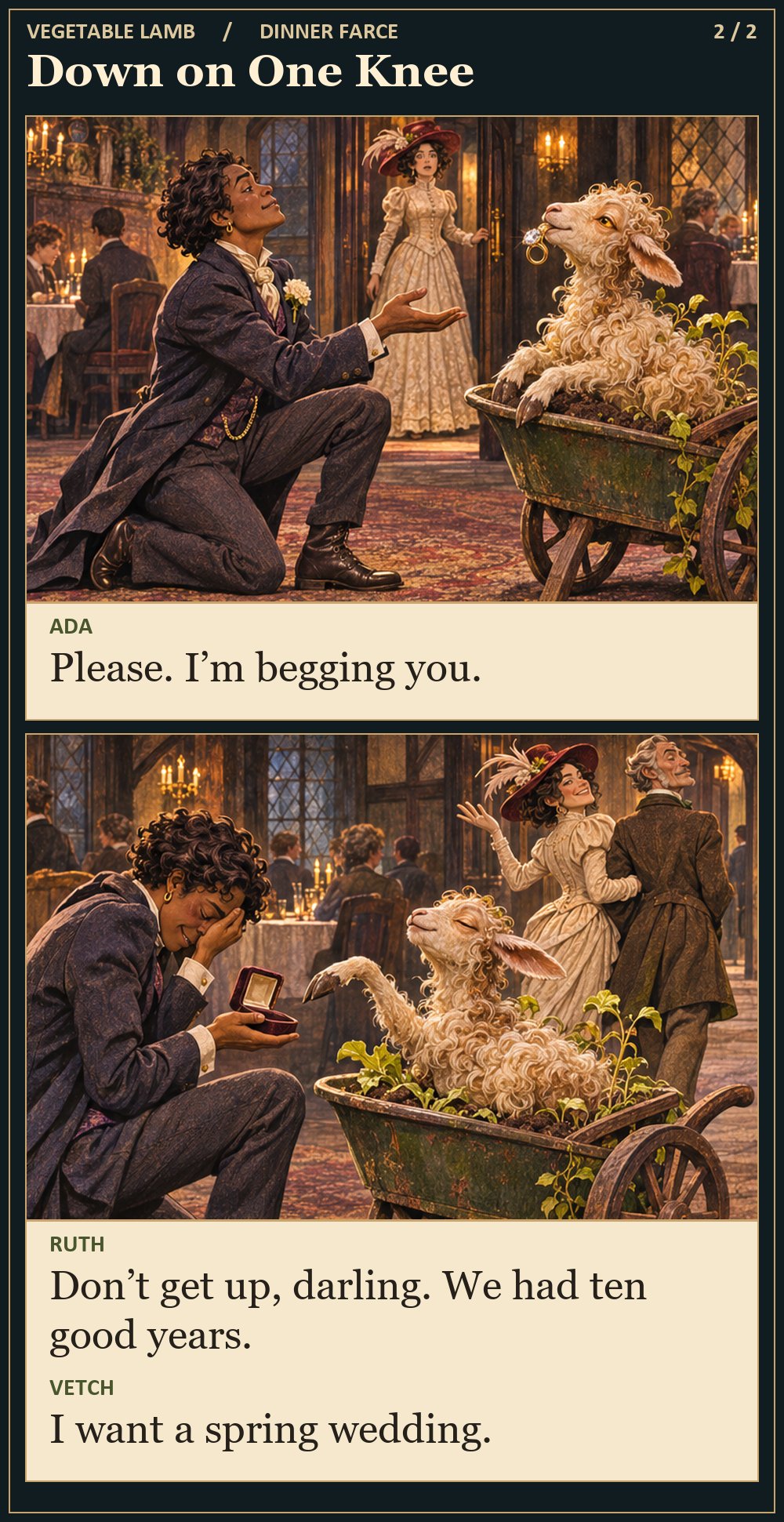
Read the comic transcript
Panel 1. Ada slips a diamond ring into Ruth’s salad. An empty ring box sits by the plate.
Ada. “Ten years married. Let’s see if she’ll say yes a second time.”
Panel 2. Vetch stretches out of his wheelbarrow and takes the first bite himself. The diamond goes with the lettuce.
Crunch.
Panel 3. On one knee before the lamb, Ada holds out her hand for the ring. Ruth walks in.
Ada. “Please. I’m begging you.”
Panel 4. Ruth turns to leave. Vetch extends one hoof toward Ada, who has her face in her hand.
Ruth. “Don’t get up, darling. We had ten good years.”
Vetch. “I want a spring wedding.”
The Coat in the Field
Read the comic transcript
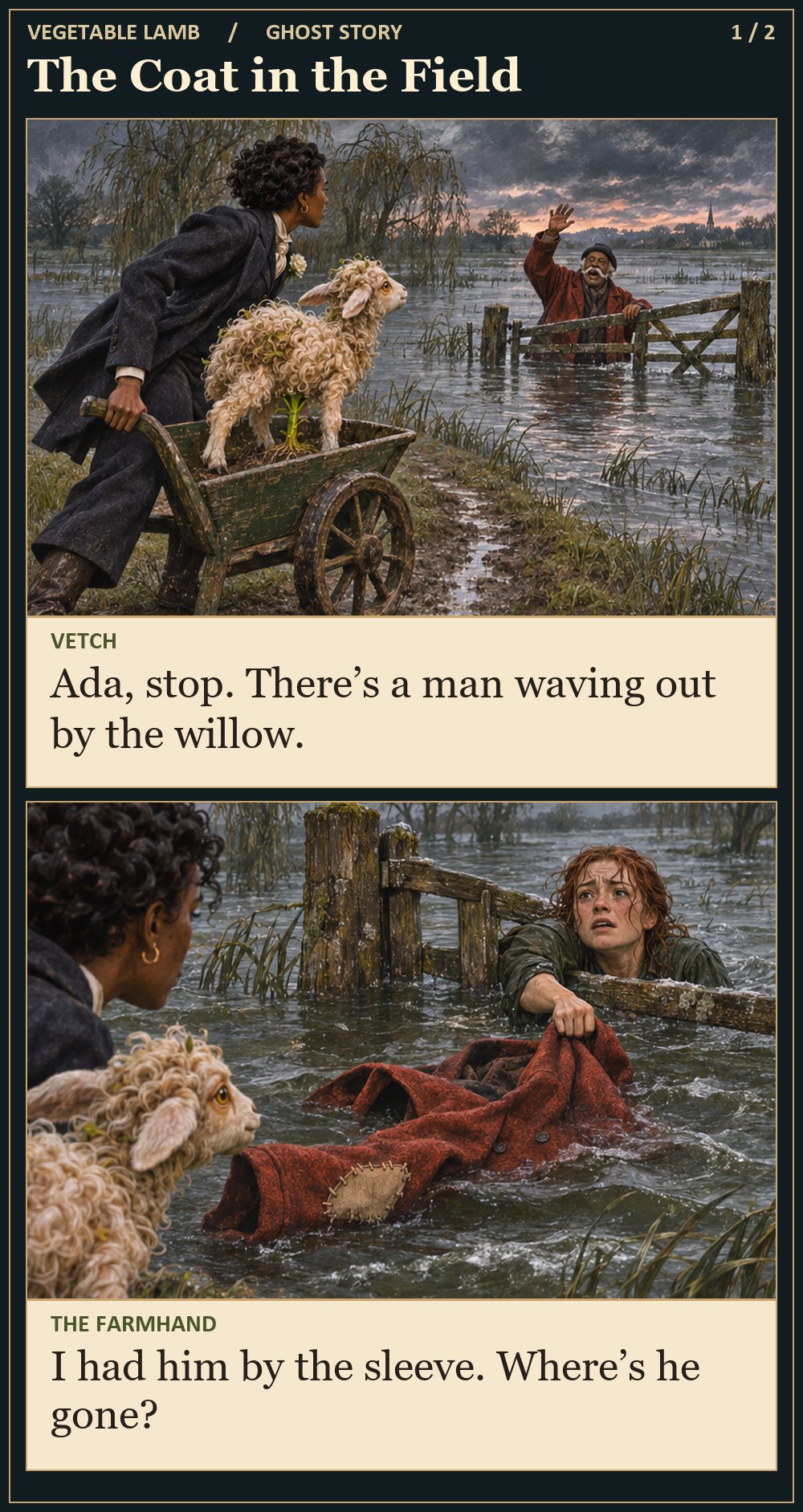
Panel 1. From the cart track, Vetch sees an old man in a patched red coat waving beside a half-submerged gate.
Vetch. “Ada, stop. There’s a man waving out by the willow.”
Panel 2. At the gate the man has vanished. A young woman in the flood is clutching the sleeve of his empty coat.
The farmhand. “I had him by the sleeve. Where’s he gone?”
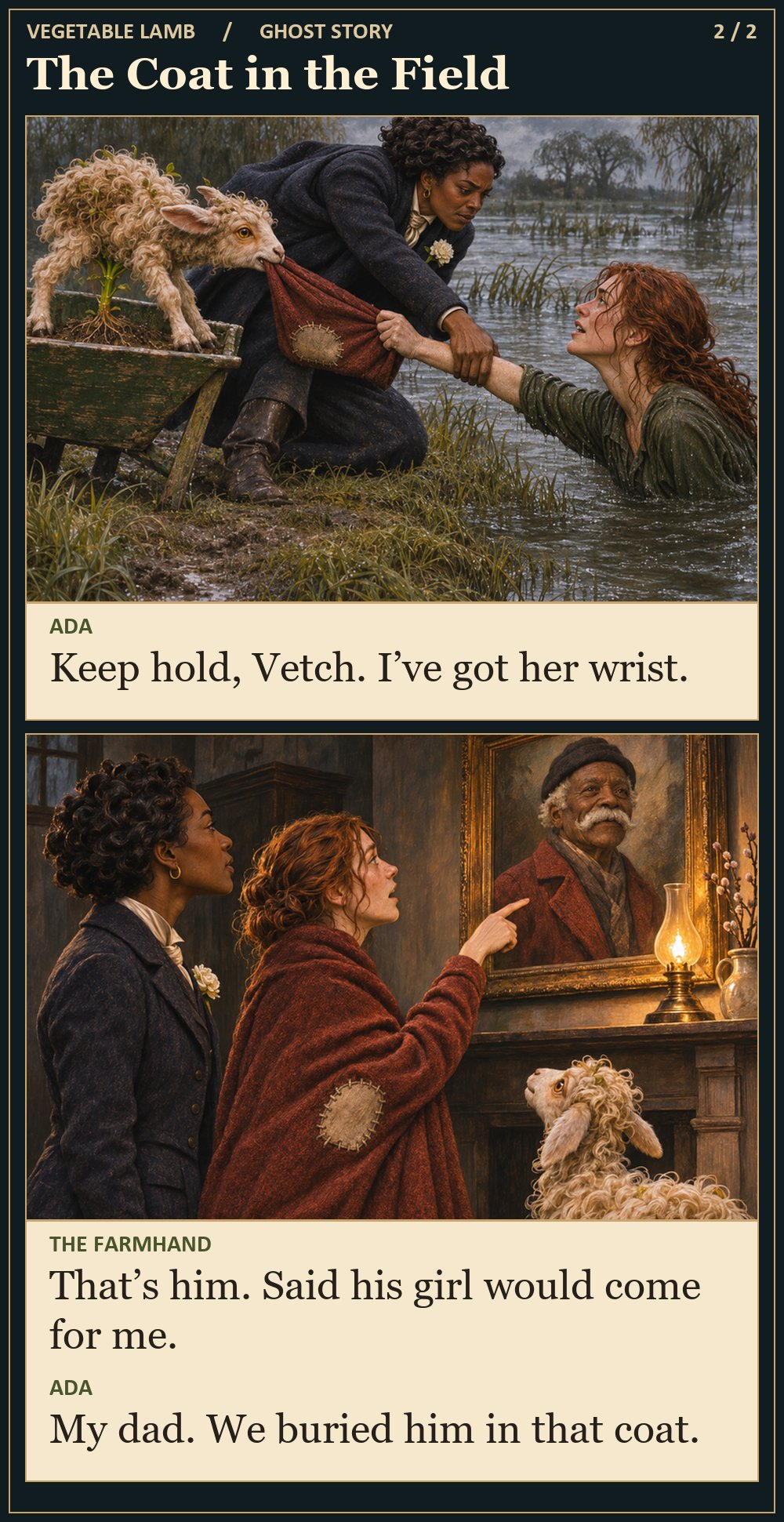
Panel 3. Vetch closes his teeth on the free end of the coat and pulls the woman within reach. Ada catches her wrist.
Ada. “Keep hold, Vetch. I’ve got her wrist.”
Panel 4. In the lamplight the rescued woman wears the patched red coat. Ada stands beside her as she points to the man in the portrait.
The farmhand. “That’s him. Said his girl would come for me.”
Ada. “My dad. We buried him in that coat.”
Original Velvet Bestiary fiction and AI-assisted illustrations.