The Tattoo She Wouldn’t Hide
They invited an elf to make the past look beautiful. They should have asked what she remembered.

Elves in medieval language, Norse writing and the ballads
Elf is an English word with early Germanic relatives, including Old English ælf and Old Norse álfr. Its history contains people encountered in songs, beings named in charms and categories described by a medieval Icelandic author. The sources differ greatly in what they preserve. An isolated word in a healing text tells us less about a creature’s appearance than a ballad in which a rider can admire its clothes, speak to it and refuse its request. [1] [2] [3]
Contents of this guide
An elf in an old story is not necessarily a gentle person with excellent cheekbones. Beauty may be the first warning, not a promise of safety.
In Gylfaginning, part of the Prose Edda, Snorri Sturluson places the light-elves in Álfheimr and describes their extraordinary radiance. His distinction between light-elves and beings living beneath the earth belongs to that particular medieval Icelandic account. It is not a universal elf taxonomy, and it does not describe antlered women wearing magical tattoos.
Read Gylfaginning, chapter XVII, in Brodeur’s translation.
The Danish ballad Elverskud offers another, darker encounter. On the eve of his wedding, Sir Oluf meets dancing elf-maidens. One invites him to join them; he refuses, saying that he is to be married. Her response is a fatal blow. By morning he is dead. This is a particular ballad tradition, preserved in different versions, not a rule that every northern elf behaves the same way.
Read the Danish Elverskud text and historical commentary.
Elves in a book and elves in a song
In the Icelandic Gylfaginning, the account of elves comes during a tour of the heavens. A questioner wants to know what remarkable places there are above him. Among the answers is Álfheimr, the home of the light-elves. Their brightness helps the reader picture a world arranged in places and orders of being. Very little is said in that passage about how an elf might feel about a human visitor. For a voice, a conversation and an invitation that turns dangerous, the Danish ballad gives us another kind of source altogether. Snorri Sturluson, Gylfaginning, chapter XVII
The Danish songbook’s commentary locates the elf folk of these ballads in woods, marshes and hills. It records a detail a listener could picture instantly. An elf maiden might look beautiful from the front and be hollow at the back. It also connects the sudden stroke in Elverskud with an older way of explaining abrupt pain or death. Those are two different forms of uncertainty. A rider cannot see the figure from every angle, and a family can see someone fall ill without knowing what struck him. The ballad brings that danger to Oluf just as his wedding promises a secure human future. Højskolesangbogen, text and commentary on Elverskud
An elf with a solo voice
The story travelled into the concert hall as well. Niels W. Gade drew on Elveskud and Elverhøj for a work first performed in 1854. The Royal Danish Library records years of revision and several hands trying out the words. Oluf, his mother and the elf-king’s daughter acquired solo voices, with a choir and orchestra around them. A creature one singer could bring to a fireside now required a roomful of musicians. That change in audience is itself part of how an elf’s reputation travels. Royal Danish Library, Gade’s Elverskud
The elves missing from the Old English story shelf
Old English supplies evidence for elves in vocabulary, names and remedies. Alaric Hall’s study of the material identifies a difficulty for a modern bestiary: a well-attested word survives without a matching set of continuous Anglo-Saxon stories about the people who bore it. A personal name containing an elf element can show that the element was available to name-makers. It cannot on its own tell us how a person thought an elf’s ears were shaped. A list of uncanny beings is similarly economical evidence. [1]
The healing charm usually called Wið færstice, for a sudden stabbing pain, has often been read backwards through later ideas about “elf-shot”. Hall examines the wording and the assumptions that have grown up around it. The text entertains more than one possible source of harm. It would be easy to turn that into an account of tiny archers equipped with identifiable stone points. The distance from a term for a sudden affliction to a fully described bowman is precisely the historical problem. The charm belongs in an account of how people understood pain as well as in an account of supernatural beings. [4]
How many sorts of elves did Snorri describe?
In Gylfaginning, composed in medieval Iceland, Snorri distinguishes the light elves associated with Álfheimr from dark elves dwelling down in the earth. His contrast involves beauty, radiance and place. It occurs in a structured question-and-answer account of the universe. Read it as one author’s arrangement of inherited material. The categories do not tell a singer which lady Thomas will meet on the Scottish border, or decide whether she will help him. [2]
The Old Norse Alvíssmál offers another sort of evidence. Thor asks how things are named among the different beings of the worlds. The dwarf Alvíss knows a distinctive word for the moon among elves, another for the heavens and others for the things that sustain life. The list gives elves a place among communities that perceive the same sky and put it into different language. It says very little about their appearance. That is itself a worthwhile result for a reader accustomed to portraits with flawlessly matching ears. [5]
Thomas the Rhymer takes the road to Elfland
At the Eildon Tree in a Scottish ballad, Thomas sees a richly dressed woman on horseback. He initially takes her for the Queen of Heaven. She corrects his identification: she is the queen of Elfland. A kiss binds him to travel with her, and the journey takes him out of the familiar country. In the version printed in Francis James Child’s English and Scottish Ballads, she shows him different roads, including the one leading to their destination. The traveller needs a guide precisely because moral expectations based on an attractive road can be misleading. [6]
The ballad and the Danish Elverskud make a revealing pair. In the Danish song, an encounter while riding interrupts the preparations for a wedding. In the Scottish song, an invitation leads to a long absence in another country. Each woman has considerable power over the human traveller, yet neither can be reduced to a general rule about what happens if a person dances with an elf. The itinerary, the bargain and the sad interruption of a family’s plans belong to particular songs. A tune or a familiar opening can carry remarkably different outcomes. [3] [6]
How to read a beautiful stranger
Text, melody and performance each carry part of this history. The medieval prose author tells us where an order of beings lives. The ballad singer can withhold crucial information until the rider has already stopped. A concert work can assign a voice and a musical part to someone the older song described in a few lines. Asking which tradition supports the broad description “beautiful and dangerous” is less revealing than asking what the stranger actually requests, what the rider understands and who at home has to bear the consequences. The markings on our elf’s skin and the significance she gives them belong to her own story. [3] [7]
Placed beside one another, these sources leave an interesting tension: the beautiful otherworldly figure may be admired, feared, invited or refused—but she is rarely allowed to be ordinary. Our story turns that tension around. What happens when humans invite an elf into their hall because they want her beauty, but not her account of what happened there?
Ilyra, her antlers, living tattoos and the town below are original fantasy. They are not presented as a lost historical belief. Her markings are a language of chosen memory; the person wearing them decides when they may be read.
Sources and further reading
- Alaric Hall, The Meanings of Elf and Elves in Medieval England, University of Glasgow
- Snorri Sturluson, Gylfaginning, chapter 17, Arthur Gilchrist Brodeur translation
- Højskolesangbogen, Elverskud, Danish ballad text and commentary
- Alaric Hall, original research on the evidence for Anglo-Saxon elf-shot, White Rose Research Online
- Poetic Edda, Alvíssmál, the names of things among the elves
- Francis James Child, The English and Scottish Popular Ballads, no. 37, Thomas Rymer, three texts
- Royal Danish Library, Niels W. Gade, Elverskud
The Tattoo She Wouldn’t Hide
Mathis had kissed the small silver branch beneath Ilyra’s collarbone often enough to know its shape.
Tonight, a name had appeared between its leaves.
“That wasn’t there yesterday.”
“No.”
He set down his wine. “Should I be jealous?”
“Of a dead magistrate? I should hope not.”
She stood in the doorway while the last rain slipped from her antlers. Layers of green leaves, knotted together with roots fine as hair, covered her like something the forest had decided to lend rather than cut. Her bare feet had left wet prints on the stone. Blue-black branches climbed her legs and arms; silver accents caught the lamplight when she moved.
Mathis knew some of those marks. A narrow fern on her wrist was her first winter alone. Three small moons commemorated three people who had taught her to read. He had been invited to learn those meanings. The rest were not an inventory he was entitled to inspect.
She held out an invitation instead.
He recognised the paper before the seal. He had cut the border block himself: lilies, clasped hands, an ornamental sun. The dead magistrate’s son had wanted something “hopeful, with a sense of continuity.”
“A memorial supper,” Mathis said.
“A celebration of his service.”
“They’ve invited you?”
“They’ve invited my antlers. I’m permitted to accompany them.”
He read the lower lines. A representative of the woodland community. A symbol of the peace the late magistrate had secured. A chance to look forward together.
There was also a discreet request that ceremonial markings be covered in the hall. For the comfort of elderly guests.
Mathis looked from the invitation to the new name.
“Ilyra.”
“I was there.”
He had heard about the fire. Everybody had. There had been a dangerous gathering in the grove, the magistrate’s men had intervened, and elf-magic had spread beyond anyone’s control. That was the version carved on the little stone beside the old road.
Ilyra put a finger on the word secured.
“They barred the path before they lit the first tree. That was how they secured it.”
The room became very still.
She had escaped through an irrigation ditch. Her friend had lifted the grate, held it long enough for her to crawl out, and not followed. The water had carried black flakes against her face. For years afterwards she had been unable to bear the smell of roasted chestnuts.
Mathis reached for her hand, then stopped where she could see him.
She took it.
“What do you want to do?” he asked.
“Go to supper.”
“That sounds like the beginning of a revenge story.”
“Only if supper is very badly cooked.”
He waited.
“I don’t want his son dead,” she said. “I want him to stop telling people his father saved us.”
Mathis glanced toward the invitation again. His beautiful border. His well-cut lilies. It was a small, unpleasant thing to find your own workmanship making a lie look respectable.
“Do you need a sword?” he asked.
“I need your press.”
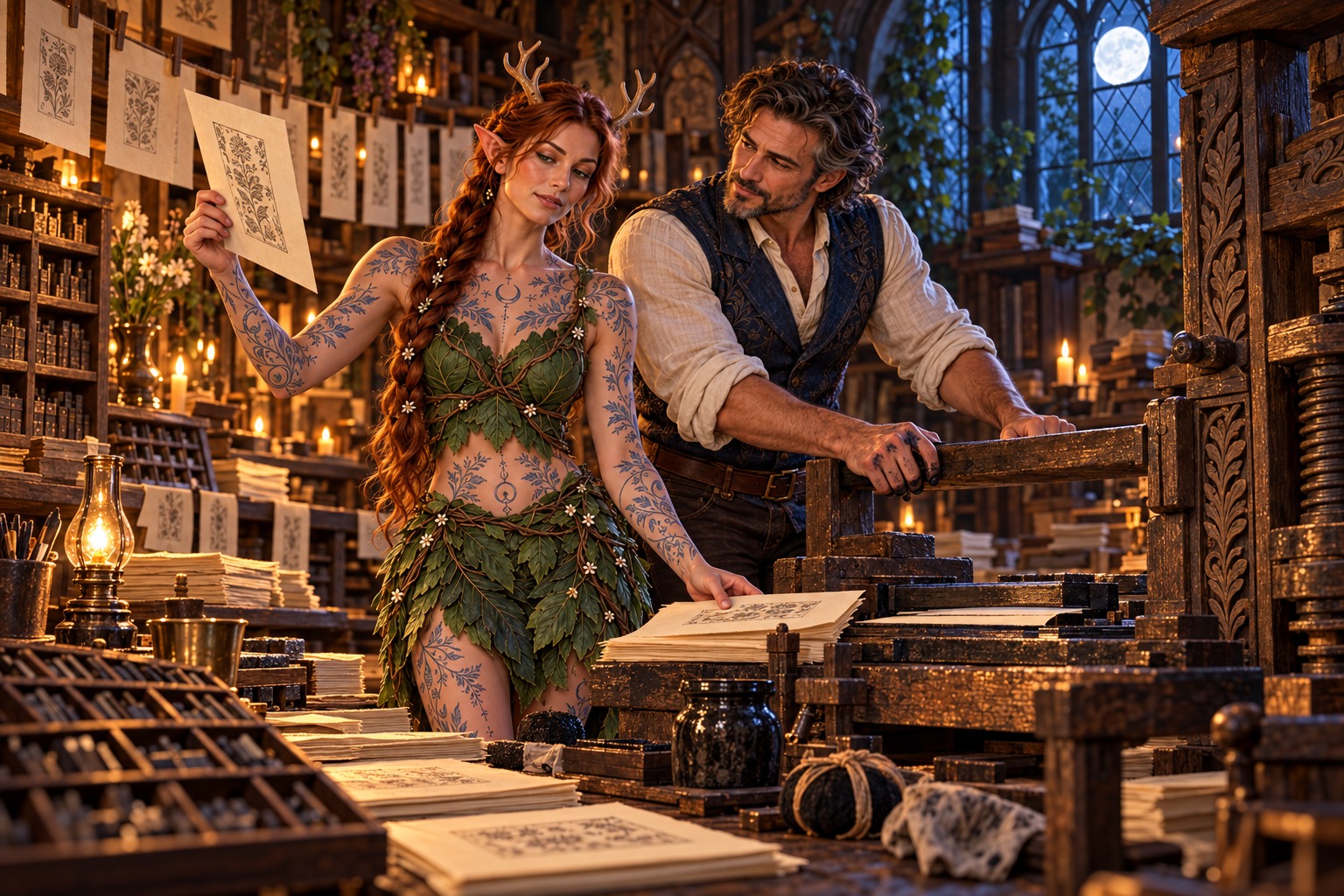
For three evenings, the printshop stayed open after the street lamps went out.
Ilyra brought the people the town’s history had misplaced: a carter who had delivered the pitch, a gardener dismissed for asking why the grove’s gates were chained, a woman who had counted the men returning without their torches. Some had spoken years before. Their statements had been filed under Disturbance, and the file had disappeared.
Mathis took their accounts down again. Each person read the finished page, corrected it and signed. When a witness could not write, another witnessed the mark. They were careful about dates. They were careful about what no one could prove.
Ilyra did not need a prettier legend. She needed an account that could survive being disliked.
On the fourth night, Mathis inked the press. She stood beside him, sorting sheets, the end of her braid brushing his wrist.
“You’ve made an enemy of a customer,” she said.
“He still owes me for the lilies.”
She laughed. It was the first unguarded sound he had heard from her all week.
He kissed her ink-stained fingers. She turned her hand and caught his jaw, keeping him there a moment longer than the work required.
“After this,” she said, “you may tell me how brave you were.”
“At length?”
“I suspect you will.”
The morning of the memorial, he delivered the programmes himself.
The steward checked the cover, admired the lilies and signed for the stack. He did not open one. Important people were always grateful when an ordinary object behaved exactly as they expected.
By dusk, a small folded insert rested inside every programme in the hall.
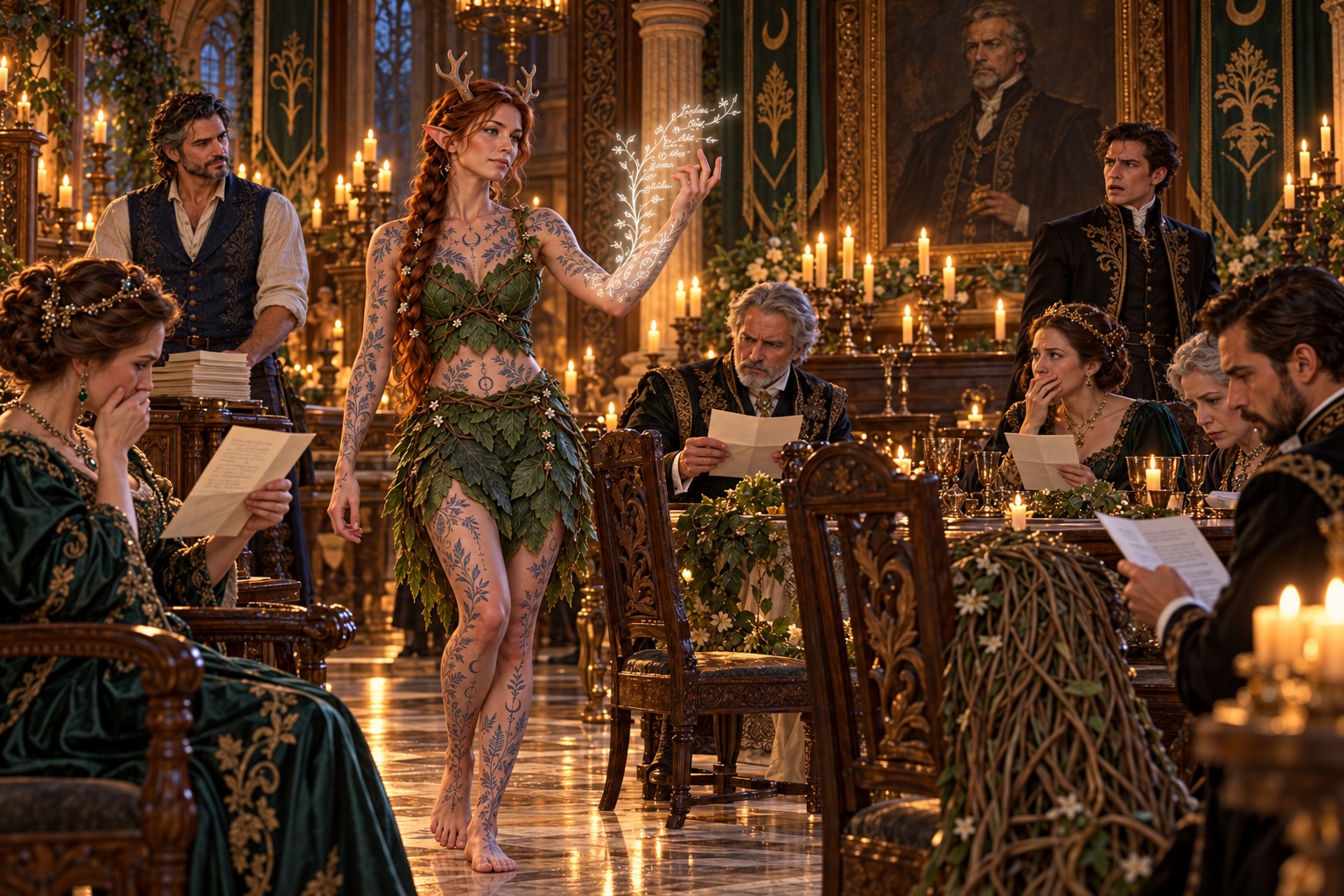
Ilyra arrived in her leaves and roots, with a mantle of woven willow fibre draped over her tattooed shoulders. Barefoot on polished marble, she was given the place of honour beside the magistrate’s portrait.
She stood where they asked. She accepted a glass. She let three people tell her how pleased the late magistrate would have been to see her there.
Mathis stayed near the printers’ table at the back. He had delivered an extra stack. There were always people who arrived without an invitation and expected paper to be waiting for them.
The magistrate’s son rose beneath the portrait. He spoke about difficult times, difficult decisions and the courage required to restore order.
Then he lifted his glass toward Ilyra.
“And here stands the living proof that our wounds may heal.”
She set her glass down.
“Some of us,” she said, “are here to tell you where they came from.”
She unfastened the mantle.
The tattoos did not blaze. They did something quieter, and harder to dismiss.
Along her forearm, a silver branch slowly opened. Leaves unfolded into letters. A name appeared, then another, then a date. The ornament became a record.
The son stared at the first name. It was his father’s.
“That is not appropriate.”
Ilyra raised her arm just enough for the front tables to read.
“He ordered the gates barred before the fire began.”
The steward started toward her. Somewhere to Mathis’s left, paper rustled.
One guest had opened the insert. Another leaned over her shoulder. At the second table, the carter’s signed account travelled from hand to hand. The hall began to make the small dry sounds of people finding out they had been seated inside a different story.
The son looked toward the back. Mathis met his eyes.
“You printed this.”
“Yes.”
“On whose authority?”
“The people who signed it.”
The steward reached for Ilyra’s fallen mantle.
“Madam. If you would cover yourself.”
She did not raise her voice.
“You invited a witness. You should have asked what I witnessed.”
For a moment no one moved.
Then an old woman near the window said the name of her sister.
It was not on Ilyra’s arm. Not yet.
Ilyra turned toward her. “Tell me.”
The woman did.
There was no sudden confession from the portrait’s son. He did not become decent because a room had gone quiet. He demanded that the papers be collected. The steward took three from a table before a guest put a hand over the fourth.
By then, too many had already left the room.
Mathis had printed six hundred.
Outside, the air smelled of rain rather than smoke.
They walked past the little stone by the road. Somebody would have to decide what to do about its inscription. Not tonight. Not while Ilyra’s hand was shaking inside his.
He said nothing about victory.
At the cottage, she let the willow mantle fall across a chair. He brought water, found the washcloth, and waited while she chose whether she wanted company.
“Stay,” she said.
He knelt to wash the street dust from her feet. It was an ordinary kindness. After a hall full of witnesses, she found she could bear that more easily than praise.
When he stood, she pulled him close by his waistcoat. Their foreheads touched beneath the sweep of her antlers.
“You didn’t try to speak for me.”
“You seemed to have the matter in hand.”
“Six hundred copies.”
“I thought we might run short.”
Her laugh caught against his mouth. She kissed him properly this time, one hand warm behind his neck, the other still holding him where she wanted him. He followed her pace until the last of the evening’s stiffness left her shoulders.
Later, beside the low lamp, he traced the air above the new silver branch without touching it.
“Does it hurt?”
“Remembering? Sometimes.”
He lowered his hand.
She caught it and brought it to a small, unmarked space at the back of her shoulder.
“This one isn’t a memorial.”
“What is it?”
“I haven’t decided yet.”
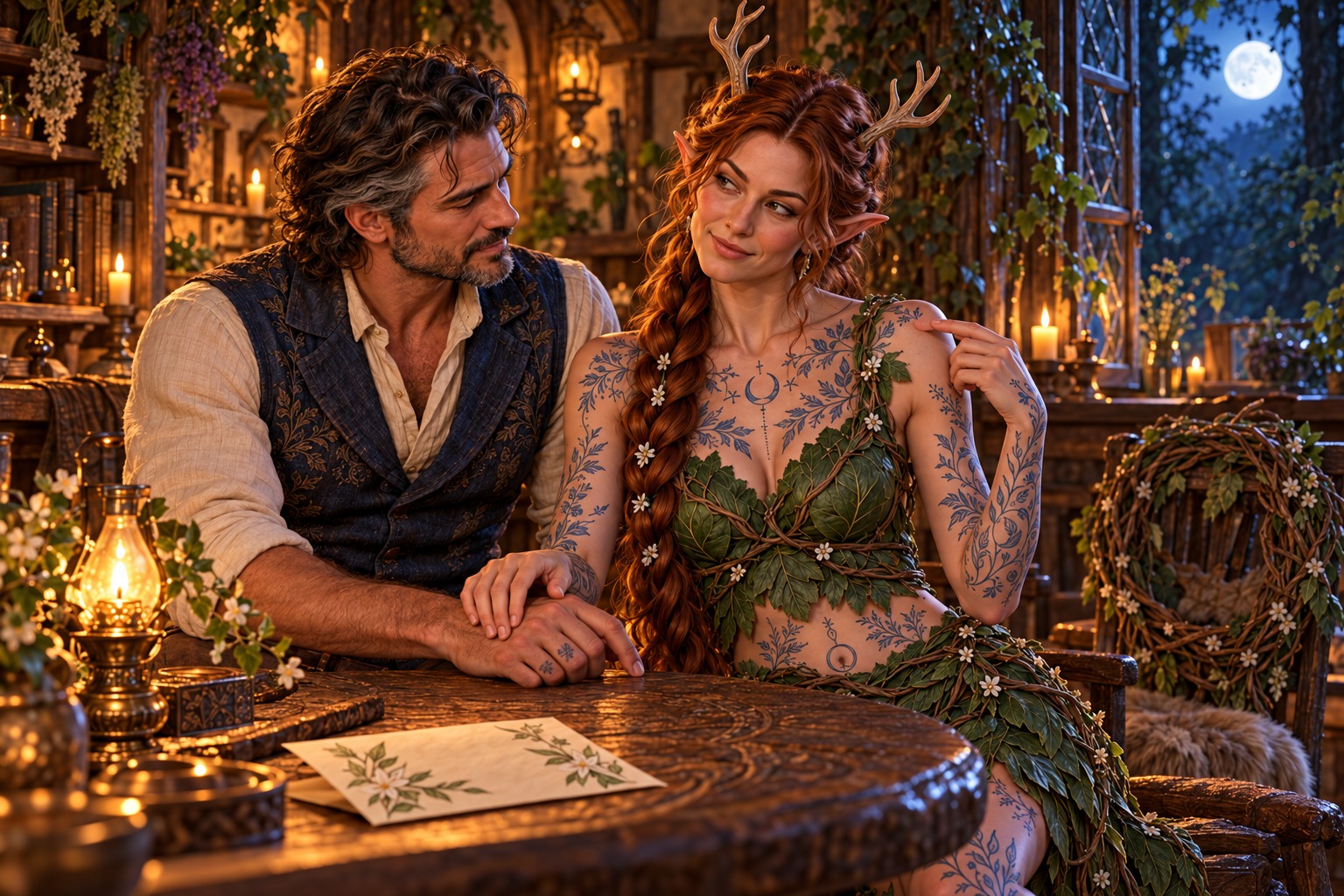
The invitation lay folded on the table. Beyond it, the lamp threw the shadows of leaves across the wall.
Ilyra drew him away from both.
Undefeated
A remarkable winning streak. One disputed result.
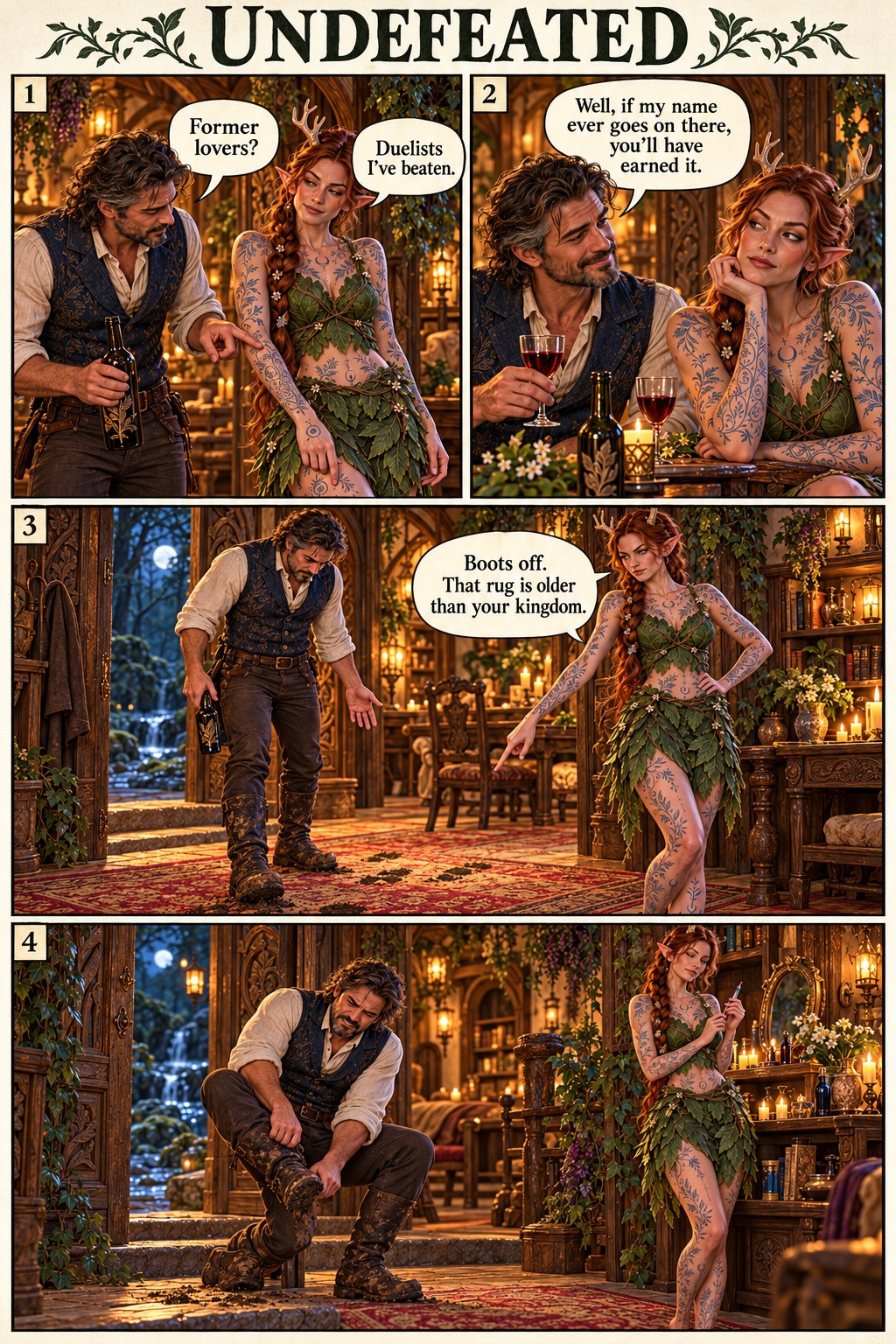
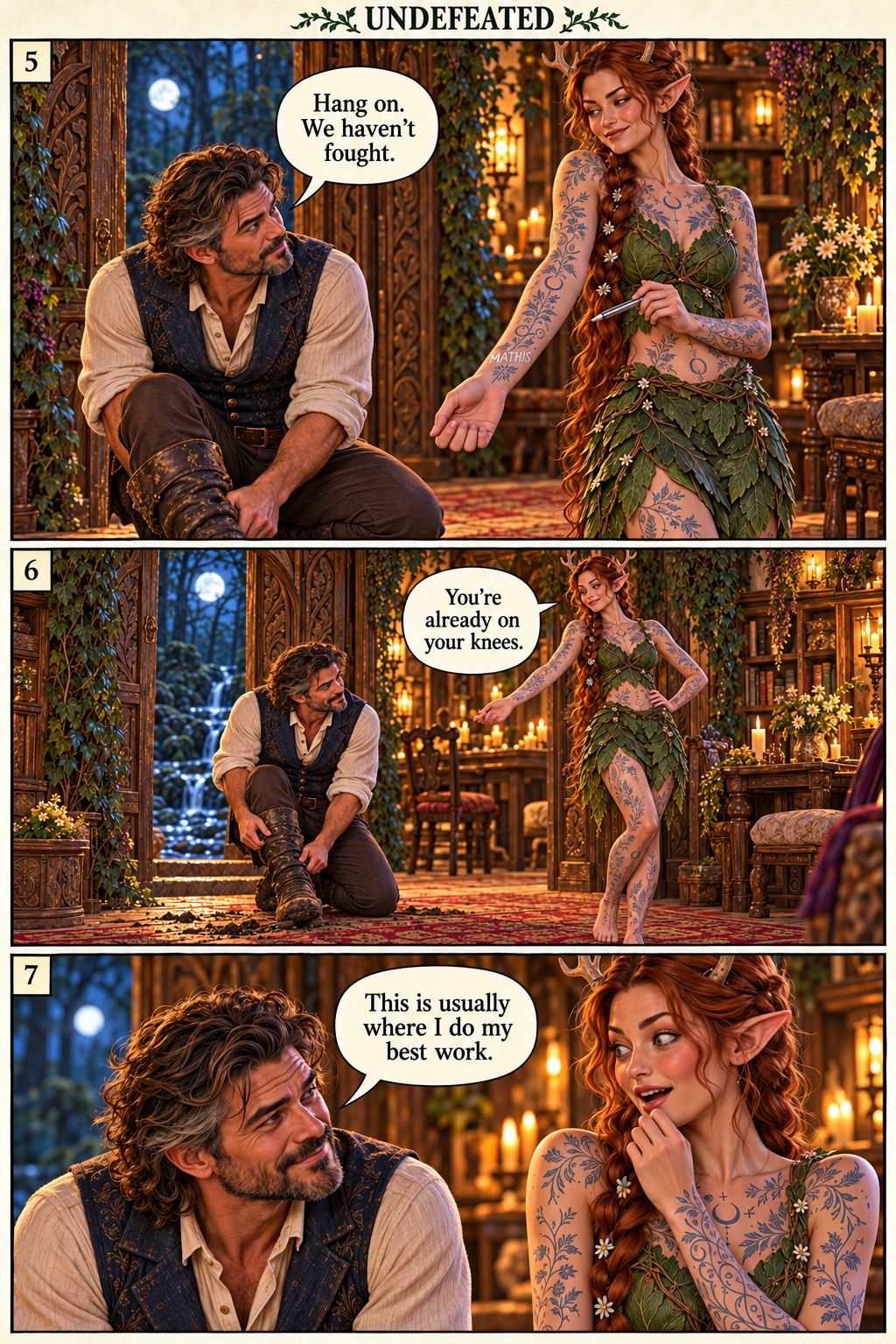
Read the comic transcript
Panel 1. Mathis: Former lovers? / Ilyra: Duelists I’ve beaten.
Panel 2. Mathis: Well, if my name ever goes on there, you’ll have earned it.
Panel 3. Ilyra: Boots off. That rug is older than your kingdom.
Panel 4. Mathis kneels to remove a stubborn muddy boot; Ilyra takes a silver cosmetic pencil.
Panel 5. On her forearm: MATHIS. / Mathis: Hang on. We haven’t fought.
Panel 6. Ilyra: You’re already on your knees.
Panel 7. Mathis: This is usually where I do my best work.
Fresh Ink
Some family traditions transfer rather well.
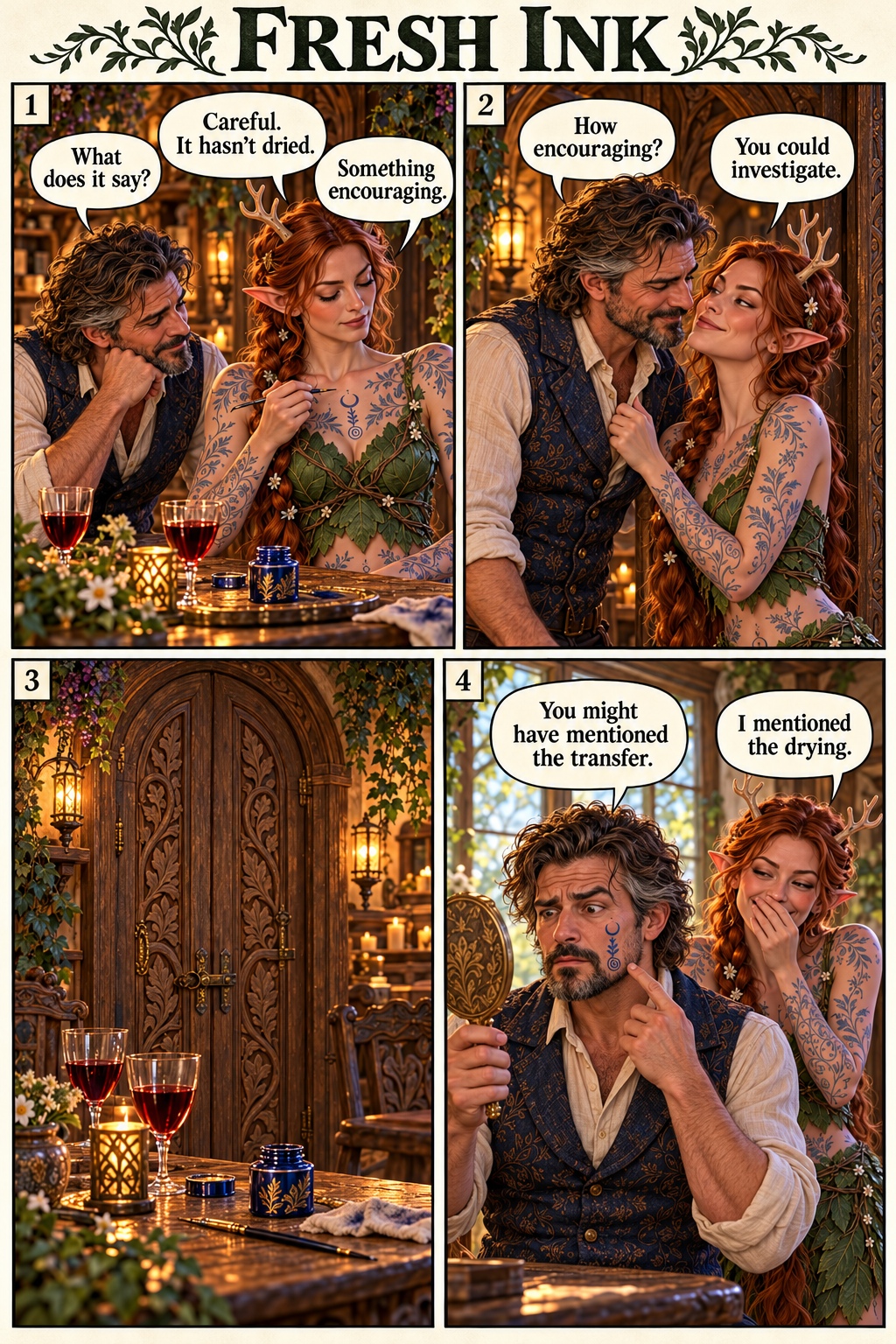
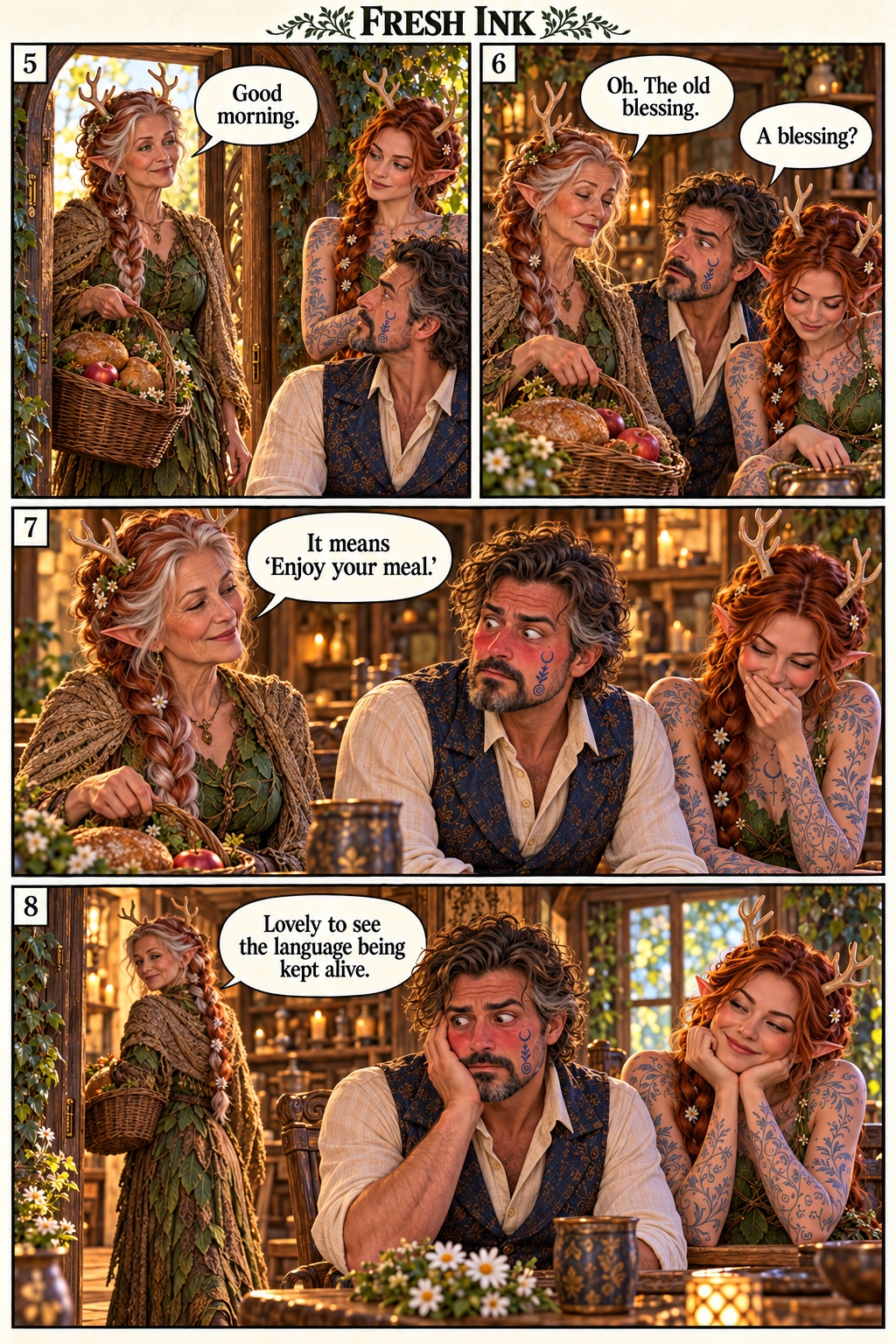
Read the comic transcript
Panel 1. Ilyra: Careful. It hasn’t dried. / Mathis: What does it say? / Ilyra: Something encouraging.
Panel 2. Mathis: How encouraging? / Ilyra: You could investigate.
Panel 3. The inner door closes. The brush and open ink pot remain beside two glasses.
Panel 4. Mathis: You might have mentioned the transfer. / Ilyra: I mentioned the drying.
Panel 5. Mother: Good morning.
Panel 6. Mother: Oh. The old blessing. / Mathis: A blessing?
Panel 7. Mother: It means ‘Enjoy your meal.’
Panel 8. Mother: Lovely to see the language being kept alive.
Comedy in Motion
Scheduled on YouTube for Nov 14, 2026. The player becomes available after release.
Watch on YouTube
Scheduled on YouTube for Nov 16, 2026. The player becomes available after release.
Watch on YouTube
Curator’s Cabinet
For readers drawn to Ilyra’s woodland markings, the Tattooed Elfess by Love Smiths carries the tattooed forest-elf aesthetic beyond the page in a handcrafted adult fantasy design.
For a quieter keepsake: a personalised photo-or-logo mug from L’Atelier Époustouflant.
Affiliate disclosure: This page contains affiliate links. If you purchase through them, we may earn a commission at no extra cost to you. Recommendations remain separate from the fiction. Read our disclosure.
Roots of the Tale
The folklore section draws on Snorri Sturluson’s medieval Icelandic Gylfaginning and the Danish ballad Elverskud, two distinct sources rather than a single universal elf tradition. Ilyra, Mathis, the living tattoos, the magistrate’s memorial and both comics are original Velvet Bestiary fiction. Antlers and tattoo magic are imaginative choices, not claims about historical belief. Illustrations are AI-assisted.
Another encounter awaits: The Starwright’s Closed Hand · The Gnome Who Kept the Receipts.